The problem: clinicians don’t need more papers, they need a workflow
The problem with evidence-based medicine (EBM) isn't the evidence; it's the friction. Every clinician has had the experience of asking a question, opening PubMed, getting 10,000 results, and giving up. In a busy clinic, you don't have time to be a researcher. You need a reproducible, high-velocity workflow that gets you from "I wonder" to "I know" in under 10 minutes.
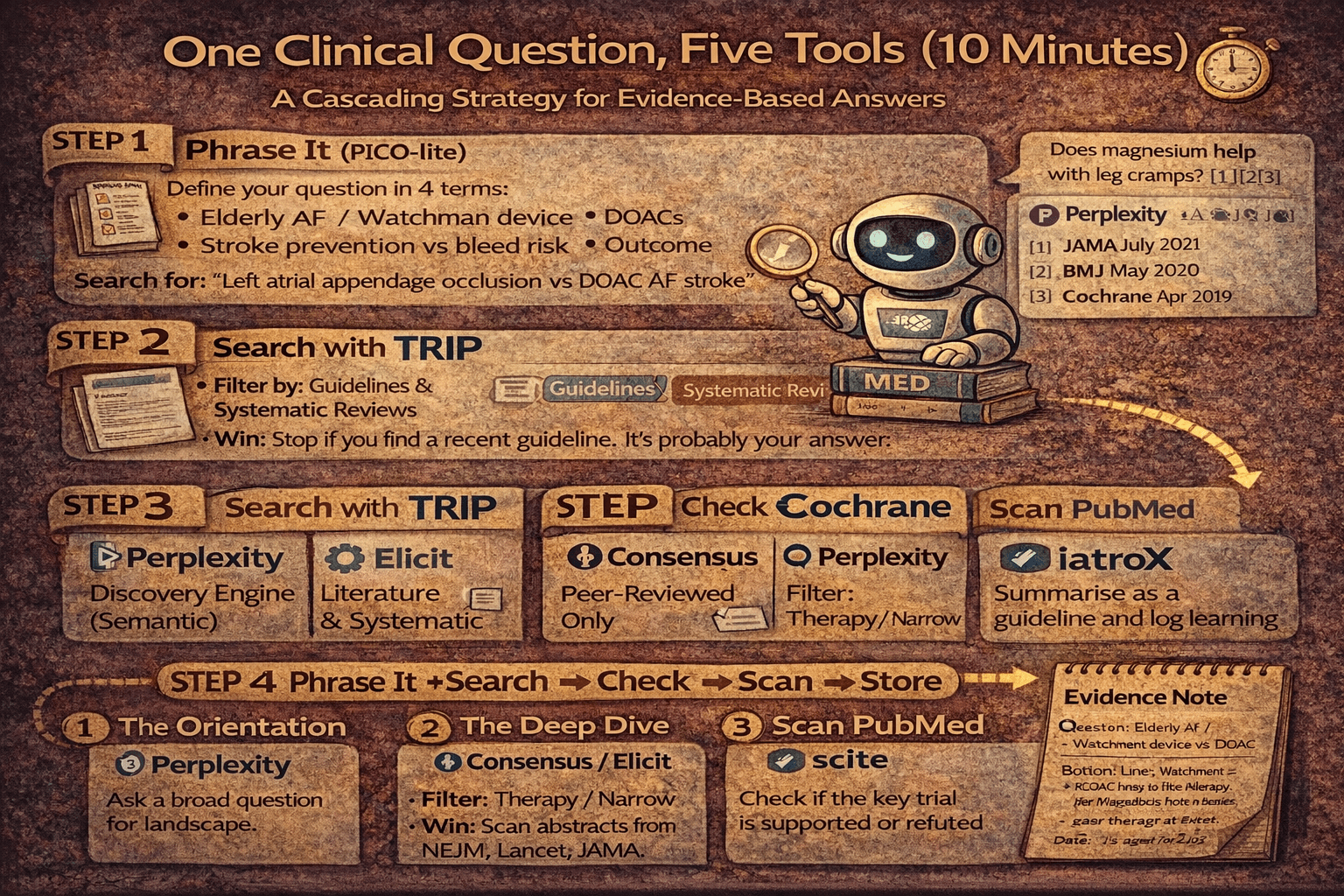
This guide outlines the "One Question, Five Tools" workflow. It uses a cascading strategy—moving from high-level summaries to primary data—to ensure you find the highest-quality answer in the shortest possible time.
Step 1: phrase the question (PICO-lite)
Before you open a single tab, spend 30 seconds sharpening your axe. A vague search yields vague results. Use a "PICO-lite" structure to define your terms.
- P (Patient): "Elderly, AF, high bleed risk."
- I (Intervention): "Watchman device (LAAO)."
- C (Comparison): "DOACs."
- O (Outcome): "Stroke prevention vs. bleed risk."
- Search String: "Left atrial appendage occlusion vs DOAC atrial fibrillation stroke"
Step 2: TRIP (for rapid high-level evidence)
Time: 2 Minutes Start with TRIP Database. It is the only search engine built specifically for the clinical workflow.
- The Action: Paste your search string.
- The Filter: Look at the right-hand sidebar. Filter immediately by "Guidelines" (UK/USA) and "Systematic Reviews."
- The Win: TRIP sorts by clinical relevance, not just keywords. If there is a NICE guideline or a high-quality review, it will be at the top. If you find a recent guideline here, stop. You have your answer.
Step 3: Cochrane (for synthesis)
Time: 2 Minutes If TRIP didn't give you a definitive guideline, go to the Cochrane Library.
- The Action: Search for your intervention.
- The Win: Cochrane reviews are the gold standard for therapeutic questions. Read the "Plain Language Summary" first for the bottom line, then the "Authors' Conclusions." This gives you the definitive stance on the quality of the evidence, not just the result.
Step 4: PubMed (to confirm primary evidence)
Time: 3 Minutes If you need the very latest trial data that hasn't made it into a guideline yet, go to PubMed.
- The Action: Use the "Clinical Queries" tool (under the search bar).
- The Filter: Set Category to "Therapy" and Scope to "Narrow" (specific).
- The Win: This filters out the noise of case reports and rat studies, showing you the key RCTs. Scan the abstracts of the top 3 results from major journals (NEJM, Lancet, JAMA).
Step 5: summarise and store (iatroX + your notes)
Time: 3 Minutes You have the answer, but if you don't capture it, you'll lose it.
- The Action: Open iatroX.
- The Synthesis: Use the Ask feature to query the UK-specific context ("What is the NICE position on LAAO?"). Then, use the CPD feature to log your finding.
- The Note: Write a one-line "Evidence Note" for your own records or to share with the team.
A reusable “evidence note” template
Don't write an essay. Use this format:
Question: [Your PICO] Bottom Line: [The answer in one sentence] Key Source: [Link to the best Guideline/Trial] Caveat: [Major limitation, e.g., "Trial excluded elderly patients"] Date: [Today's date]
FAQ
Why start with TRIP and not Google? Google prioritises SEO and patient-facing content. TRIP prioritises clinical evidence levels. It saves you the step of filtering out "healthline.com" articles.
Can I use Perplexity instead? Perplexity is an excellent "Step 0" tool for fast orientation. It can give you a quick summary and list of papers to check. But you must verify those papers in the source databases (TRIP/PubMed) before trusting the conclusion.
How often should I do this? Try to do one "deep dive" search a week. It builds your search muscle memory and keeps your EBM skills sharp for when you really need them.