Introduction
"Should I buy PassMedicine and Pastest?" This is the most common question in UK medical exam forums. The underlying driver is usually anxiety, not strategy. The fear of missing a single high-yield vignette drives candidates to buy every resource available, leading to a fragmented, inefficient revision period.
The rational approach is not "more is better." It is "optimised is better." The optimal setup for most candidates is a simple three-part stack:
- A Daily Engine: For adaptive learning and spaced repetition.
- A Simulation Layer: For full-length mocks that match the real exam interface.
- A Gap Patcher: A secondary bank added only if a specific weakness is identified.
This guide provides a decision framework to help you decide if you really need that second subscription, based on cognitive load theory and evidence-based learning.
The three real problems you’re solving
Before opening your wallet, define the problem. A question bank solves three distinct issues:
- Coverage: Have I seen the entire blueprint? (Do I know what can come up?)
- Mastery: Can I answer correctly under pressure? (Do I understand it?)
- Retention: Will I still remember this in 8 weeks? (Can I recall it?)
Most single Q-banks cover #1 and #2. The failure point is usually #3—retention. Buying a second bank to solve a retention problem is often a mistake; you don't need new questions, you need spaced review of the concepts you already messed up.
Cognitive load — why “more resources” can lower performance
Every time you switch platforms, you pay a "cognitive tax."
- Interface Fatigue: Your brain has to re-adjust to a new UI, a new way of displaying labs, and a new explanation style.
- False Productivity: Doing the "easy" questions in a new bank feels like progress, but it is often just busywork.
- Passive Reading: Having two different explanations for the same concept can lead to confusion and passive comparison, rather than active retrieval.
The Rule of 2: Never use more than two primary resources simultaneously. One primary bank + one support tool is the cognitive limit for efficient study.
The evidence-based learning layer
Quality of practice matters more than quantity of questions.
- Retrieval Practice: The "testing effect" is robust. The act of answering a question is the learning event. Doing 2,000 questions actively is better than seeing 5,000 passively.
- Distributed Practice (Spacing): Evidence shows that spacing out reviews improves exam outcomes. If your bank doesn't support resurfacing weak concepts at optimal intervals, you are doomed to "re-learn" the same fact three times.
Decision framework — when one Q-bank is enough
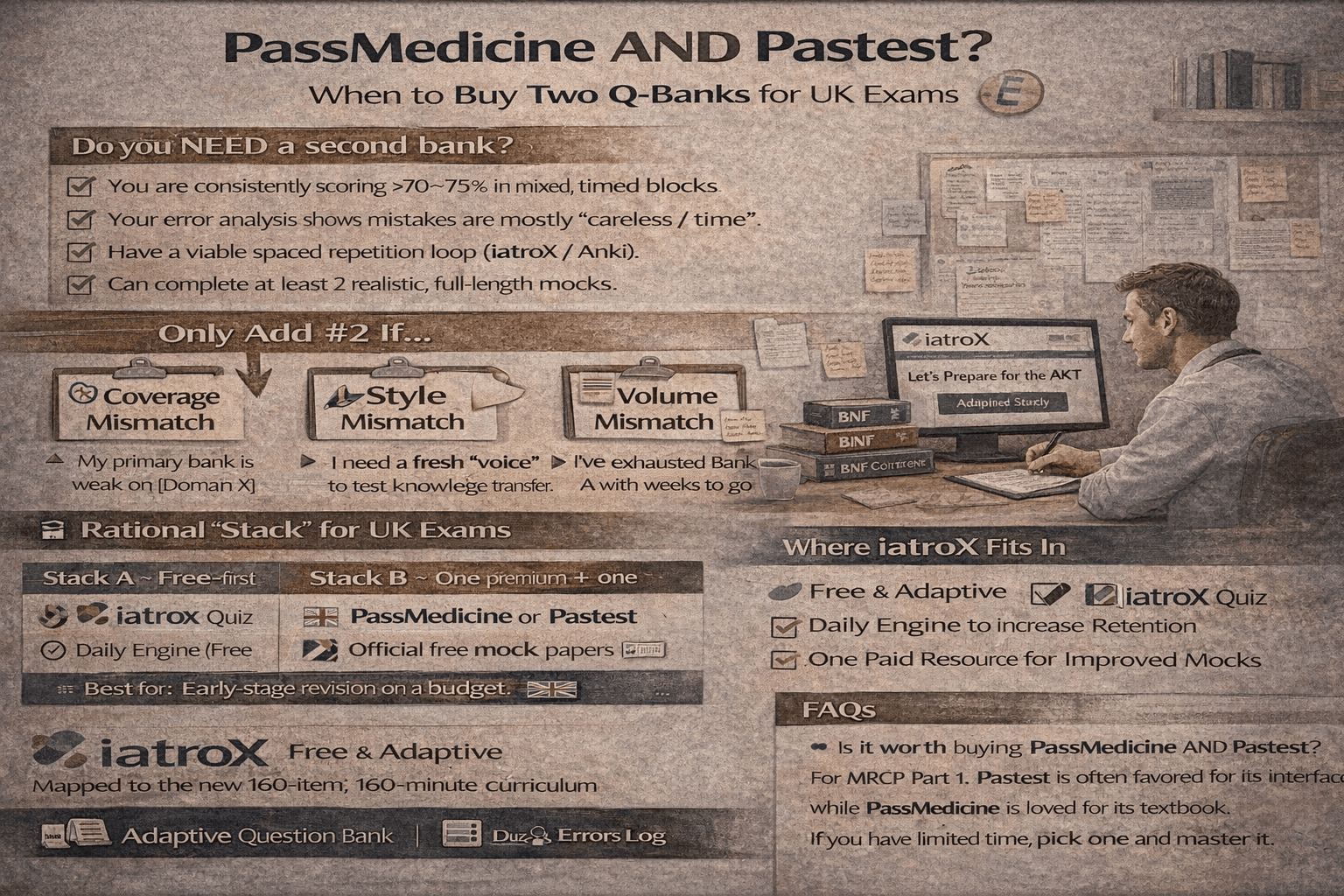
You do not need a second bank if:
- You are consistently scoring >70–75% in mixed, timed blocks.
- Your error analysis shows mistakes are mostly "careless/time" rather than "knowledge gaps."
- You have a strong spaced repetition loop running (e.g., Anki or iatroX).
- You can complete at least 2 realistic, full-length mocks before the exam with your current tool.
When you should add a second bank
Add a second resource only if you can identify a specific "Mismatch":
- Coverage Mismatch: Your primary bank is weak on a specific domain (e.g., the Admin/Org domain in the AKT).
- Style Mismatch: You have memorised the stems in your current bank. You need a fresh "voice" to test your transfer of knowledge.
- Volume Mismatch: You are a high-volume learner and have exhausted the bank with 6 weeks to go.
- Confidence Mismatch: You need the psychological reassurance of seeing a "Pass" score on a different platform.
A rational “stack” for UK exams
Stack A — Free-first (Budget Constraints)
- Daily Engine: iatroX Quiz (Free adaptive + spaced repetition).
- Simulation: Official college sample papers / free mock trials.
- Best for: Early-stage revision, medical students on a budget.
Stack B — One premium + one engine (Optimal)
- Main Textbook: A premium bank (e.g., PassMedicine or Pastest) used for deep dives and mocks.
- Daily Engine: iatroX used for daily adaptive drills and spaced repetition to ensure retention of the premium bank's content.
- Best for: Most trainees (AKT/MRCP).
Stack C — Two premium banks (The "Belt and Braces")
- Primary: Bank A for daily use.
- Secondary: Bank B used only for weekend mock exams to test transferability.
- Best for: High-stakes resits where confidence is the primary barrier.
Where iatroX fits (and why it changes the economics)
iatroX Quiz fundamentally changes the "buy two banks" equation because it is free and adaptive.
- The Workflow: Instead of buying a second bank for variety, use iatroX as your "Daily Engine." Its adaptive algorithm targets your weaknesses automatically.
- The Saving: You can rely on a single paid subscription (like PassMedicine) for your core volume, using iatroX to handle the retention and spacing mechanics that static banks often lack.
Practical budgeting
A simple heuristic for deciding on a second bank:
- Good Spend: If buying Pastest for the MRCP buys you 2 months of stress relief and better mocks, it is worth every penny of the ~£150.
- Bad Spend: If buying a second bank just adds 2,000 questions to your "to-do" list and makes you feel behind, it is a negative investment.
FAQs
Is it worth buying PassMedicine AND Pastest? For MRCP Part 1, Pastest is often favoured for its interface and volume, while PassMedicine is loved for its textbook. Many buy both, but only if they have time to complete >50% of both. If you have limited time, pick one and master it.
How many questions per day is optimal? Quality over quantity. 50 questions reviewed deeply (with spaced repetition of errors) is better than 100 questions skimmed.
Do I need mocks? Yes. You must simulate the fatigue of the exam. A Q-bank is for learning; a mock is for conditioning.
What’s the best way to use spaced repetition with a Q-bank? Don't just re-do the question. Extract the learning point (the fact you missed) and put it into a spaced repetition system (like the iatroX adaptive engine or Anki) so you review the concept, not just the vignette.