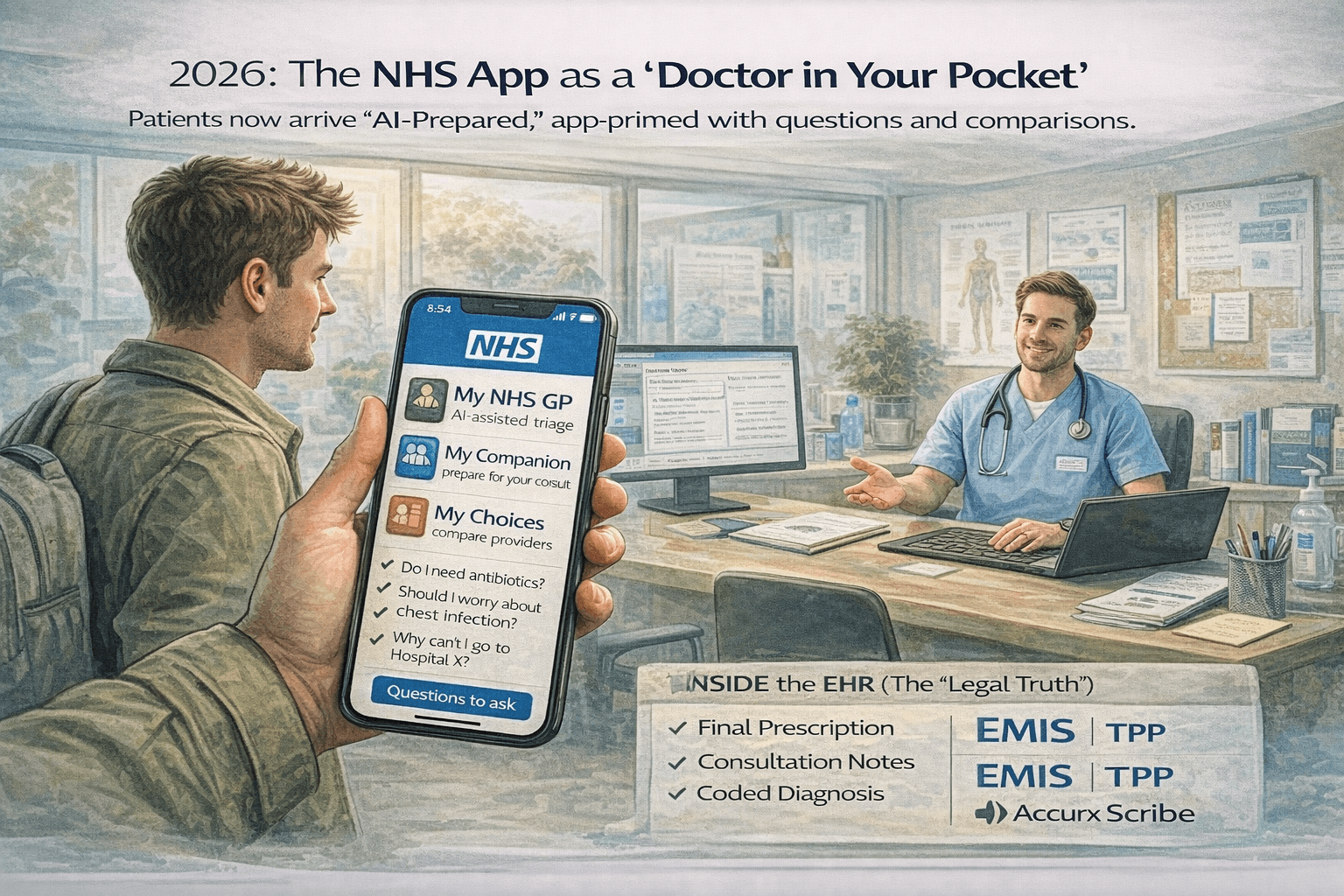
For years, the NHS App was essentially a vaccine passport and a repeat prescription ordering tool. That is about to change.
The Department of Health and Social Care (DHSC) has explicitly positioned the next iteration of the App as a "doctor in your pocket." This isn't just about booking appointments; it is about shifting the power dynamic. The goal is to give patients AI-assisted tools to navigate their own care, compare providers, and arrive at your door (or screen) with a structured agenda.
In practice, this means you will increasingly meet the "AI-prepared patient." They will arrive not just with symptoms, but with a digital summary, a list of AI-generated questions, and sometimes a firm expectation of what comes next.
What’s actually being proposed (separate facts from hype)
“Doctor in your pocket”: the stated direction
The "doctor in your pocket" is the central metaphor of the government's digital reform. The vision is a single patient record accessible via the App, moving towards an "NHS Online" hospital model by 2027 where triage, booking, and even some specialist consultations happen purely digitally.
The AI features being described
Three specific tools have been announced that will impact General Practice directly:
- My NHS GP: This is the triage layer. It uses AI to "direct people to the most appropriate and timely care." The goal is diversion: sending self-limiting conditions to pharmacies or self-care before they hit your appointment book.
- My Companion: This is the consultation assistant. It is described as ensuring "two experts in every consulting room." It helps patients articulate their history and prompts them to ask questions they might otherwise forget.
- My Choices: This is the consumer comparison engine. It allows patients to compare providers based on waiting times, outcomes, and satisfaction scores. Expect patients to ask, "Why can't I go to Hospital X? The App says they have a shorter wait."
“This is not the same as an AI diagnosis engine”
It is critical to distinguish these tools from "diagnostic" AI. The NHS App tools are currently framed as navigation, preparation, and information access. They are designed to help the patient manage the system, not replace your clinical judgement on the pathology.
The practical changes GPs should anticipate (5 shifts)
1. Shift in demand shape, not just demand volume
Ideally, My NHS GP will filter out the "simple colds," reducing your minor ailment load. However, you will likely see a rise in second-order demand:
- "The App told me to see you within 24 hours—is that right?"
- "It suggested I need antibiotics—can you confirm?" Your role shifts from primary triage to "validator of the digital advice."
2. Shift in the consultation dynamic: “agenda density” rises
Patients using My Companion will arrive with a denser agenda. Instead of an open-ended "How can I help?", you may be presented with a pre-written list of 5 questions.
- The Upside: The history may be clearer ("Timeline, Symptoms, Concerns").
- The Downside: Expectation inflation. If the App prompted them to ask about "long-term side effects," they will want a detailed answer, potentially pressuring the 10-minute slot.
3. Shift in documentation expectations
If the NHS App becomes the default communication channel, the "push notification" will replace the letter.
- Expect patients to show you advice screens on their phone: "Can you put this in my notes?"
- You will need to handle more async "pre-visit" questionnaires that flow into the record before the patient walks in.
4. Shift in patient safety risk profile
Be alert to two new safety risks:
- Over-reassurance: A stoic patient with chest pain might delay calling 999 because the App's algorithm weighted their age/risk profile too low.
- Over-escalation: Anxious patients may flood urgent care slots because the App advised escalation "just in case" to avoid liability.
5. Shift in inequality and access debates
While the App empowers the tech-savvy, it risks leaving the "digitally excluded" behind. You will likely spend time advocating for elderly or vulnerable patients who cannot navigate My Choices to get the same care as those who can.
The “GP safety framework” (medicolegal-friendly, simple)
When an AI-prepared patient sits down, use this operating procedure to keep your license safe.
A. Treat App output as “patient-supplied information”
Legally, treat the App's advice exactly as you would treat a patient's verbal history.
- Do: Acknowledge it. "I see the App suggested this might be reflux."
- Don't: Rely on it. It is not a clinical referral; it is a patient's concern.
B. Require a “clinical bridge”
You must build a "bridge" between the App's suggestion and your decision. That bridge is your independent history and examination. Never shortcut your own red-flag check because the App "already did it."
C. Document the key triage logic
Use a simple 3-line template to defensive-proof your notes:
"Patient attended with App-prompted questions regarding [Condition]." "Clinician assessment: History taken, exam normal. No red flags for [X]." "Plan: Diagnosis is [Y]. Explained why App suggestion of [Z] is unlikely. Safety-netting provided."
D. Make safety-netting explicit
The App might have given generic safety-netting. You must override it with specific, person-centred advice. Tell them clearly: "Regardless of what the App says, if you develop X, you must call us immediately."
A safe way to use AI as the clinician (where iatroX fits)
If the patient is using AI to prepare, you need to use AI to respond.
When a patient presents with a dense, App-generated agenda, you don't have time to browse guidelines manually. You need a reasoning workspace that sits beside your EHR.
iatroX Brainstorm is designed for this high-pressure moment.
- The Scenario: Patient arrives with "The App says I need to ask about 3 rare causes of my fatigue."
- The Workflow: Run a quick Brainstorm pass. "45F, fatigue, asking about Lupus/Lyme."
- The Output: iatroX gives you the discriminating questions to ask right now to rule those conditions in or out.
It allows you to meet the "AI-prepared patient" with "AI-assisted clarity"—not by asking for a diagnosis, but by structuring your thinking pathway instantly.
Governance Note: Always keep your iatroX queries de-identified (no names/NHS numbers). Use it to support your reasoning, verify the plan against CKS, and document your decision in the notes.
What practices and PCNs should do now
- Update patient comms: Add a line to your website/intro message: "The NHS App provides advice, but your GP provides your care. Always contact us if you are worried, even if the App says it's fine."
- Train staff: Receptionists need a script for "The App told me to come in." (Answer: "We will assess you based on your symptoms today.")
- Create a script: Agree on a standard phrase for clinicians: "I'm glad you checked the App. Let's look at your symptoms together to see what's actually going on."
FAQ
What is the NHS App ‘doctor in your pocket’ plan? It is a DHSC initiative to make the NHS App the single front door for healthcare, offering AI-assisted triage (My NHS GP), consultation preparation (My Companion), and provider choice (My Choices).
What is ‘My NHS GP’ and is it diagnosing patients? No. It is a triage and navigation tool designed to direct patients to the right service (e.g., pharmacy vs GP), not to provide a definitive medical diagnosis.
What is ‘My Companion’ and how will it affect GP consultations? It is a tool to help patients prepare for appointments. Expect patients to arrive with clearer histories but potentially longer lists of questions and higher expectations for their consultation.
Will the NHS App become the default way practices contact patients? Likely, yes. The aim is to move away from SMS/letters to "in-app messages" and push notifications as the primary channel.
How should GPs document when AI tools influence a consultation? Document the App's input as "patient-supplied history." Explicitly record your own independent assessment and safety-netting, noting where your clinical judgement differs from the App's suggestion.