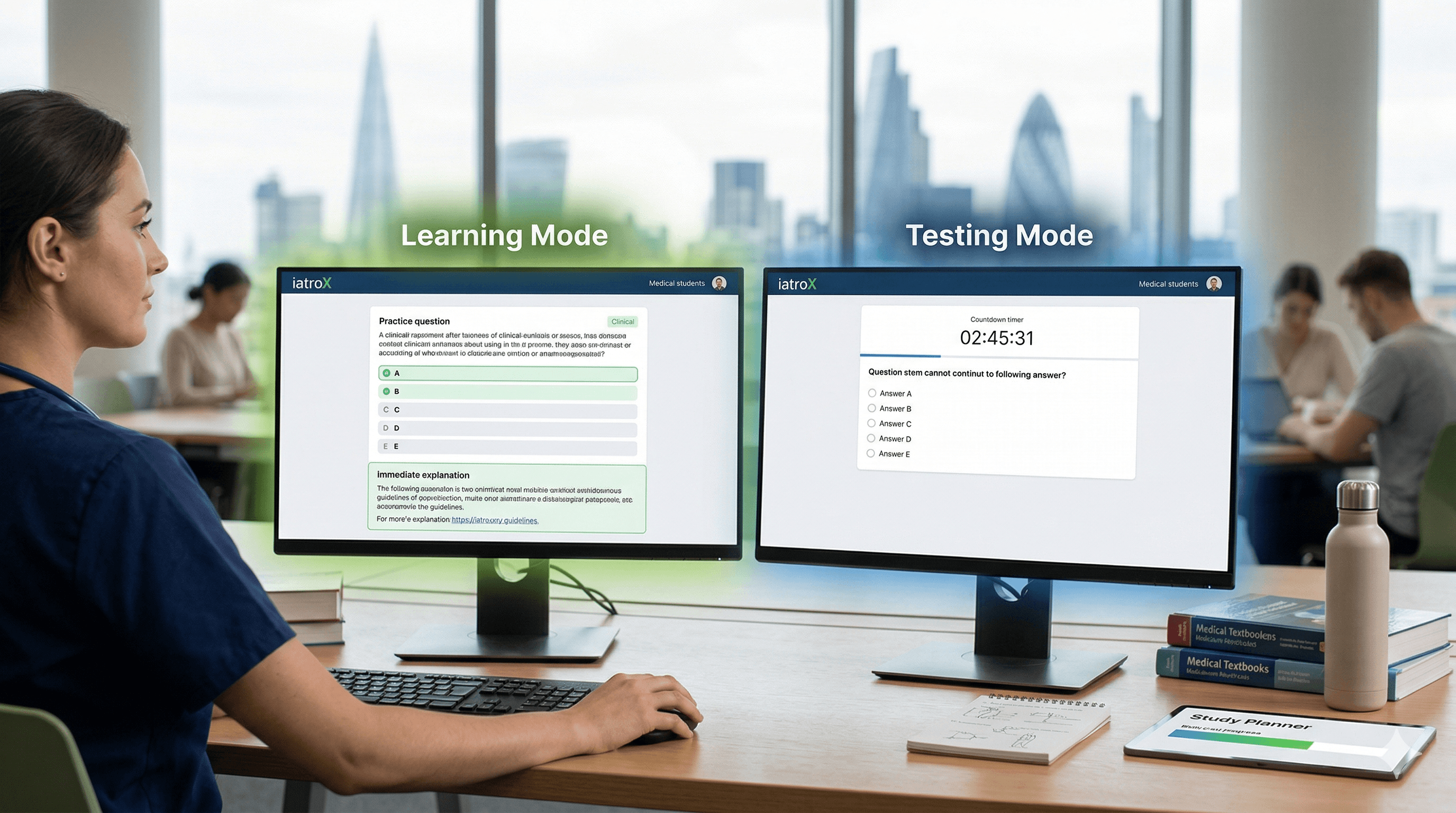
iatroX offers two distinct study modes — and using the wrong one at the wrong time is one of the most common preparation mistakes medical students make. Understanding the difference between practice questions and mock exams, and knowing when to shift between them, is the difference between efficient preparation and busy procrastination.
Practice Questions: The Learning Mode
Practice questions on iatroX are designed for learning. They have four characteristics that make them effective for building knowledge.
Immediate explanations. After every question, you see the full explanation — why the correct answer is correct, why the other options are wrong, and the guideline reference that underpins the answer. This immediate feedback loop is the mechanism of learning: you attempt retrieval, discover whether you succeeded, and receive corrective information within seconds. The learning happens in the gap between your answer and the explanation.
Topic filtering. You can select specific clinical domains — cardiovascular, respiratory, psychiatry — and practise within those topics. This is useful during the foundation phase when you are building knowledge in specific areas and want concentrated practice in your weakest domains.
Adaptive difficulty. The engine adjusts question difficulty based on your performance. Questions that are too easy (topics you have already mastered) are deprioritised. Questions at the edge of your competence (topics where your accuracy is 50-70%) are prioritised. This keeps every question in the productive learning zone — challenging enough to produce learning, not so difficult as to produce frustration.
No time pressure. You can take as long as you need on each question. You can look up the BNF. You can use Ask iatroX. You can think carefully. The goal is accuracy and understanding, not speed.
Mock Exams: The Testing Mode
Mock exams on iatroX are designed for testing. They have four characteristics that distinguish them from practice questions.
Deferred explanations. During the mock, you see questions and answer options only — no feedback on whether you are right or wrong until the entire mock is complete. This replicates the exam experience: you must manage uncertainty across the full exam duration without the psychological support of knowing your last answer was correct. The deferred feedback trains your tolerance of uncertainty — a critical exam skill that practice questions do not develop.
No topic filtering. The mock draws from the full exam curriculum — you cannot select topics or avoid weak areas. Questions appear in randomised order, mixing clinical domains unpredictably. This mirrors the real exam, where a cardiovascular question is followed by a psychiatry question with no warning. The randomisation trains flexible retrieval — the ability to switch between clinical domains rapidly, which is what the real exam demands.
Real time limits. The clock runs continuously. If you take 3 minutes on a difficult question, you have less time for the remaining questions. If you finish early, you can review flagged questions. If time runs out, the mock auto-submits with unanswered questions marked incorrect. Time management is itself a skill that only timed practice develops — and untimed practice gives you false confidence about your exam-day pace.
Exam-day simulation. The cumulative effect of deferred feedback, random topics, and time pressure creates a cognitive environment that closely approximates the real exam. The fatigue of question 150 (when you have been concentrating for 2.5 hours), the uncertainty of not knowing whether you are passing or failing, the time pressure of falling behind schedule — these are experiences that only mock exams provide. And experiencing them in practice reduces their impact on exam day.
When to Use Each
First 60-70% of your preparation: practice questions. You are building knowledge. You need immediate feedback to learn from errors. You need topic filtering to concentrate on weak areas. You need adaptive difficulty to keep questions productive. Doing a mock at this stage would be premature — you would expose yourself to topics you have not yet studied, producing frustration without learning.
Last 30-40% of your preparation: add mock exams alongside practice questions. You have built the knowledge. Now you need to test whether it holds up under exam conditions. Start with one mock every 2 weeks. Increase to weekly. Continue daily practice questions alongside — but shift from topic-filtered to mixed-topic sessions, mirroring the randomised topic distribution of mocks.
Final week: one mock, then rest. Your last mock should be 5-6 days before the exam. Review the results. Do targeted practice questions on the 2-3 weakest topics identified. Then stop. Rest the day before.
Common Timing Mistakes
Starting mocks too early. If you have only covered 30% of the curriculum, a mock exposes you to 70% unfamiliar content — producing a demoralising score that reflects curriculum gaps rather than knowledge weakness. Wait until you have covered at least 60% of the curriculum (which the study planner's coverage tracker shows) before your first mock.
Starting mocks too late. If your first mock is one week before the exam, you have one data point — and no time to act on what it reveals. A mock showing 45% in psychiatry is only useful if you have weeks of targeted practice ahead to close that gap. Start mocking 8 weeks out for sufficient feedback cycles.
Doing mocks instead of practice questions. Some candidates, anxious about the exam, switch entirely to mock mode in the final month — doing 2-3 mocks per week and no adaptive practice. Mocks diagnose weaknesses. They do not fix them. The fixing happens through targeted adaptive practice between mocks. The optimal ratio in the final month is 2-3 practice sessions for every 1 mock — using the mock results to guide which topics the practice sessions address.
Ignoring mock review. Completing a mock and immediately starting the next study session without reviewing the results wastes the diagnostic value of the mock. Spend at least 30 minutes reviewing every mock: which topics were weakest, which questions took the longest, and which errors were knowledge gaps versus time-pressure errors. The post-mock review is where the learning from the mock actually happens.
How the Study Planner Handles the Balance
The AI study planner eliminates the need to decide when to transition between practice and mock modes. It handles the balance automatically based on your readiness score and time remaining.
Foundation phase: 100% practice questions. Broad coverage. Topic clustering. Immediate explanations. Building the knowledge base.
Application phase: 90% practice questions (targeted at weak areas), 10% mock preparation (first baseline mock scheduled). Transitioning from learning to testing.
Performance phase: 60% practice questions (mixed-topic, increasingly timed), 40% mock exams (fortnightly → weekly). Testing and refining under exam conditions.
The planner transitions between phases automatically — you do not need to decide when to start mocking. The readiness score determines the pace: if your score is improving rapidly in the application phase, the planner introduces mocks earlier. If your score is still climbing in the foundation phase, the planner extends foundation-phase practice before scheduling the first mock. The transition is data-driven, not calendar-driven — because every candidate's learning trajectory is different.
The study planner handles this balance for you completely automatically — so you can focus on learning, not scheduling. Start at iatrox.com/study-plan.