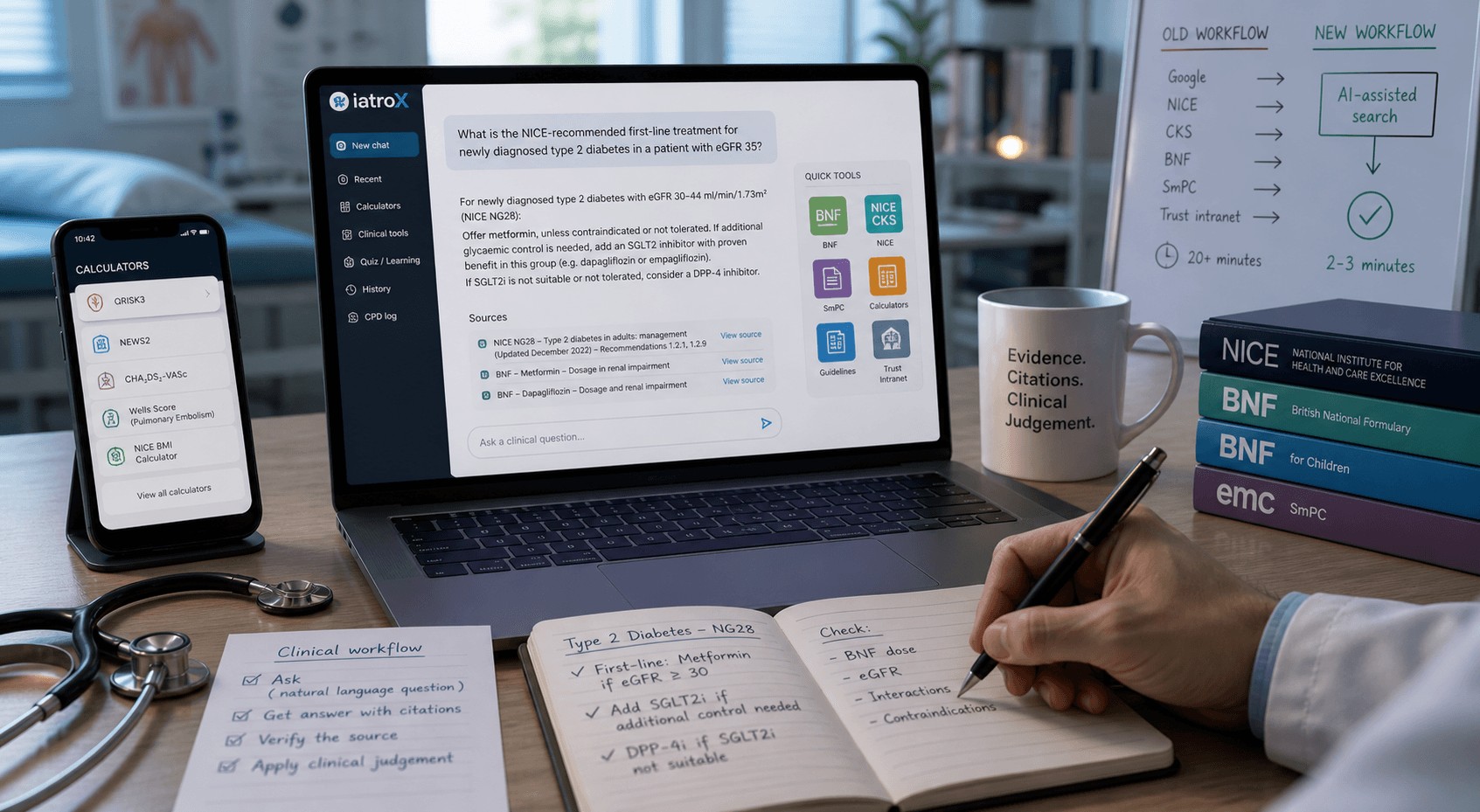
The behaviour change is bigger than any single company. Doctors increasingly expect clinical information to be retrieved, summarised, and cited in seconds — not found manually across six different browser tabs over several minutes.
Why Doctors Search Differently Now
Two forces are converging. Clinical information has expanded beyond any individual’s capacity to navigate manually: NICE publishes extensive guidance, CKS covers hundreds of primary-care conditions, eMC hosts product-specific SmPCs, and the peer-reviewed literature adds millions of papers. At the same time, clinical tools can now answer natural-language questions with citations.
Clinicians expect the speed of web search from clinical evidence retrieval. They do not want to navigate separately through NICE, CKS, a relevant SmPC on eMC, the local formulary and the wider literature. They want a concise answer with citations that lead back to the authoritative source.
The Old Medical Search Stack
The traditional approach involves multiple disconnected resources, each requiring separate navigation.
Google. Fast, broad, unreliable for clinical questions. May surface patient-facing content, outdated articles, or US-specific recommendations for UK queries.
PubMed. Gold standard for peer-reviewed literature. Powerful for research questions. Not designed for point-of-care clinical queries — a PubMed search returns study abstracts, not clinical recommendations.
NICE/CKS. UK guideline portals. Comprehensive but slow to navigate. A single NICE guideline can span dozens of pages. CKS is faster for primary care but covers a defined topic list.
eMC (SmPCs). Product-led regulatory information, organised by medicine, strength and formulation. Fast when the product is known; not designed to answer condition-led questions such as “what should I prescribe?”
SmPC (emc). Manufacturer's product information. Complete but verbose. Useful for specific dose adjustments, excipient data, and interaction details. Not designed for quick browsing.
Trust intranet. Local antimicrobial policies, clinical pathways, formulary restrictions. Variable quality, often buried in PDFs, frequently outdated.
Textbooks. Comprehensive but static. Updated yearly at best.
The New AI-Assisted Search Stack
The emerging model compresses this workflow.
Step 1: Ask a natural-language clinical question — "What is the NICE-recommended first-line for newly diagnosed type 2 diabetes in a patient with eGFR 35?"
Step 2: Receive a concise synthesis with citations to the specific NICE recommendation, CKS topic, SIGN section, SmPC section or other relevant primary source.
Step 3: Verify the relevant passage by clicking the citation. The AI found and synthesised; the clinician verifies and decides.
Step 4 (optional): Use a clinical calculator for scoring (QRISK3, NEWS2, CHA₂DS₂-VASc), check an exam question on the same topic for learning reinforcement, or log the clinical query for CPD.
The authoritative sources remain NICE, CKS, SIGN, relevant SmPCs on eMC, local guidance and the published evidence. The retrieval pathway becomes faster; the need to verify the cited source does not change.
Why Citations Matter
Clinical AI search without citations is a black box. A tool that says "prescribe metformin 500mg twice daily, titrating to 1g twice daily" without citing NICE NG28 is indistinguishable from a hallucination. A tool that says the same thing with a link to the specific NICE NG28 paragraph is verifiable in seconds.
Citations are the minimum safety requirement for clinical AI search. They convert an AI-generated response from "trust me" into "check this source." Every tool in this category should be evaluated first on citation quality — specificity (which paragraph, not just which guideline), accuracy (does the cited source actually say what the AI claims?), and completeness (are important caveats from the source reflected in the answer?).
Why Local Relevance Matters
Clinical guidelines are not interchangeable across countries. A tool citing ADA (American Diabetes Association) guidelines for a UK GP managing type 2 diabetes is not just unhelpful — it may recommend different drugs, different thresholds, and different monitoring protocols than NICE NG28. The same applies to hypertension (NICE NG136 vs ACC/AHA), antibiotic prescribing (NICE antimicrobial guidance vs IDSA), cancer screening (NHS screening programmes vs USPSTF), and virtually every other managed condition.
For UK clinicians, local relevance is not a nice-to-have — it is a safety requirement.
The Emerging Tools
OpenEvidence proved the demand in the US — $12 billion valuation, 40%+ daily physician use, 18 million monthly consultations. Trained on peer-reviewed literature. Now reportedly withdrawn from UK/EU.
Praxis Medicine shows European founders and investors see this category as venture-scale — 70 million SEK from Balderton and Creandum for a UK-focused clinical search product.
iatroX is designed for doctors who want a fast clinical starting point, not an unsupported black-box answer: short responses, source links, calculators, and learning tools in the same ecosystem. UKCA-marked, MHRA-registered. Free.
Medwise, Umbil, AMBOSS AI Mode each address different segments of the same shift — from manual guideline navigation to AI-assisted clinical search.
How to Use AI Medical Search Safely
Clinical AI search does not replace guidelines. It does not replace clinical judgment. It compresses the retrieval step — the time spent finding the right information — so the clinician can spend more time on the decision itself.
Verify every clinical answer against the cited source before acting on it. Check the citation — does the source actually say what the AI claims? Consider the currency — when was the cited guideline last updated? Apply clinical judgment — the AI retrieves information; you make the decision.