Executive summary
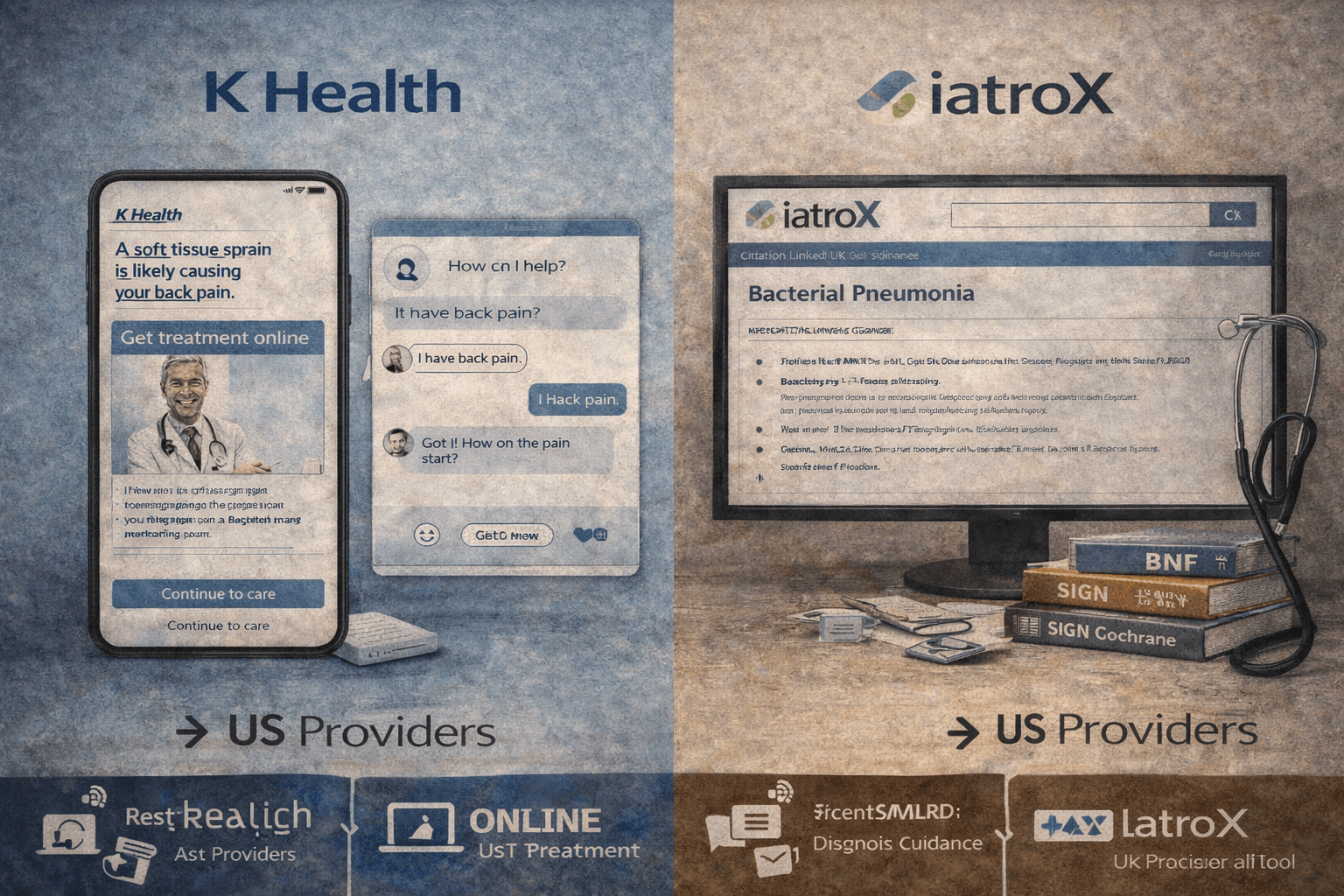
K Health is a US-centric platform that combines an AI symptom checker with a paid virtual consultation service. While it has generated headlines with its recent "AI Physician Mode" study in Annals of Internal Medicine, it is crucial for UK clinicians to understand that it is not a tool designed for NHS practice.
Its primary business model—linking symptom assessment to a paid US provider network—does not translate to the UK's free-at-point-of-use system. Furthermore, systematic reviews continue to show that symptom checker accuracy varies widely. For UK clinicians, the key takeaway is not to adopt the tool, but to learn from its "record-aware" AI design, while sticking to UK-governed, citation-first platforms like iatroX for their own clinical decision support.
What K Health is (plain-English, no hype)
K Health is a "digital front door" that blends two functions:
- AI Symptom Checker: A free-to-use conversational tool that asks patients about their symptoms and compares them to a database of millions of anonymised medical records to suggest potential causes.
- Virtual Care Platform: A subscription-based service (primarily in the US) that connects patients to a human clinician for diagnosis and treatment.
The Governance: K Health's own Terms of Service and app store listings are explicit: the symptom checker results are not medical advice or a diagnosis. They are information to help a patient decide if they need to see a doctor (Google Play, K Health).
The interesting bit: “AI Physician Mode”
In 2024, K Health publicised a study published in the Annals of Internal Medicine comparing its "AI Physician" to human doctors in a virtual urgent care setting.
- The Claim: The study suggested that the AI's notes and recommendations were often rated as high-quality by blinded reviewers.
- The Context: This was a specific, controlled study in a US virtual care environment. While promising, it is a single study, not a systematic review, and it reflects a specific workflow (generating a note from a patient chat) rather than open diagnostic reasoning (Business Wire).
The uncomfortable bit: symptom checker accuracy is variable
Despite individual success stories, the broader evidence base remains cautious. A 2025 review in npj Digital Medicine highlighted that the diagnostic accuracy of symptom assessment apps varies widely, with some tools performing poorly on "top-1" diagnosis accuracy compared to human physicians.
- The Takeaway: Treat headline accuracy numbers as signals, not certainties. Different study designs produce different results, and real-world performance on an undifferentiated UK population may differ from a controlled US study (Nature).
UK practice angle: why K Health isn’t directly portable to the NHS
K Health is built for a different world.
- Access Model: It relies on a direct-to-consumer subscription or insurance model, which conflicts with the NHS free-at-point-of-delivery principle.
- Prescribing: Its recommendations are based on US FDA approvals and formularies, not the BNF or NICE guidelines.
- Liability: In the UK, any software influencing clinical care must meet DTAC standards and have a clear DCB0129/0160 safety case. K Health is not optimised for this specific NHS governance landscape (NHS England).
What UK clinicians can learn from K Health
Even if you don't use the app, its design offers valuable lessons for the future of NHS tech:
- Record-aware AI > Prompt-only AI: K Health's strength lies in using historical patient data, not just the text typed in the chat box.
- Constrained outputs: It forces the user down a structured path rather than allowing free-text rambling, which improves safety.
- Escalation logic: The "product" is the hand-off to a human, not the AI diagnosis itself. This human-in-the-loop safety net is essential.
Where iatroX fits (and why the comparison is fair)
iatroX is the UK-centric, clinician-first alternative.
- The Job: K Health is a patient care platform (US context). iatroX is a clinician reference & learning tool (UK context).
- Provenance: iatroX positions itself as a UKCA-marked and MHRA-registered Class I medical device for informational use. It is free, has no ads, and focuses entirely on providing citation-first answers from UK-accepted guidance like NICE and SIGN (iatroX).
The Positioning: "K Health connects US patients to doctors; iatroX connects UK doctors to the evidence."
FAQs
Is K Health available in the UK? The app may be downloadable, but its primary "chat with a clinician" and prescribing features are designed for the US healthcare system and are not integrated with the NHS.
Is K Health the same as ChatGPT for medicine? No. K Health uses a proprietary database of anonymised medical records to inform its symptom checker, whereas ChatGPT is a general-purpose language model trained on the open internet.
What does ‘symptom checker is not medical advice’ actually mean? It means the tool is providing information based on statistics ("people like you often have X"), not a clinical diagnosis based on your specific history and examination.
What should NHS clinicians use instead for point-of-care answers? For verifying clinical decisions in the NHS, use a citation-first professional tool like iatroX or BMJ Best Practice.