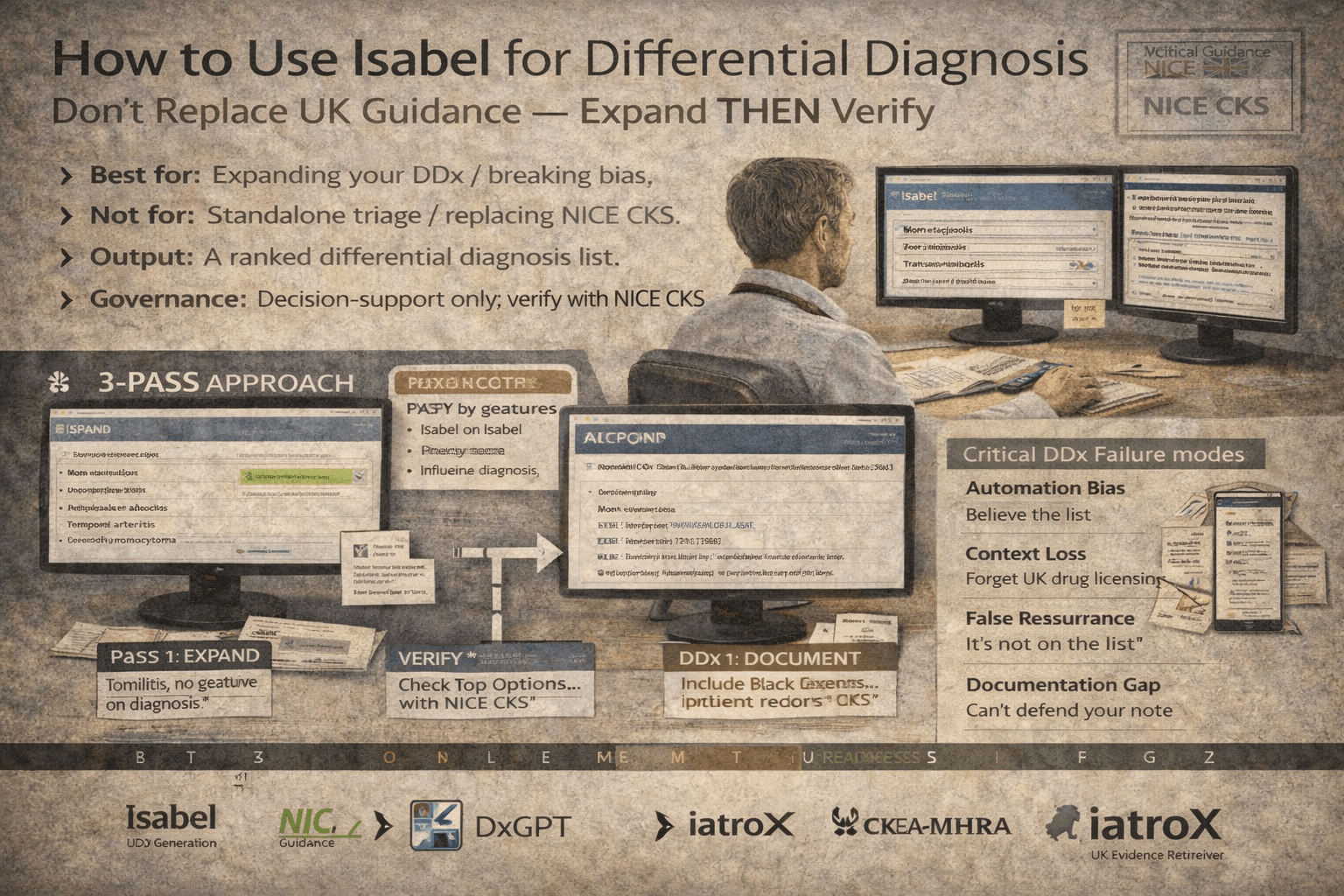
Use-case fit in 20 seconds
Best for: Expanding your differential diagnosis (DDx) when faced with uncertainty, countering cognitive bias, and supporting teaching or portfolio reflection. Not for: Triage decisions in isolation or replacing NICE/CKS pathways for management. Output: A ranked list of potential diagnoses based on clinical features. Governance note: Treat as "decision-support" only; always verify against primary sources and document your own clinical rationale.
What Isabel is (and what it’s not)
Isabel DDx Companion is a "Differential Diagnosis Support System" (DDSS), not a guideline engine. Its job is to suggest possibilities you might have missed, not to tell you what to do in the NHS today.
It allows you to enter signs and symptoms in natural language and returns a list of potential diagnoses from a vast database of over 10,000 conditions. Its core proposition is breadth and speed: it casts a wide net to ensure you haven't closed your mind to a "don't-miss" diagnosis prematurely.
The GP reality: why DDx tools are attractive
In a high-volume, 10-minute consultation environment, the cognitive load is immense. The risk isn't usually missing a "zebra" (a rare disease); it's missing a "can't-miss" condition because of anchoring bias or fatigue.
A DDx list helps by reframing the case. It prompts questions you might not have asked ("Could this be early presentation of X?"). However, it clashes with the GP workflow when you need to know the specific local referral threshold or the first-line antibiotic licensed in your ICB. For that, you need NICE CKS, not a list of diseases.
How to use Isabel properly in UK practice (a practical “3-pass” workflow)
To use Isabel safely in the NHS, integrate it into a structured check-verify-document loop.
- Pass 1 (30s): Expand. Use Isabel to input the key features. Scan the list. Ask yourself: "Is there anything here I haven't considered that is plausible?"
- Pass 2 (2–3 min): Verify. Pick the top 2-3 likely differentials. Verify the management and referral criteria against NICE CKS (the UK backbone).
- Pass 3 (1 min): Document. Record your reasoning. "Differential includes X and Y. Excluded Z based on examination. Safety-netting provided per NICE guidance."
Where Isabel is strong
- Breadth: It covers a huge range of conditions, making it excellent for "unfamiliar presentations" where your internal script is empty.
- Speed: It is designed for the point of care, delivering results quickly without the "chatty" delay of some LLMs.
- Structure: Unlike a general LLM, it is built specifically for medical diagnosis, reducing the noise of non-clinical information.
Failure modes (what can go wrong)
- Automation bias: The tendency to believe "it’s on the list, so it must be true."
- Context loss: Isabel doesn't automatically know your local GP context—prevalence rates, local pathways, or patient-specific factors.
- False reassurance: "It's not on the list, so I've ruled it out." Never use a tool to exclude a diagnosis; use your clinical judgement.
- Documentation gap: A list of diagnoses is hard to defend in a notes review unless you link it to the evidence or pathway you actually followed.
UK governance: what an NHS clinician should assume
If a tool influences your clinical decision, you must treat it with due diligence.
- Who made it? Isabel Healthcare is an established vendor with a long history in the sector.
- Does it cite sources? Ensure you can verify the suggestions against trusted evidence.
- Does it align with UK practice? Remember that its database is global. A diagnosis valid in the US might have a different name or management pathway in the NHS.
- NHS expectation: Tools influencing care commonly require clear assurance (DTAC-type thinking). Ensure you are using it within your organisation's IG policy.
Isabel vs DxGPT vs iatroX (category comparison)
| Feature | Isabel | DxGPT | iatroX |
|---|---|---|---|
| Primary Job | DDx Generation | DDx + Narrative | UK Evidence Retrieval |
| Typical Use | Uncertainty ("What could it be?") | Rare-case thinking | "What does UK guidance say?" |
| Provenance | Database-backed | Generative (GPT-4) | Citation-first (NICE/CKS) |
| UK Readiness | Global Tool | Research/Pilot | Explicit Alignment |
| Best User | GP / Acute | Academic / Specialist | GP / Trainee / Student |
Where iatroX fits
iatroX is positioned as a UKCA-marked, MHRA-registered Class I medical device. It complements a tool like Isabel rather than competing with it.
- Use Isabel for the open question: "What could this be?"
- Use iatroX Ask for the closed question: "What does the NICE guideline say about managing this condition, and show me the citations?"
- Use iatroX Brainstorm to structure your reasoning for a referral letter or learning log.
- Use iatroX Quiz to convert that moment of uncertainty into a lasting learning point.
FAQs
Is Isabel better than ChatGPT for diagnosis? Isabel is a purpose-built medical tool with a curated database, whereas ChatGPT is a probabilistic language model. Isabel is generally safer for generating a structured medical differential, while ChatGPT requires careful prompting and verification to avoid hallucination.
Can Isabel be used in the NHS? Yes, it is used by individual clinicians and some organisations. However, always check your local Trust or ICB policy regarding the use of clinical decision support tools.
What should I document if I used a DDx tool? Document your clinical reasoning, not just the tool's output. "Considered differential of X, Y, Z. History and exam rule out X. Treating as Y." You can mention using a decision support aid, but the decision is yours.
How do I verify outputs against NICE/CKS? Don't rely on the tool's internal links alone. Open NICE CKS in a separate tab or use iatroX to rapidly retrieve the specific UK management summary for the condition suggested.