Executive summary
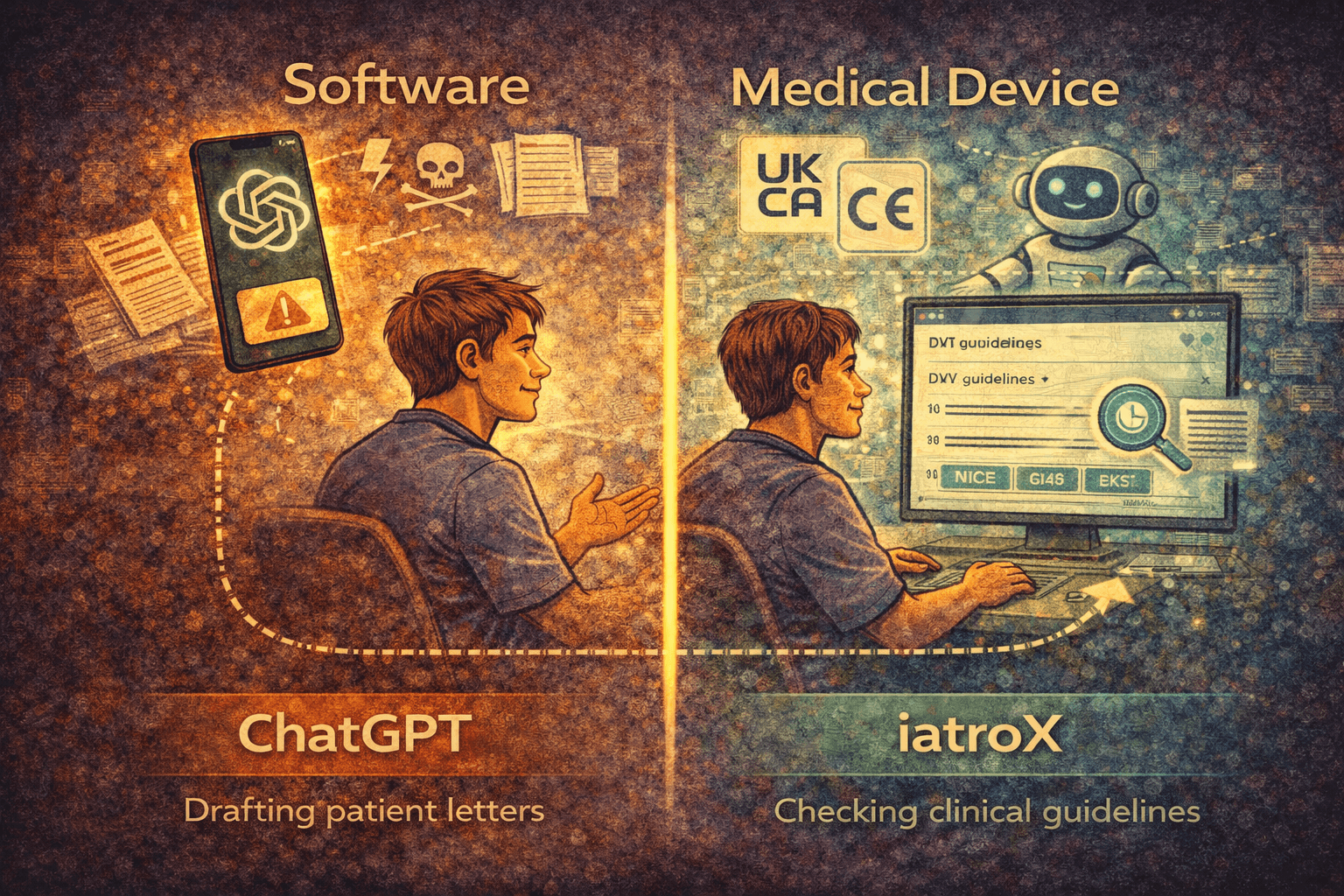
In the rapidly expanding world of clinical AI, a critical question for every UK clinician is: "Is this tool just software, or is it a regulated medical device?" The answer determines everything from the safety evidence you should expect to the legal protections you have.
The distinction lies in the "intended use." If a tool calculates, interprets, or triages patient data to influence a clinical decision, it is likely a medical device under UK law and must carry a UKCA or CE mark. However, simple reference tools and educational aids fall outside this scope. This guide breaks down the MHRA's position, explains why iatroX is registered as a UKCA Class I device, and gives you a practical framework to interpret vendor claims.
The basic concept: “medical purpose” and why it matters
In the UK, software becomes a medical device when the manufacturer states it has a "medical purpose." According to the MHRA (Medicines and Healthcare products Regulatory Agency), this isn't just about what the code can do, but what the company claims it does.
If software is intended for the:
- Diagnosis, prevention, monitoring, treatment, or alleviation of disease,
- Anatomy investigation or replacement, or
- Control of conception,
...then it is a medical device. Crucially, "diagnosis" includes software that provides information used to make a diagnosis or decision, such as a risk calculator or a triage tool (GOV.UK).
Examples: when is software regulated vs. not?
To navigate the market, it helps to see where common tools land.
NOT a medical device (usually)
- Digital textbooks and reference viewers: Apps that present static source material for a user to interpret—for example, an organisation-approved medicines-reference app or a static NICE-guidance viewer—may function as reference material rather than manipulating patient data. Classification still depends on the product’s intended purpose and functionality.
- Simple search tools: A tool that finds a document based on a keyword.
- Lifestyle apps: Fitness trackers that log steps or sleep without making medical claims.
- Administrative tools: Scheduling software or patient record systems that just store data without interpreting it.
IS a medical device
- Calculators that influence treatment: An insulin bolus calculator or a tool that calculates a QRISK3 score. It takes patient data (weight, blood glucose) and outputs a value that directly guides treatment.
- Diagnostic AI: Software that analyses a mole and says "high probability of melanoma" or reads a chest X-ray to flag a nodule.
- Symptom checkers: Triage bots (like 111 online) that tell a patient "go to A&E" or "see a GP" based on their symptoms.
What UKCA/CE marking signals (and what it doesn’t)
When you see a UKCA (UK Conformity Assessed) or CE mark on an app, it signals that the manufacturer has followed a legal process to demonstrate the device is safe and performs as intended.
- Class I (Self-Certified): For low-risk devices. The manufacturer declares conformity themselves. This covers many clinical decision support tools.
- Class IIa / IIb / III (Notified Body): For higher-risk devices (e.g., those that diagnose or monitor vital functions). These require an independent audit by a "Notified Body" before they can be sold.
Note on Brexit: The UK is in a transition period. A valid CE mark is still accepted on the Great Britain market until 30 June 2028 (or 2030 for some devices), but eventually, all devices will need a UKCA mark (GOV.UK).
What it doesn't mean: A Class I mark does not mean the MHRA has personally tested the app. It means the company has taken legal responsibility for its safety and registered it.
Practical takeaway: how clinicians should interpret vendor claims
When a salesperson or website says "we use AI," ask three questions:
- "Is this a registered medical device?"
- If yes, ask for their class and certificate.
- If no, ask "Why not?" If it's doing something clever with patient data, it probably should be.
- "What is the intended use?"
- Beware of tools that act like diagnostic aids but claim to be "for educational purposes only" to avoid regulation. This is a red flag.
- "Check the register."
- You can verify any device on the MHRA's Public Access Registration Database (PARD).
Where iatroX sits in the “regulated vs unregulated” landscape
iatroX is a UKCA Class I Medical Device, registered with the MHRA.
Why? Because we go beyond simple search. While our primary function is informational—helping you find and understand guidelines—our architecture is designed to support clinical decision-making in a structured, safe way. We chose to register as a medical device to hold ourselves to a higher standard of clinical safety governance (DCB0129) and quality management than a standard tech startup. However, we are clear on our intended use: iatroX is an information retrieval and educational aid, not a diagnostic tool. It supports your decision; it does not make it for you.
Sources
- GOV.UK: Medical devices: software applications (inc. AI)
- MHRA: Software and AI as a Medical Device Change Programme