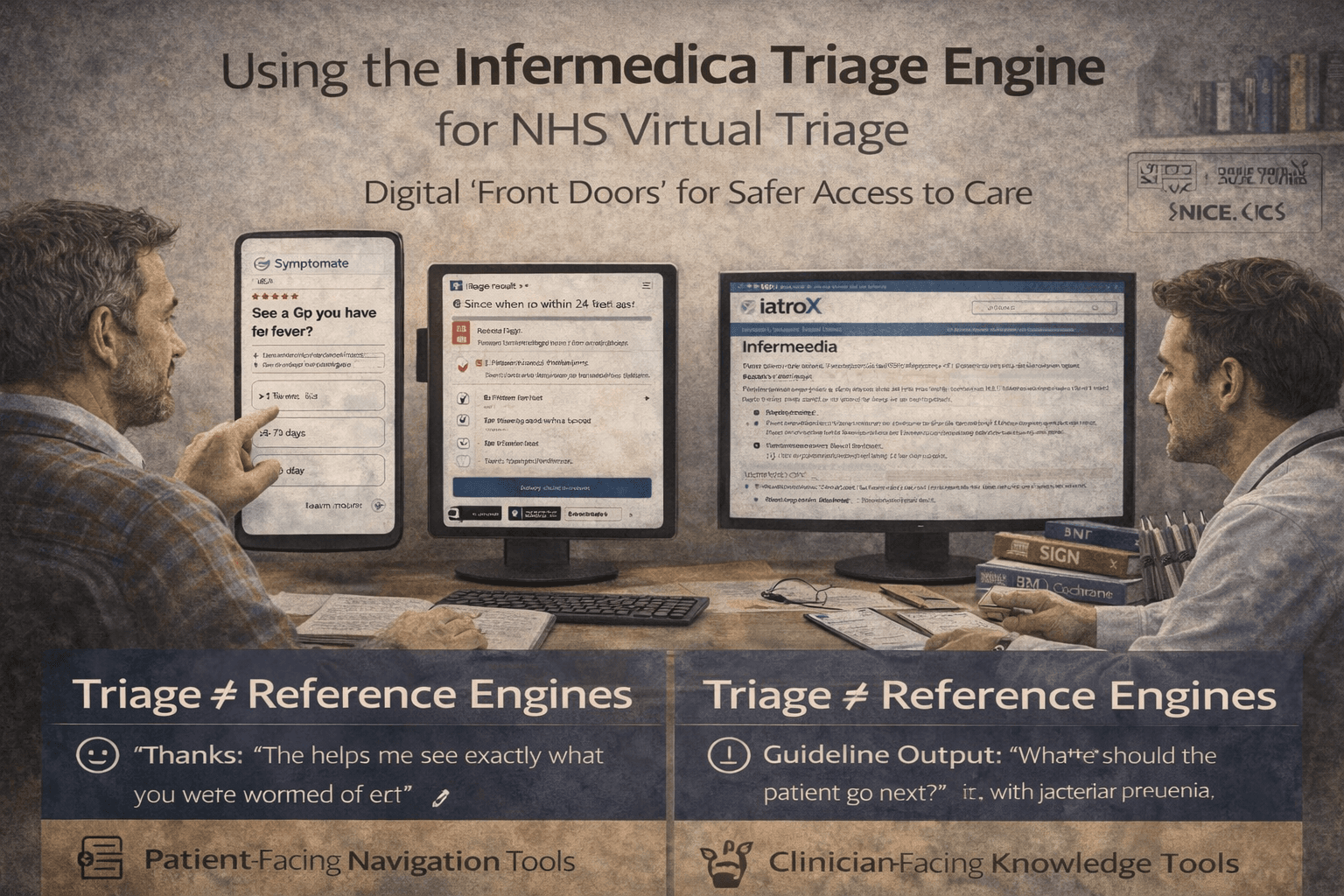
Tool facts
- Category: Enterprise virtual triage / symptom assessment.
- Outputs: Urgency assessment + navigation guidance (e.g., "See a GP within 24 hours," "Self-care").
- Deployment: API-first integration into patient portals, apps, and websites.
- Best for: Digital front doors, insurance gatekeeping, and call-centre support.
- Not for: Definitive diagnosis or replacing clinical judgement.
Introduction: what Infermedica is
Infermedica is a "conversational triage" engine. It engages patients in a dynamic Q&A to understand their symptoms, assess urgency, and guide them to the appropriate level of care. You might know its consumer-facing demo as Symptomate, but its primary business is providing the API engine that powers triage for health insurers and providers globally.
It is distinct from a simple "decision tree" because it uses a probabilistic inference engine to ask the next most relevant question, rather than following a rigid script.
The key distinction: triage engines ≠ clinical reference engines
To buy safely, you must understand the difference:
- Triage engines (e.g., Infermedica): Answer "Where should the patient go next?" (ED, GP, Pharmacy, Home). They are patient-facing navigation tools.
- Clinical reference engines (e.g., iatroX): Answer "What does the evidence say about management?" They are clinician-facing knowledge tools.
Mixing these up is a governance failure. You wouldn't use a triage bot to decide on a chemotherapy regimen, and you wouldn't use a clinical search engine to route a patient queue.
How these engines are typically built
Infermedica and its peers are built on three layers:
- Knowledge Base: A massive, curated database of conditions, symptoms, and risk factors, maintained by physicians.
- Inference Engine: An algorithm that calculates the probability of various conditions and the severity of the presentation to decide which question to ask next.
- Validation: A continuous process of testing against "gold standard" clinical vignettes to ensure safety and accuracy (Infermedica).
Evidence and validation: what to look for
Marketing claims are not enough. Systematic reviews have consistently shown that the diagnostic accuracy of symptom checkers varies wildly. Some are excellent at triage (safety) but poor at diagnosis (specificity).
When evaluating Infermedica or any triage AI for the NHS, look for:
- Triage Accuracy: Does it safely identify emergencies? (Sensitivity for urgency).
- Vignette Studies: Has it been tested against standard clinical cases relevant to the UK population?
- Real-world Pilots: Are there case studies from similar health systems?
UK/NHS fit: where virtual triage helps
- Benefits: Reduces friction for patients, standardises pre-assessment data, and provides 24/7 access to safety-netting advice.
- Risks: The "risk of over-triage" (sending everyone to A&E to be safe) and "digital exclusion" (leaving behind those who can't use the app).
The “12 questions” procurement checklist
Before procuring any triage AI, ask these 12 questions:
- Intended Purpose: Is it a medical device? What class?
- Risk Class: Does it meet UKCA/MHRA requirements for that class?
- Data Processing: Where does the patient data go? (UK/EU sovereignty).
- Retention: How long is data kept?
- Clinical Safety: Is there a DCB0129 safety case?
- Adopter Safety: Are we ready to write our DCB0160?
- Audit Logs: Can we trace why a patient was sent to A&E?
- Uncertainty: What does it do when it doesn't know the answer? (It should default to safety).
- Local Eval: Have we piloted it with our patient population?
- Accessibility: Does it meet WCAG 2.1 AA standards?
- Governance: Who is the named Clinical Safety Officer (CSO)?
- Incidents: What is the route for reporting a near-miss?
Where iatroX fits (and why it’s a safer “first adoption”)
iatroX is a clinician tool, not a patient triage bot.
- Governance Signal: iatroX positions itself as a UKCA-marked and MHRA-registered Class I medical device for informational and educational use (iatroX).
- The Complementary Workflow:
- Use Infermedica to navigate the patient to the right clinician.
- Use iatroX Ask to help the clinician verify the management plan against UK guidance once the patient arrives.
- Use iatroX Brainstorm to structure the clinical note and reasoning.
iatroX is "always free and has no ads," making it a low-friction way to add AI safety checks to your clinical team without a complex procurement cycle.
FAQs
What is Infermedica used for? It is used to automate patient intake and triage, guiding patients to the right level of care (e.g., book an appointment vs call 999).
How should NHS services evaluate triage AI? By running a "shadow mode" pilot where the AI's triage recommendation is compared to a human clinician's decision for the same cases, before letting it direct real patients.
Is Infermedica the same as a symptom checker? Yes, "Symptomate" is their consumer symptom checker brand. "Infermedica Triage" is the enterprise engine that powers it.
What’s the safer alternative for clinicians? For clinicians needing to check guidelines or evidence, a citation-first reference tool like iatroX or BMJ Best Practice is the correct choice, not a triage engine.