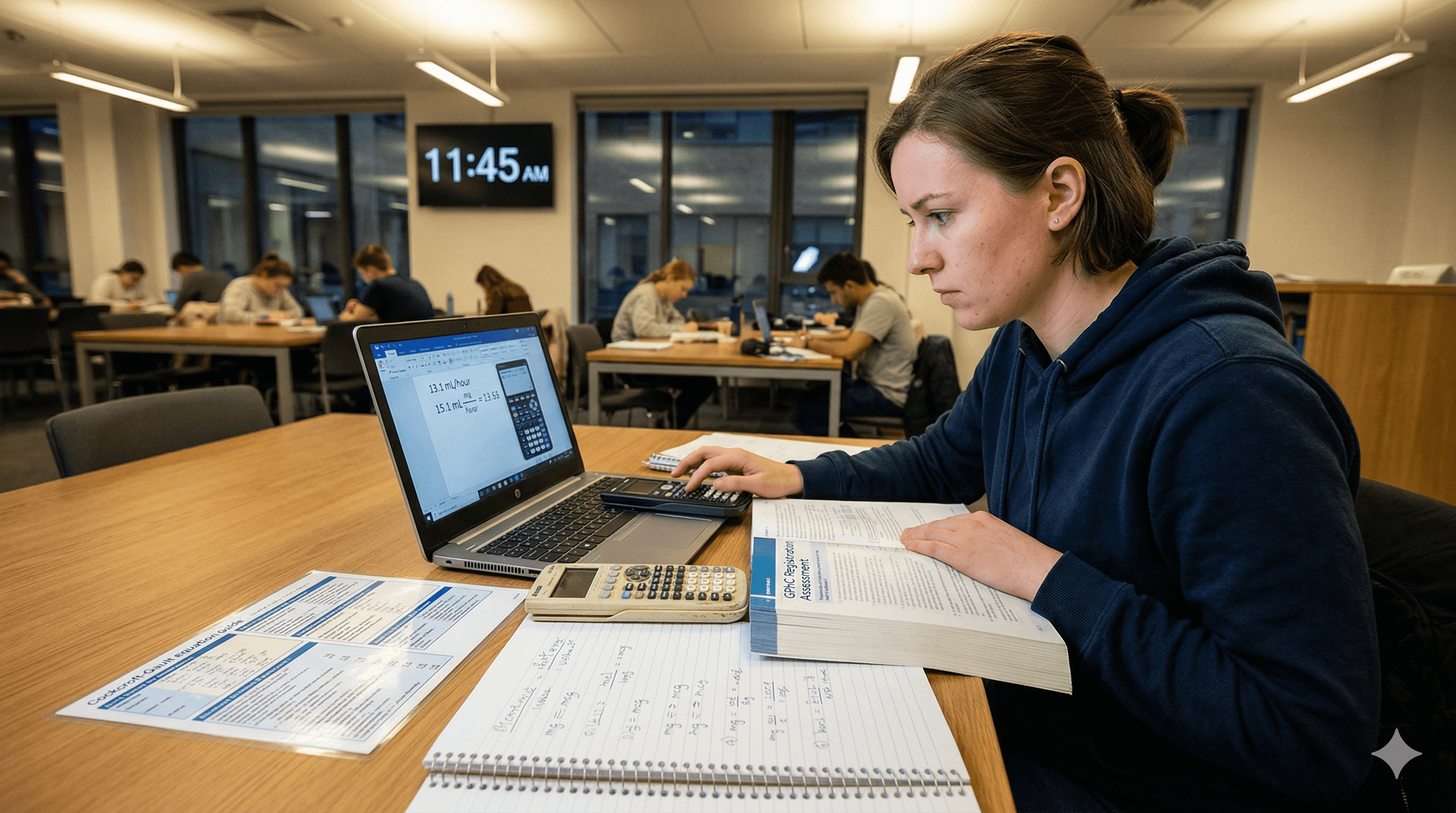
Part 1 of the GPhC Common Registration Assessment is 40 calculations in 120 minutes. You type the number — no multiple choice, no partial credit. In June 2025, the pass mark was 24/40 and 16% of candidates failed Part 1 alone. In November 2024, the failure rate was even higher.
The candidates who fail Part 1 are not candidates who cannot do mathematics. They are candidates who have not drilled the specific calculation types under timed conditions. They know the method but not the pace. They practise the types they are comfortable with and avoid the ones they find confusing. They use the on-screen calculator for the first time on exam day.
This guide covers every calculation type with worked examples, the specific mistakes that cost marks, and how to drill each one.
Type 1 — Dose and Dose Regimen Calculations
Calculate a single dose, daily dose, or course dose from a prescribed regimen.
Worked example: Amoxicillin 250mg/5mL suspension. Dose: 500mg three times daily for 7 days. Volume per dose: (500/250) × 5 = 10mL. Daily volume: 30mL. Total course: 210mL.
Common mistake: Confusing dose expressions. "150mg/kg/day in 3 divided doses" means total daily dose = 150mg/kg, each dose = 50mg/kg. Not 150mg/kg per dose.
Type 2 — Unit Conversions
Converting between mg/mcg, g/mg, mL/L, mmol/mg.
Worked example: Levothyroxine dose: 0.1mg. Express in micrograms: 0.1 × 1000 = 100 micrograms.
Common mistake: The tenfold error in mcg-to-mg. Digoxin 125 micrograms is 0.125mg, not 1.25mg. This specific error kills patients in practice and kills scores in exams.
Type 3 — IV Infusion Rates
Calculate mL/hour, drops/minute, or infusion duration.
Worked example: Dopamine 800mg in 500mL glucose 5%. Dose: 5mcg/kg/min. Patient: 70kg. Required dose: 5 × 70 = 350mcg/min = 0.35mg/min. Concentration: 800mg/500mL = 1.6mg/mL. Rate: 0.35/1.6 = 0.219mL/min = 13.1mL/hour.
Common mistake: Not converting mcg to mg before dividing by concentration in mg/mL. Unit mismatch produces a 1000-fold error.
Type 4 — Displacement Values
Calculate diluent volume accounting for powder displacement when reconstituting injections.
Worked example: Cefotaxime 1g powder for injection. Displacement value: 0.5mL per 1g. Required final volume: 4mL. Water to add: 4 - 0.5 = 3.5mL.
Common mistake: Adding the full final volume of diluent and ignoring displacement — producing a lower concentration than intended. The Board of Assessors feedback specifically flags this.
Type 5 — Concentration Expressions
%w/v, %w/w, 1:x ratios, parts per million.
Worked example: Chlorhexidine 0.5% w/v. How many mg in 200mL? 0.5% w/v = 0.5g per 100mL = 500mg per 100mL. In 200mL: 1000mg = 1g.
Common mistake: Confusing %w/v (g per 100mL) with %w/w (g per 100g). For solutions, w/v is standard. For creams and ointments, w/w is standard.
Type 6 — Creatinine Clearance and Renal Dose Adjustments
Cockcroft-Gault equation: CrCl = [(140 - age) × weight × constant] / serum creatinine. Constant: 1.23 (male), 1.04 (female). Creatinine in µmol/L.
Worked example: 68-year-old female, 55kg, creatinine 130µmol/L. CrCl = [(140-68) × 55 × 1.04] / 130 = [72 × 55 × 1.04] / 130 = 4118.4 / 130 = 31.7mL/min. BNF dose adjustments for renally excreted drugs apply at this level.
Common mistake: Using the wrong constant (1.23 for males, 1.04 for females). Or using eGFR (CKD-EPI) instead of CrCl (Cockcroft-Gault) — they are not interchangeable for drug dosing.
Type 7 — Paediatric Weight-Based Dosing
Calculate doses using mg/kg, check against maximum dose, determine volumes from available preparations.
Worked example: Child 22kg. Ibuprofen 5mg/kg three times daily. Single dose: 110mg. Available as 100mg/5mL. Volume: (110/100) × 5 = 5.5mL. Check BNFc: max single dose for this age — within limits.
Common mistake: Not checking the calculated dose against the BNFc maximum. A heavy child might produce a calculated dose that exceeds the maximum — the exam tests whether you catch this.
Type 8 — Quantities to Supply and Dilutions
Calculate total supply quantities for a course, or dilution volumes to achieve a target concentration.
Worked example (dilution): You have 50mL of 10% w/v glucose. Dilute to 5% w/v. C₁V₁ = C₂V₂. 10 × 50 = 5 × V₂. V₂ = 100mL. Water to add: 100 - 50 = 50mL.
Common mistake (supply): Rounding errors — the Board of Assessors specifically notes that rounding should occur at the individual dose stage before calculating the final supply quantity.
How to Drill
Do not practise untimed. Ever. From week one. 40 questions in 120 minutes is 3 minutes per question — and that includes reading, extracting data, calculating, checking, and entering.
iatroX tracks your accuracy and speed across each calculation type independently. The adaptive engine identifies your weakest types and concentrates practice there — with difficulty scaling as you improve. The performance dashboard shows proficiency by calculation type, not just an aggregate score.
Start at iatrox.com/quiz-landing?exam=uk-gphc.