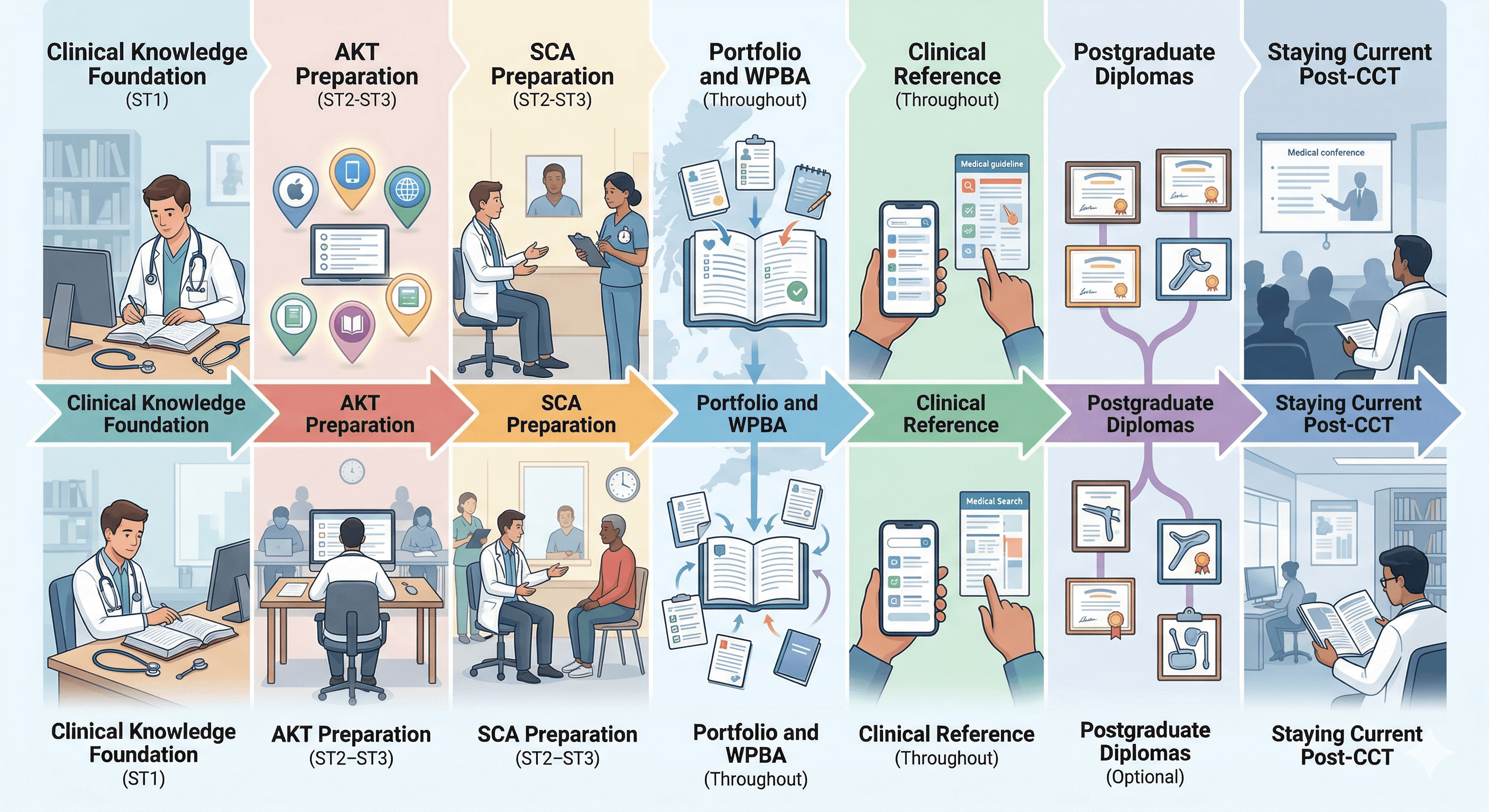
There are at least 20 platforms, apps, and tools relevant to GP training. Some are free. Some cost £200+. Some are essential. Some are optional. And nobody has written down which one fits where in your training journey — so most GP registrars discover tools too late, pay for overlap, or miss free alternatives entirely.
This resource map fixes that.
Phase 1: Clinical Knowledge Foundation (ST1)
You are building the breadth of clinical knowledge that general practice demands. Every consultation is a potential unknown — today you see a child with a rash, tomorrow a care home patient with delirium, the day after a young woman requesting contraception. The tools in this phase give you the reference infrastructure to manage safely while you build confidence.
NICE CKS (free). Primary care management pathways — your daily clinical reference. CKS provides structured management algorithms for common primary care conditions: when to investigate, when to treat, when to refer, what safety netting to provide. Bookmark this on your desktop and phone on day one. Use it in every consultation where you are unsure of the current NICE recommendation.
Medicines access. Bookmark eMC for product-specific SmPCs and confirm which medicines service, formulary and antimicrobial guidance your organisation uses. Before prescribing, verify the exact product and follow applicable local, NICE, SPS or specialist guidance.
Ask iatroX. A clinical-retrieval tool that can return cited NICE and CKS guidance and medicines information from relevant SmPCs on eMC. It may be useful for a focused question; use CKS or the full guideline when you need the complete pathway, and always inspect the cited source.
iatroX MRCGP AKT Q-bank (free). Start adaptive practice early — even in ST1. The AKT sits in ST2-ST3, but building the habit of daily question practice from ST1 means 12-18 months of spaced repetition accumulates knowledge gradually rather than cramming it in 3 months. Even 10-15 questions per day during ST1 builds a substantial knowledge base by the time you need it.
Red Whale Pearls (free email). Weekly guideline updates — the "Sunday night check" for what changed this week in primary care. Subscribe from day one.
Oxford Handbook of General Practice (approximately GBP 35). The physical pocket reference for the consulting room. Covers the practical aspects of GP that digital tools do not: appointment management, telephone consultations, home visits, administrative processes, medico-legal basics.
Phase 2: AKT Preparation (ST2-ST3)
The AKT is a 200-question, 3 hour 10 minute paper testing clinical medicine (80%), evidence-based practice (10%), and health informatics/administration (10%). It is the knowledge component of the MRCGP and must be passed before your CCT date. Most trainees sit in ST2 or early ST3.
iatroX adaptive Q-bank (free). Spaced repetition mapped to the AKT blueprint. The adaptive engine identifies your weakest clinical domains and concentrates practice there. Performance dashboard shows mastery across all AKT domains. Free — start here. If you started in ST1, you already have months of performance data guiding your revision. The AKT tests 200 questions across the full breadth of primary care medicine — cardiovascular, respiratory, endocrine, musculoskeletal, dermatology, ENT, ophthalmology, psychiatry, paediatrics, women's health, and more. The adaptive engine ensures you are not spending 3 hours on cardiovascular (which you see daily in practice and already know well) while neglecting ophthalmology (which you rarely see and need to revise).
Passmedicine (GBP 35-50/4-12 months). The most-used AKT Q-bank — widely recommended by GP registrars and programme directors. Large static bank with RCGP-endorsed question style. Particularly strong for data interpretation (clinical trials, NNT/NNH, sensitivity/specificity, systematic reviews, meta-analyses) and evidence-based practice questions — the 10% of the AKT that many candidates under-revise because it feels less "clinical." The data interpretation section catches candidates who have not practised it since medical school. Use alongside iatroX: iatroX for adaptive targeting of weak clinical areas, Passmedicine for volume and data interpretation.
Pastest (GBP 95-180/3-12 months). Premium Q-bank with greater clinical depth per question. Includes an AI tutor feature for personalised feedback on wrong answers. Strong for complex clinical scenarios with multiple comorbidities and nuanced management decisions. Higher price but higher quality per question. Some trainees use Passmedicine for breadth (months 1-3) then Pastest for depth (months 4-6). Others use one throughout. Both are credible — the choice is personal.
RCGP AKT learning resources (official, free). Blueprint, tutorials, data interpretation guidance, sample questions. Read the blueprint first — it defines what the exam tests and in what proportions. The data interpretation tutorial is critical: 10% of the AKT tests research methodology and statistics, and many trainees have not practised this since medical school. The health informatics section (10%) tests QOF, contract structures, NHS governance, and clinical coding — material that is not covered by any Q-bank and must be learned from the RCGP resources directly.
iatroX Calculators (free). QRISK3, CHA2DS2-VASc, CKD-EPI, CURB-65, PHQ-9, Wells PE — practise the exact tools tested in the AKT. Understanding what the scores mean, when to apply them, and how to interpret the results in clinical context is directly tested in the clinical medicine section.
AKT preparation timeline: Start 6 months before your sitting. Months 1-2: 20-30 questions per day on iatroX (adaptive targeting across all domains) + familiarise with the RCGP blueprint. Months 3-4: increase to 30-40 questions per day, add Passmedicine or Pastest for volume and data interpretation. Months 5-6: mixed-topic practice under timed conditions, weekly mock exams, intensive data interpretation and health informatics revision. Use the iatroX performance dashboard to identify remaining weak areas in the final 2 weeks.
Phase 3: SCA Preparation (ST2-ST3)
The SCA tests consultation skills across 12 cases in a single sitting — Data Gathering and Diagnosis, Clinical Management and Medical Complexity, and Relating to Others.
SCAreVision (GBP 11.99-15.99/month). 350+ cases, 350+ AI patients, 70+ consultation videos (Premium), group revision via QR code. The market leader — trusted by 9,000+ trainees. Start 3-4 months before the exam. See our detailed SCA platform comparison for the full market analysis.
SCAPrep. AI case generator — unlimited fresh cases for variety. Useful in the final weeks when you have exhausted SCAreVision's case bank.
MedTutor AI. AI patient simulator with structured feedback for solo practice. Credit-based pricing.
RCGP SCA hub (official, free). Format, marking criteria, sample cases. Read this before your first practice session.
Ask iatroX (free). The clinical knowledge layer — verify your management plans against NICE guidelines before practising them in SCA simulations. Ensures your consultations are clinically accurate, not just communicatively fluent. A management plan for heart failure that correctly sequences ACEi, beta-blocker, MRA, and SGLT2i per NICE NG106 scores significantly higher in Clinical Management than a vague "start them on heart failure medication."
Peer practice (free). The RCGP strongly advises against revising for the SCA alone. Find 2-3 study partners from your VTS (vocational training scheme) group. Practise 2-3 cases per session, rotating roles (doctor, patient, marker). SCAreVision's group mode makes remote group practice frictionless.
Phase 4: Portfolio and WPBA (Throughout Training)
Your ARCP determines whether you progress through training and ultimately achieve CCT. The portfolio is the evidence — and it is assessed not just on quantity but on quality of reflection and breadth of coverage. Start collecting from week one. The trainees who leave WPBAs until month 11 have a stressful, compressed portfolio-building experience that undermines the developmental purpose.
FourteenFish. Portfolio and appraisal toolkit — the standard for GP training across most UK deaneries. WPBAs (CBD, COT, miniCEX), reflective logs, CPD tracking, and appraisal output. Learn the interface in your first week. Understand what your ARCP panel expects: minimum WBA numbers, evidence spread across the GP curriculum, and quality reflective accounts that demonstrate learning and behaviour change — not just "I did this case."
iatroX CPD (free). Log learning from clinical encounters and Q-bank use. The performance dashboard provides measurable CPD evidence — "my cardiovascular proficiency improved from 52% to 78% over 3 months through targeted adaptive practice" is a stronger reflective account than "I did some cardiology revision." The data-driven nature of iatroX CPD evidence satisfies the GMC requirement for demonstrable engagement with professional development.
Praktiki (free app). Daily CPD logging from clinical sessions — designed for mobile-first, quick-entry logging. Capture learning points during or immediately after consultations before they are forgotten. The friction of traditional CPD logging (sit down, open FourteenFish, write a reflective account) means many learning moments go unrecorded. Praktiki reduces this friction to a 30-second mobile entry.
ePortfolio (RCGP). WPBAs — CBD (Case-Based Discussion), COT (Consultation Observation Tool), miniCEX (mini Clinical Evaluation Exercise), MSF (Multi-Source Feedback), PSQ (Patient Satisfaction Questionnaire). Request one WBA per week from ST1 onwards — this distributes the collection naturally across your training rather than creating a desperate scramble before ARCP. The key is asking the right senior at the right time: after a teaching ward round (CBD), during a joint surgery (COT), after an acute assessment (miniCEX). Make the request immediately after the clinical encounter while the details are fresh.
Phase 5: Clinical Reference for Daily Practice (Throughout)
iatroX (free). AI clinical reference + calculators + guideline summaries. The daily companion that answers clinical questions during consultations and generates CPD evidence.
GPnotebook (free / Pro GBP 7.99/month). 30,000-page encyclopedia. Excellent for rare conditions and encyclopedic depth. Pro adds automatic CPD tracking. See our GPnotebook vs iatroX comparison.
BMJ Best Practice (free via NHS OpenAthens). Evidence-based clinical guidance with diagnostic algorithms. Check if your trust provides OpenAthens access.
PCDS (free). Primary Care Dermatology Society guidelines — the GP dermatology reference. Photo-illustrated management pathways for primary care.
DermNet NZ (free). The gold-standard dermatology image library for comparing rashes against reference photographs.
Phase 6: Postgraduate Diplomas (Optional, Career-Enhancing)
Diplomas enhance your portfolio, open doors to enhanced service contracts, and build clinical depth in areas of interest. They are not required for CCT — but they are increasingly expected for competitive salaried and partnership posts, and they unlock specific clinical services (LARC fitting requires DFSRH, care home enhanced services benefit from DGM, event medicine requires DipIMC).
Common GP diploma combinations: DRCOG + DFSRH (women's health — opens doors to contraception services, LARC fitting, and women's health clinics), DGM (elderly care — care home rounds, frailty services, enhanced elderly care contracts), DipIMC (pre-hospital and emergency — BASICS schemes, event medicine, expedition medicine, air ambulance).
When to sit diplomas: Most trainees sit during ST2-ST3, using study leave for preparation. Some sit post-CCT. The key is not to overlap diploma preparation with MRCGP AKT/SCA preparation — the cognitive load of preparing for two exams simultaneously dilutes performance on both. Sequence them: MRCGP first, then diplomas.
iatroX Boards (GBP 29/month or GBP 99/year). Adaptive Q-banks for DRCOG (600+ Qs), DFSRH (867 Qs), DGM (484 Qs), DipIMC (700+ Qs), FFICM (727 Qs), DTM&H (600+ Qs), and DCH. One subscription covers all diploma exams — significantly more cost-effective than purchasing separate Q-banks for each. If you are sitting two or more diplomas, iatroX Boards is the clear value choice. The adaptive engine targets your weak areas within each diploma curriculum independently.
PasSRH (GBP 59). DFSRH-specific — field-tested and community-endorsed. If only sitting the DFSRH and you prefer the most established single-exam option, PasSRH is the safe choice. See our PasSRH vs iatroX comparison.
RCOG SBA bank (GBP 25). Official DRCOG practice questions — 140 SBAs. Useful as a supplement for format familiarisation with the exam board's own question style.
Phase 7: Staying Current Post-CCT
After CCT, maintaining clinical currency across the breadth of general practice is essential for revalidation and patient safety.
NB Medical Hot Topics (from GBP 195/course). Annual concentrated GP update. Spring 2026 covers new NICE diabetes and CHF guidelines. See our NB Medical vs Red Whale vs iatroX comparison.
Red Whale membership. Ongoing searchable library + weekly Pearls (free email).
iatroX (free). Daily AI clinical reference + CPD logging + adaptive knowledge maintenance. The platform that grew with you from ST1.
The Resource Discovery Problem
Most GP trainees discover tools too late. A common trajectory: you start ST1 using only CKS and the current UK medicines information. In ST2, a colleague mentions Passmedicine and you subscribe 4 months before the AKT — losing the 12 months of spaced repetition you could have built from ST1. A week before the SCA, someone recommends SCAreVision — too late for meaningful practice. After CCT, you discover NB Medical and Red Whale and wonder why nobody mentioned them during training.
This resource map exists to prevent that trajectory. Every tool listed here is mapped to a specific training phase — not because the tools are phase-specific, but because your learning needs change as you progress from clinical novice (ST1) to exam candidate (ST2-ST3) to independent practitioner (post-CCT).
The single most impactful change you can make is starting iatroX adaptive practice in ST1. Not because the AKT is imminent, but because 18 months of spaced repetition produces fundamentally stronger knowledge retention than 4 months of intensive cramming. The adaptive engine and spaced repetition algorithm need time to work — the longer the runway, the stronger the outcome.
Common Resource Mistakes GP Trainees Make
Mistake 1: Buying everything at once. Choose resources around your current training need. Start with free clinical reference such as askiatroX and the medicines-reference services available through your organisation. Compare paid AKT, SCA and diploma resources when you reach the relevant stage, using samples before committing.
Mistake 2: Using only one platform. The opposite mistake. Some trainees choose Passmedicine OR iatroX OR Pastest and use nothing else. Every platform has strengths and weaknesses. Passmedicine has volume but no adaptive engine. iatroX has adaptive targeting but less volume. Pastest has depth but higher cost. The optimal approach uses at least two Q-banks — one for adaptive targeting (iatroX, free) and one for volume and format variety (Passmedicine or Pastest, paid). The marginal cost of adding iatroX to any other Q-bank is zero.
Mistake 3: Ignoring the SCA until 6 weeks before. The SCA requires a fundamentally different type of preparation from the AKT — consultation skills are built through practice, not reading. Six weeks is not enough to develop the communication, clinical management delivery, and rapport skills the exam tests. Start SCA practice 3-4 months before the sitting — the earlier you start, the more natural the consultation framework becomes.
Mistake 4: Not using clinical tools during placements. Many trainees treat iatroX, CKS, and the current UK medicines information as exam tools — things you use during dedicated study time. In reality, the fastest clinical learning happens during consultations — when a clinical question arises naturally, looking it up in real time using Ask iatroX or CKS embeds the answer more durably than reading it in a textbook later. Use your clinical reference tools during clinical work, not just during study sessions.
Mistake 5: Neglecting the portfolio until ARCP. WPBAs, reflective logs, and CPD evidence should be collected continuously throughout training — not assembled in a panic the month before ARCP. One WBA per week from ST1 produces a naturally distributed, high-quality portfolio by the time your ARCP panel reviews it. Praktiki and iatroX CPD logging reduce the friction of daily evidence collection.
The iatroX Thread: One Platform, Every Phase
The resource map above mentions iatroX in every phase — not because this is an iatroX marketing document, but because iatroX is the only platform that genuinely spans the entire GP training journey. In Phase 1, it provides clinical AI reference and early AKT practice. In Phase 2, it provides the adaptive AKT Q-bank. In Phase 3, it provides the clinical knowledge that underpins SCA consultations. In Phase 4, it generates CPD evidence. In Phase 5, it serves as your daily clinical companion. In Phase 6, it covers diploma exams. In Phase 7, it maintains your clinical knowledge post-CCT.
No other platform spans all seven phases. Passmedicine covers Phase 2 only. SCAreVision covers Phase 3 only. GPnotebook covers Phase 5 only. NB Medical covers Phase 7 only. iatroX covers all of them — at a base cost of zero.
This is not a recommendation to use iatroX instead of other tools. It is a recommendation to use iatroX alongside other tools — as the free adaptive, AI-powered, MHRA-registered foundation that every other tool builds upon.
Budget Summary
| Tier | Tools | Annual Cost |
|---|---|---|
| Free or already available | iatroX free tools + NICE CKS + organisation-provided medicines-information services + Red Whale Pearls where eligible + Praktiki + DermNet | Check eligibility and local access |
| Essential paid | Add Passmedicine (GBP 35) + SCAreVision Standard (GBP 11.99/month x 3 months) | ~GBP 71 |
| Full stack | Add NB Medical (GBP 195) + iatroX Boards (GBP 99/year) + Pastest (GBP 95) | ~GBP 460 |
The free tier covers AKT adaptive revision, clinical AI reference, 80+ calculators, weekly guideline updates, and daily CPD logging at zero cost. This is a legitimate, functional training toolkit. Everything above is supplementary — adding volume, consultation practice, diploma preparation, and concentrated annual updates. The total full stack cost of approximately GBP 460/year is less than many trainees spend on a single premium Q-bank subscription.
Verdict
The GP training journey from ST1 to CCT requires different tools at different phases — and the trainees who discover the right tool at the right time outperform those who stumble upon resources too late or waste money on overlap.
This resource map is designed to be bookmarked on day one of ST1 and revisited at each training milestone. Share it with your VTS group. Share it with incoming trainees. The resource landscape changes annually — platforms launch, pricing shifts, features evolve — but the phase-based structure (foundation, AKT, SCA, portfolio, clinical reference, diplomas, post-CCT) remains constant.
Start at iatrox.com — the free foundation that every other tool builds upon.