Executive summary
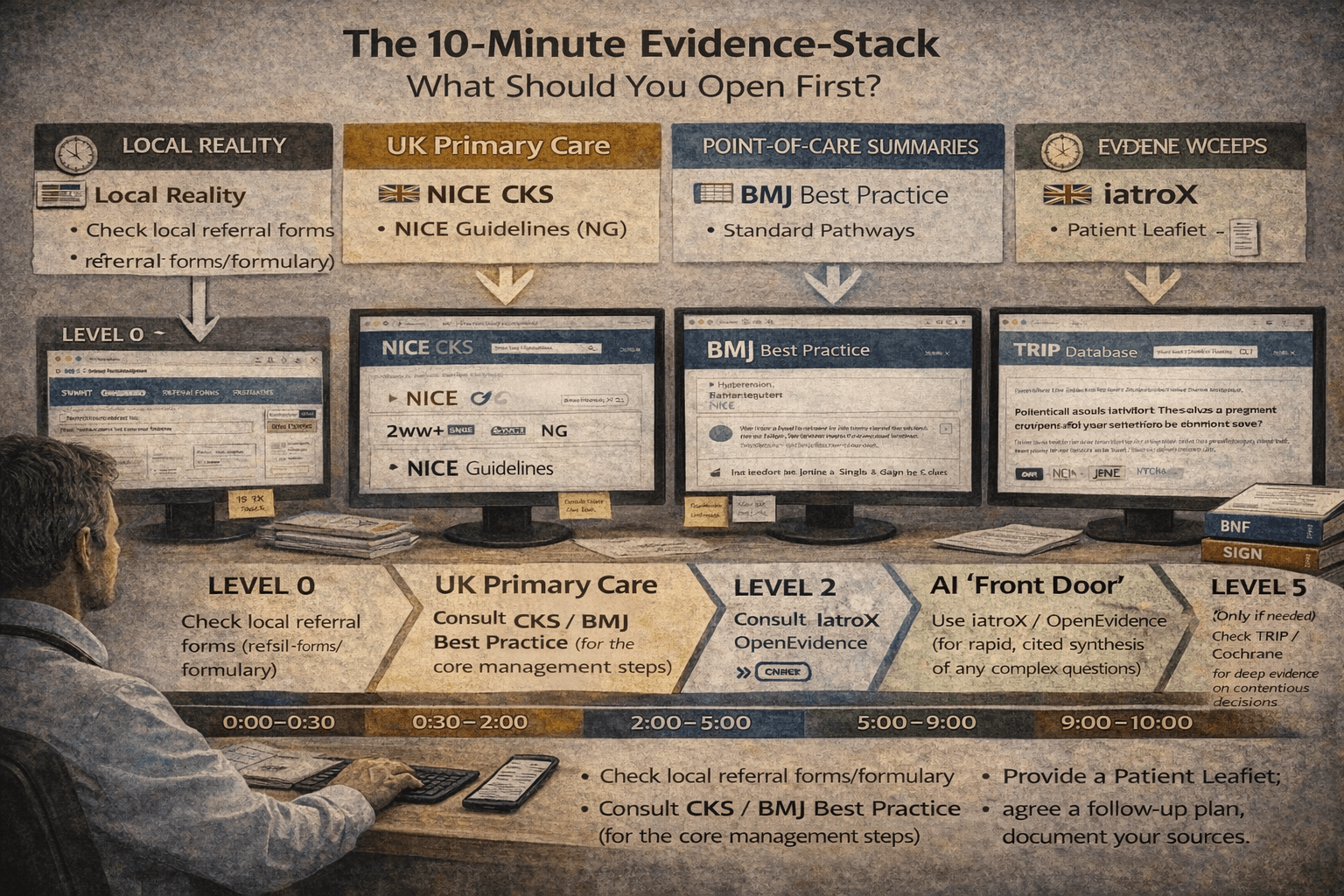
In a 10-minute consultation, speed without provenance is a risk. UK GPs need a repeatable, stress-tested workflow to find, verify, and apply clinical evidence without drowning in open tabs. This guide provides a practical "open this first" hierarchy for 2026.
We map out the three distinct layers of the stack: National Guidance (NICE/CKS) for policy and standards; Point-of-Care Summaries (BMJ Best Practice) for structured consultation support; and AI Front Doors (iatroX, OpenEvidence) for rapid retrieval and synthesis. By following this tiered approach—and using smart tools for patient communication and follow-up—you can make safer, evidence-based decisions in a fraction of the time.
Disclaimer: This is an information workflow guide, not clinical advice. Always follow local governance and use your professional judgement.
The problem: “I have 10 minutes, not 10 tabs”
The cognitive load of modern general practice is immense. Clinicians often waste valuable seconds navigating between disparate portals, searching for a specific guideline paragraph, or trying to reconcile conflicting advice. The goal of this "Evidence Stack" is to reduce that cognitive overload by giving you a clear, repeatable hierarchy for every clinical question.
Key principles:
- National guidance tells you what you should do.
- Point-of-care summaries tell you how to do it.
- AI tools help you find and combine the right source fast—provided citations remain visible.
The “open this first” hierarchy
Level 0 — Local reality (10–30 seconds)
Use when: You need to know referral routes, test availability, or local prescribing restrictions. Open first: Your local intranet, referral templates, or formulary (e.g., MicroGuide). Why: Local policy reflects commissioned services and funding. It is the operational reality you must work within.
Level 1 — UK primary-care default (30–90 seconds)
Use when: You are managing common presentations and need pragmatic management steps. Open first: NICE CKS. It is concise, open-access, and specifically written for primary care. Escalate to: The full NICE Guideline (NG) only when you need high-level policy context, evidence reviews for complex cases, or to check a Technology Appraisal (TA) funding mandate.
Decision Tree:
- "Common GP presentation?" → CKS
- "Complex pathway or commissioning decision?" → NICE Guidance
- "Conflicting or unclear?" → Step up to Level 2 or 3
Level 2 — Consultation-shaped summaries (60–120 seconds)
Use when: You need a structured "what to do next" guide that covers evaluation, treatment, and follow-up in one place. Open first: BMJ Best Practice. Why: It is structured around the patient journey. Its Comorbidities Manager is unique for tailoring plans to complex patients. It also includes patient leaflets and calculators, making it a powerful "all-in-one" tool. Access: Free for all NHS staff in England via OpenAthens or the NHS Knowledge & Library Hub.
Level 3 — AI front doors (2–4 minutes)
Use when: You are asking a specific question rather than browsing a topic. You want a cited synthesis of multiple sources.
- 3A) iatroX (UK-first point-of-care retrieval):
- Positioning: A free, independent, UK-centric AI assistant.
- Best for: Rapid "Ask" queries to find specific guidance in NICE, CKS, or the SmPC/emc. Use "Brainstorm" to explore differentials or 'what if' scenarios.
- Safety: It prioritises UK sources and shows citations clearly. If sources diverge (e.g., NICE vs European guidance), it aims to surface the conflict rather than blending it.
- 3B) OpenEvidence (Evidence orientation):
- Positioning: A literature-grounded search engine, free for verified US HCPs (access may be limited for UK users).
- Best for: Rapid orientation to the wider evidence base and key trials behind a guideline.
- 3C) ClinicalKey AI (Enterprise-grade):
- Positioning: Conversational AI over Elsevier's vast library.
- Best for: Deep, citation-linked summaries when your organisation holds a subscription.
Level 4 — Evidence search engines (4–8 minutes)
Use when: You need to confirm the primary evidence, check for a systematic review, or verify if a guideline is outdated. Open first:
- TRIP Database: The best clinical search engine for finding guidelines and systematic reviews quickly.
- Cochrane Library: The gold standard for systematic reviews of interventions.
- PubMed: For primary literature searches (use "Clinical Queries" filters).
GP Tip: If you have 2 minutes, look for a systematic review or guideline on TRIP. Only go to primary trials on PubMed if you have 10 minutes to critically appraise them.
Level 5 — Patient communication & follow-up planning (8–10 minutes)
The consultation isn't over until the patient understands the plan.
- Patient Leaflet: Use BMJ Best Practice or Patient.info to print or text a leaflet. Standardising this reduces re-consultation rates.
- Follow-up Plan: Document a clear "if... then..." safety net.
- Documentation: Use a micro-template: "Source checked (CKS/NICE/iatroX); Reason for deviation (local pathway); Safety netting given."
The 10-minute timeline
- 0:00–0:30: Check Local Reality (referral forms/formulary).
- 0:30–2:00: Consult CKS / BMJ Best Practice for the core management steps.
- 2:00–5:00: Use iatroX / OpenEvidence for a rapid, cited synthesis of any complex questions.
- 5:00–9:00: (Only if needed) Check TRIP / Cochrane for deep evidence on contentious decisions.
- 9:00–10:00: Provide a Patient Leaflet, agree a follow-up plan, and document your sources.
"Don't get fooled": common failure modes
- Automation Bias: Accepting the first plausible answer from an AI. Fix: Always click the citation.
- Jurisdiction Drift: Accidentally following a US or EU guideline. Fix: Use UK-centric tools like iatroX or CKS as your default.
- Local Mismatch: The guideline is right, but your system can't deliver it. Fix: Local policy always trumps national guidance for operational decisions (referrals/prescribing).
Prompt pack (copy/paste)
For iatroX (UK focus):
"Give a UK-first approach. Structure as: assessment → management → follow-up → safety netting. Include citations and note if any major guidance differs internationally."
For OpenEvidence / ClinicalKey AI (Evidence focus):
"Summarise the highest-level evidence (systematic reviews/guidelines) first. Then list key trials. Provide citations. Add a final section: 'UK pathway alignment to check'."
Which tool should I use? (Decision table)
| Question Type | Time Available | Open First | Second Check |
|---|---|---|---|
| Common GP Presentation | 1 min | NICE CKS | BMJ Best Practice |
| Complex Multimorbidity | 3 mins | BMJ Best Practice (+ Comorbidities) | Local Policy |
| Need Cited Synthesis | 2 mins | iatroX | OpenEvidence |
| Uncertain Evidence | 5 mins+ | TRIP / Cochrane | PubMed |
FAQ
- What is the best clinical guideline source for GPs in the UK?
- NICE CKS is the best starting point for routine primary care. NICE Guidelines provide the definitive evidence base.
- Is BMJ Best Practice free on the NHS?
- Yes, for all NHS staff in England. Access it via the NHS Knowledge & Library Hub with your OpenAthens login.
- Is OpenEvidence available in the UK?
- It is marketed as free for verified US HCPs. UK access may be limited or require manual verification.
- What is TRIP and when should I use it?
- TRIP is a clinical search engine. Use it to quickly find high-quality evidence like guidelines and systematic reviews that might be buried in a Google search.