In 2026, the app store for doctors is a confusing place. Every tool claims to be an "AI Copilot," "Answer Engine," or "Digital Brain."
The problem is that we are trying to compare apples, oranges, and spanners. Comparing Eolas Medical to UpToDate is like comparing your hospital intranet to a medical textbook. They are both useful, but if you look for a drug dose in the intranet or a rota on the textbook, you’re going to have a bad time.
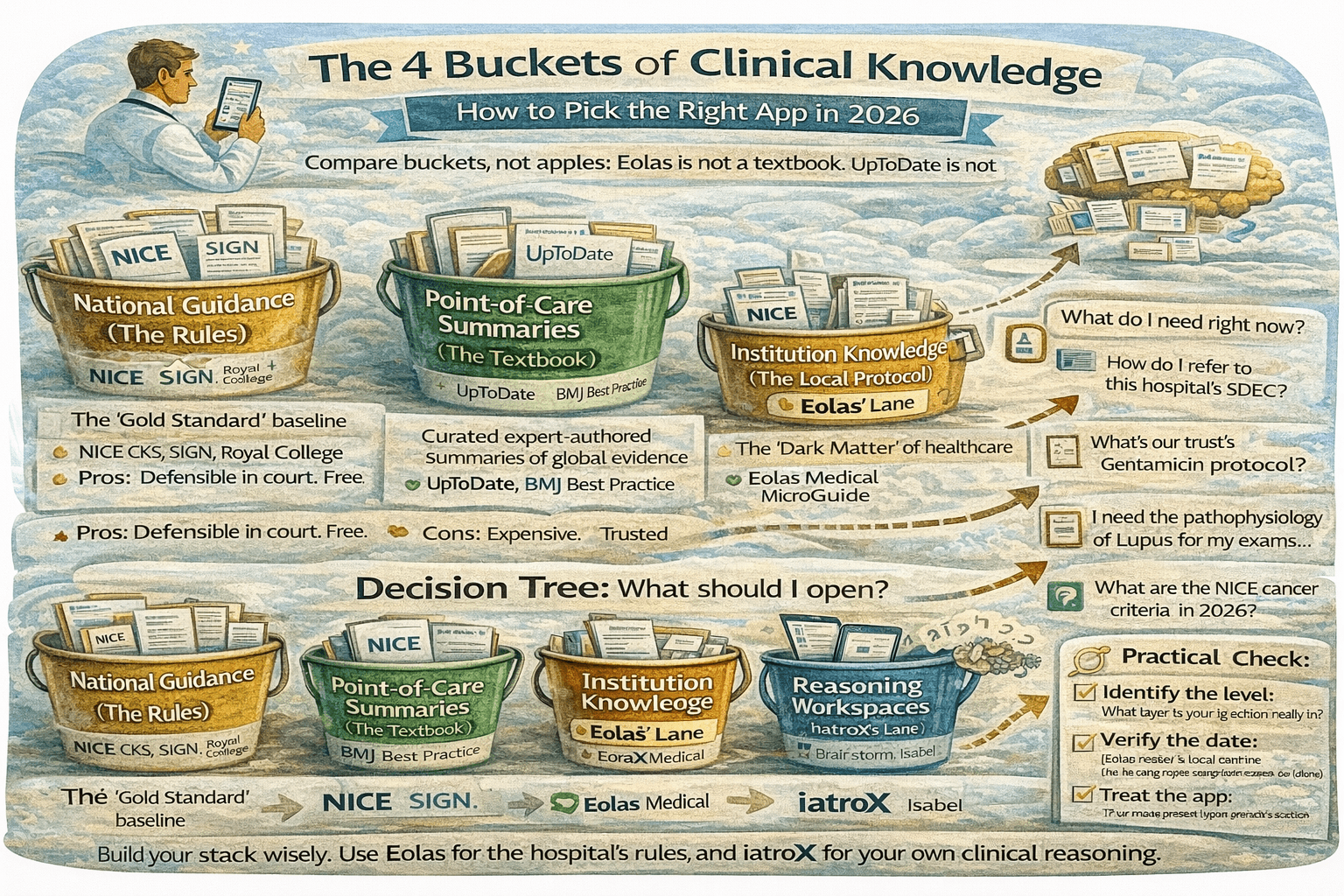
To choose the right tool, you need to understand the 4 Buckets of Clinical Knowledge.
The 4 Buckets Model
Stop asking "Which app is best?" and start asking "Which layer of knowledge do I need?"
1. National Guidance (The Rules)
- What it is: The "Gold Standard" baseline. Public, static, legally robust.
- Examples: NICE CKS, SIGN, Royal College Guidelines.
- Pros: Defensible in court. Free.
- Cons: Dense. Slow to read. "Treat sepsis fast" is easy to read; "How do I refer to this hospital's SDEC?" is missing.
2. Point-of-Care Summaries (The Textbook)
- What it is: Curated, expert-authored summaries of global evidence.
- Examples: UpToDate, BMJ Best Practice.
- Pros: Comprehensive. Trusted.
- Cons: Expensive. Can be too academic for a 3 AM ward cover shift. Doesn't know your local antibiotic code.
3. Institution Knowledge (The Local Protocol) — Eolas’ Lane
- What it is: The "Dark Matter" of healthcare. The stuff that used to be on a laminated poster or a WhatsApp group.
- Examples: Eolas Medical, MicroGuide.
- Pros: Tells you how to do it here. (e.g., "Which bleep is the med reg?" "What is the login for the cupboard?").
- Cons: Only as good as the person maintaining it. If your Trust hasn't uploaded the file, Eolas can't find it.
4. Reasoning Workspaces (The Thinking) — iatroX’s Lane
- What it is: The "Second Brain." A tool to help you structure the messy, undifferentiated patient before you find the guideline.
- Examples: iatroX Brainstorm, Isabel.
- Pros: Interactive. Helps with "I don't know what I'm looking for yet." Generates differentials and discriminators.
- Cons: Not a replacement for the primary source; it’s a bridge to it.
Eolas in one paragraph
Eolas Medical is optimised for Organisational Memory. It shines when your problem is logistical or protocol-based. Use it to find the local version of the truth: the specific induction pack for your rotation, the Trust-approved pathway for DVT, or the phone number for the on-call team. It is essentially a "Team Brain" that replaces the chaotic shared drive.
iatroX in one paragraph
iatroX is optimised for Clinical Cognition. It shines when your problem is uncertain or requires synthesis. Use Brainstorm to walk through a complex case ("45M with chest pain and weird rash"), generate a differential, and find the discriminating questions. Use Ask iatroX to instantly retrieve referenced answers from national guidance (NICE/CKS) when you need to verify a decision quickly.
Decision Tree: What should I open?
- "I need the bleep number for the Gastro Reg."
- 👉 Open Eolas (or MicroGuide).
- "I need to check the exact dose of Gentamicin for a patient with eGFR 20."
- 👉 Open BNF or Eolas (if your Trust has a specific renal calculator).
- "I have a patient with fatigue, weight loss, and hypocalcaemia, and I don't know where to start."
- 👉 Open iatroX Brainstorm (Reasoning).
- "I need to read the full pathophysiology of Lupus for my exam."
- 👉 Open UpToDate or iatroX Q-Bank (Learning).
- "I need to know the NICE criteria for referring suspected cancer in 2026."
- 👉 Open Ask iatroX (Retrieval).
Common Pitfalls
Confusing “Answer Engines” with “Diagnostic Engines”
iatroX and Eolas help you find the answer. They do not diagnose the patient for you. Never type "Does this patient have cancer?" into an app. Type "What are the red flags for cancer in this demographic?"
Ignoring Governance
Just because an app is on the App Store doesn't mean it's safe for NHS data.
- Safe: "45M with chest pain." (De-identified).
- Unsafe: "John Smith, NHS Number 12345." (Never put this in a cloud tool unless it is part of your Trust's sanctioned EPR).
A ‘Safe Use’ Mini-Checklist
Before you rely on any tool for a clinical decision, check the Procurement Baseline:
- DTAC / UKCA: Does the app meet the NHS Digital Technology Assessment Criteria or have a UKCA medical device mark? (Hint: iatroX is a Class I UKCA marked device).
- Citation: Does the answer link to a source you recognise (NICE, BNF, Local Trust Policy)?
- Timestamp: Is the source from this decade?
Build your stack wisely. Use Eolas for the hospital's rules, and iatroX for your own clinical reasoning.