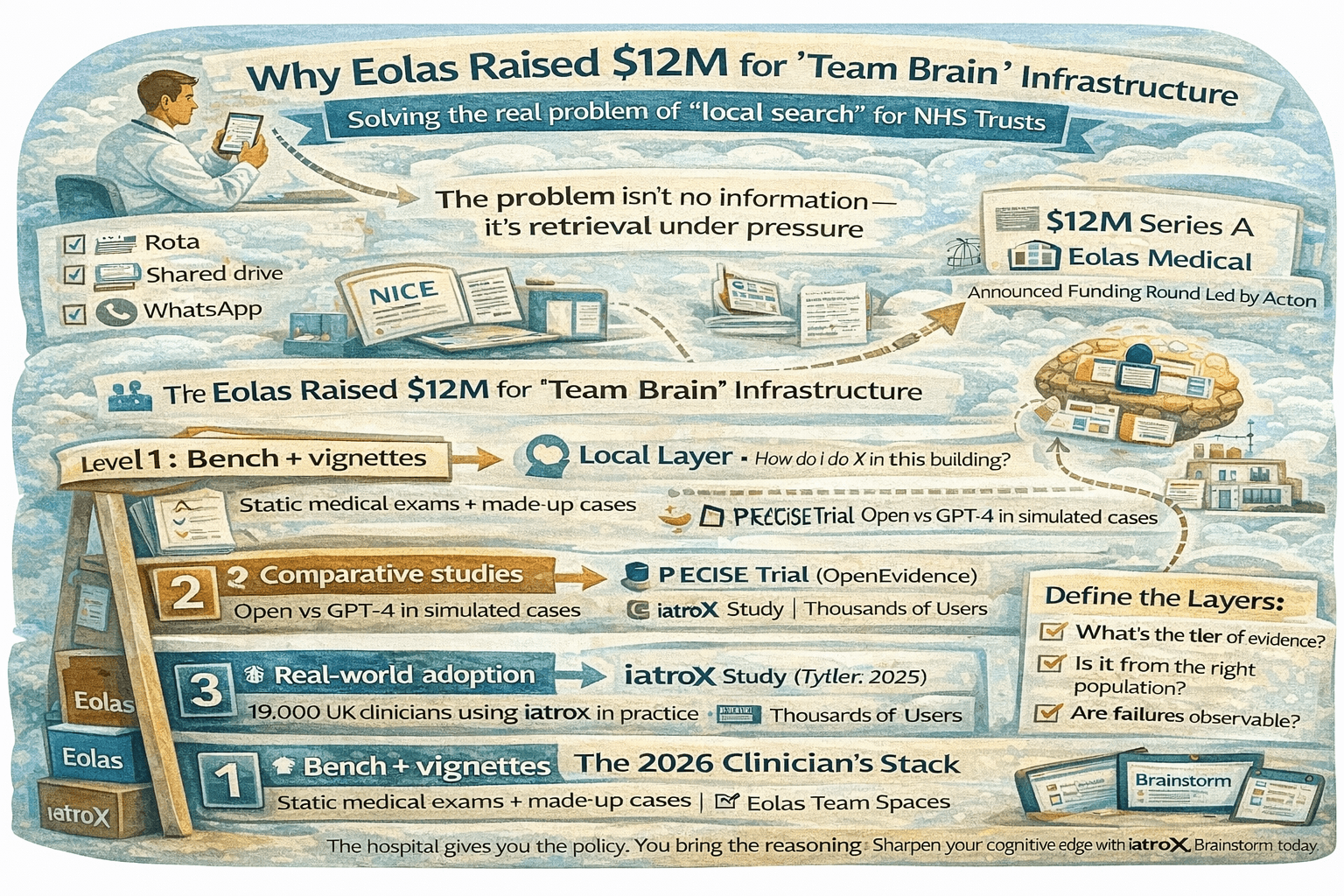
Yesterday, Belfast-based Eolas Medical announced a $12M Series A raise led by Acton Capital.
For the tech press, this is a story about a Northern Irish startup scaling globally. But for the NHS clinician on a Tuesday morning ward round, this is a story about something far more painful: Search.
Investors are not betting $12M on another PDF viewer. They are betting on a fundamental shift in how hospitals manage their "Collective Brain." They are betting that the era of the dusty SharePoint intranet is over, and the era of Clinical Knowledge Infrastructure has arrived.
The real problem: “It’s not lack of information — it’s retrieval under pressure”
If you ask a Foundation Doctor why they feel unsafe on a new rotation, they rarely say, "I don't know the medicine." They say, "I don't know how things are done here."
Medicine has a "Last Mile" problem.
- We know the national guideline (NICE says "Treat Sepsis fast").
- We don't know the local implementation ("Which antibiotic does this Trust use for community-acquired pneumonia, and where is the code for the cupboard?").
This information is usually buried in a shared drive, a Whatsapp group, or a laminated poster that was taken down three months ago. Eolas’ pitch—and the reason they are now in 85% of NHS acute trusts—is that they index this "local dark data" and put it on the clinician's phone.
Define the category: The 3 Layers of Truth
To understand where this funding is going, we need to distinguish between the three layers of clinical knowledge.
- National Guidance (The "What"): NICE, SIGN, Royal College guidelines. These are public, static, and high-level.
- Local Policy (The "How"): Trust MicroGuides, rotas, bleep numbers, referral pathways. This is institution-specific and highly volatile.
- Point-of-Care Synthesis (The "Why"): The reasoning process that connects the two to the patient in front of you.
What Eolas is built for: The “Team Brain”
Eolas dominates the Local Policy layer. Its architecture is built around "Team Spaces."
- The Claim: A single, searchable source of truth for the institution.
- The Value: It allows a Trust to push a new "Winter Pressure Discharge Protocol" to every junior doctor's phone instantly.
- The Tech: Their new funding is earmarked for "Agentic Document Extraction"—using AI to read those thousands of messy PDFs and turn them into structured answers, rather than just search results.
Where individual clinicians still struggle
However, even with the best institutional intranet, the individual clinician has a gap.
Eolas tells you what the policy is. It doesn't necessarily help you reason through the case when the patient doesn't fit the policy.
- Eolas answers: "What is the antibiotic for UTI in this hospital?"
- It doesn't answer: "This patient has a UTI but is allergic to the first-line antibiotic and has complex renal failure—how should I think about the risk/benefit of the second line?"
This is the difference between Retrieval (finding a document) and Reasoning (solving a problem).
Where iatroX fits: The “Second Screen” for Reasoning
In 2026, the modern clinician needs a "Second Screen" that sits alongside the institutional app. This is where iatroX fits.
While Eolas manages the Trust's knowledge, iatroX supports the Clinician's cognition.
- Ask iatroX: Use this to retrieve the broader evidence base (Cochrane, NICE CKS) when the local policy is silent.
- Brainstorm: Use this to structure your thinking for the complex, undifferentiated patient before you even look up the policy.
- UK Q-Bank: Use this to reinforce your core knowledge so you rely less on looking things up in the first place.
Practical takeaways: The 3-layer stack
Don't choose one tool. Build a stack that covers all your bases.
The 2026 Clinician's Stack
- Local Layer (Eolas/MicroGuide): "How do I do X in this building?" (Referrals, Drugs, Rotas).
- National Layer (NICE/BNF): "What is the gold standard?" (Baseline safety).
- Reasoning Layer (iatroX): "What am I missing?" (Differential diagnosis, critical appraisal, case structuring).
The hospital gives you the policy. You bring the reasoning. sharpen your cognitive edge with iatroX Brainstorm today.