Executive summary
For busy UK clinicians, Continuing Professional Development (CPD) can often feel like an administrative burden rather than a meaningful learning opportunity. The good news is that the regulatory landscape, led by the GMC and RCGP, has decisively shifted to favour the quality of reflection over the simple quantity of hours logged. This change opens the door for a smarter, more efficient approach to learning (GMC UK, rcgp.org.uk).
The most effective strategies in 2025 leverage microlearning and spaced repetition to turn "dead time" into valuable, evidence-based learning that actually sticks (PMC, jmir.org). The key is to pair these small learning bursts with "log-while-working" tools that capture your evidence at the point of care. Platforms like the iatroX CPD logger, the Physicians’ CPD app, FourteenFish, and Agilio Clarity are all designed to make this "capture and reflect" process seamless, helping you build a high-quality appraisal portfolio with minimal administrative effort.
CPD landscape in 2025: appraisal reality vs College schemes
It's essential to understand what is actually required for your appraisal and revalidation.
- GMC position (revalidation): The GMC does not mandate a fixed number of hours or credits. Its guidance focuses on a simple cycle: plan, do, reflect, and discuss. You must bring sufficient, relevant supporting information to your appraisal that covers your whole scope of work (GMC UK).
- AoMRC & College conventions: The Academy of Medical Royal Colleges (AoMRC) also de-emphasises credit-counting. However, many individual colleges (like the RCS and RCPath) still publish numeric guidance as a benchmark (e.g., ~50 credits per year). For most GPs, the "1 hour ≈ 1 credit" convention is still a useful guide, but the reflection is what gives it value (AOMRC, NHS England).
High-yield activity types that maximise CPD per minute
- Targeted e-learning via NHS e-LfH: As an NHS professional, you have free 24/7 access to a vast catalogue of modules on e-Learning for Healthcare (e-LfH), all of which provide certificates and track your progress.
- Live webinars with instant certificates: Platforms like MedAll host thousands of free webinars, many of which are CPD-accredited and provide an instant certificate, making it easy to log participatory learning hours.
- Evidence look-ups (you’re doing them anyway): The clinical questions you look up during your workday are high-impact CPD. The key is to capture them. Using a tool that lets you log a guideline search as a reflective entry is the most efficient CPD you can do.
Microlearning & spaced education: learn in the flow of work
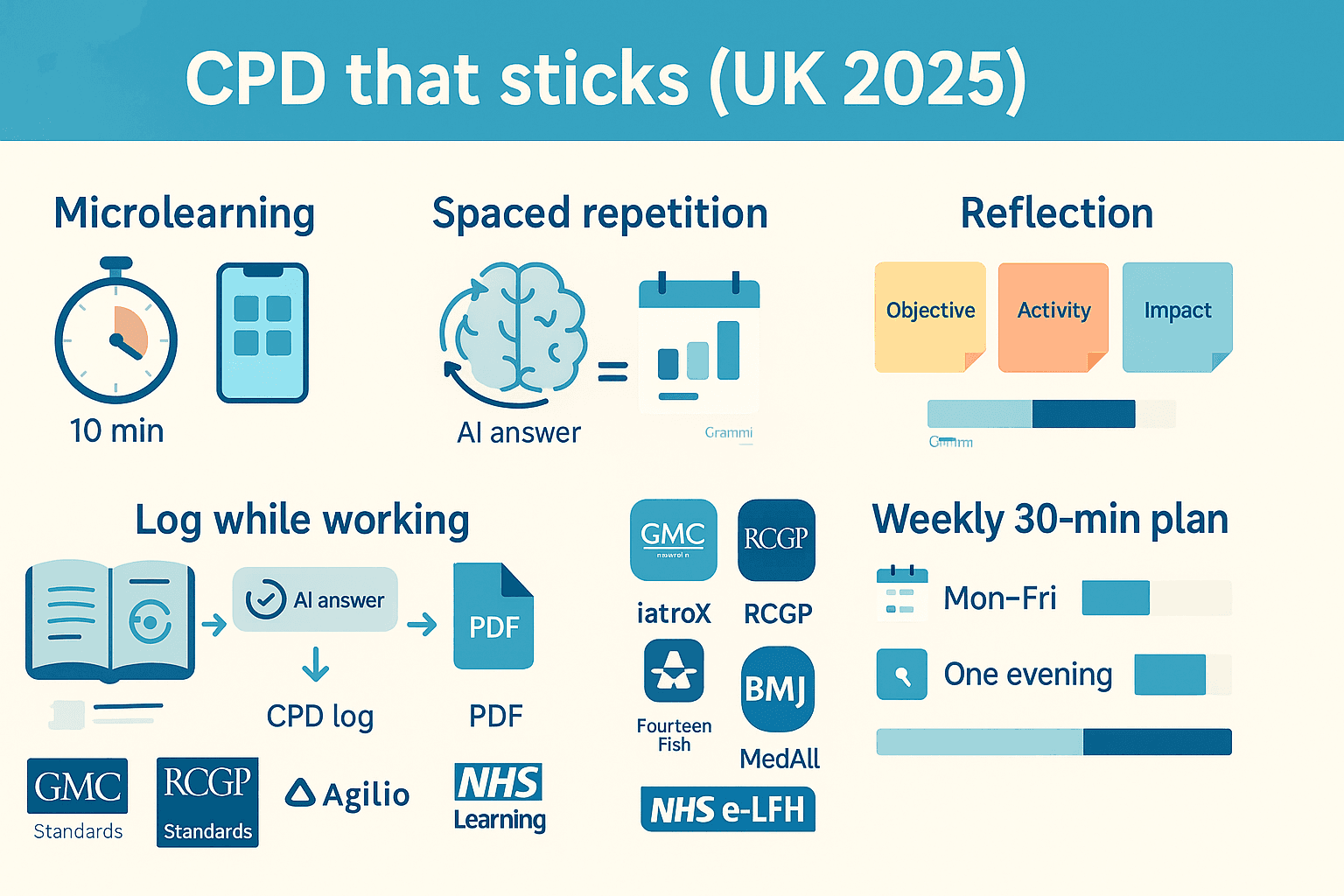
The science is clear: microlearning (short, 5-10 minute focused bursts of learning) improves knowledge uptake and confidence, as it fits seamlessly into busy clinical schedules (PMC).
This is even more powerful when combined with spaced repetition. Research shows that spaced digital education, where concepts are revisited at increasing intervals, leads to more durable, long-term knowledge retention than "cramming" for a single session (jmir.org). For a clinician, this means a 10-minute daily quiz on your commute is more effective than a four-hour reading session once a month.
“Log while working” toolstack (UK-ready)
iatroX CPD (free)
- What it is: A free, integrated tool within the iatroX app designed to capture learning at the point of discovery. You can turn an Ask iatroX clinical query into a CPD entry with a single click. It features AI-assisted reflection prompts to help you structure your thoughts and a one-click PDF export to generate a professional report for your appraisal.
- How it fits: Use the iatroX Knowledge Centre or Ask feature to get a fast, cited answer from UK-accepted guidance, then immediately save that learning moment to your CPD log before you forget.
Physicians’ CPD (Federation of RCPs)
- What it is: A dedicated mobile app and diary from the Federation of Royal Colleges of Physicians. Its stand-out feature is the ability to capture reflections on the go using voice transcription, making it very fast to use.
FourteenFish Portfolio
- What it is: A widely-used platform for GP appraisal. Its Portfolio mobile app is excellent for adding learning logs, photos of certificates, and other evidence on the move. It also features a popular "email-to-diary" function.
Agilio Clarity (Doctors)
- What it is: The market-leading appraisal toolkit, deeply integrated with the wider Agilio ecosystem (like TeamNet). Its AMP app allows clinicians to log CPD and link learning resources from their phone.
MedAll
- What it is: A go-to platform for finding thousands of free live and on-demand webinars, virtual conferences, and courses. It automatically logs all your attendance and provides instant, downloadable CPD certificates.
BMJ Learning & RCGP eLearning
- What it is: These platforms offer a vast library of peer-reviewed, structured modules. They are ideal for deeper dives into specific topics and provide robust certificates as evidence.
Reflection made simple (and faster)
For your appraisal, a long, rambling essay is less valuable than a concise, structured reflection. Use this simple 3-step mini-template, which aligns with GMC and AoMRC expectations:
- Objective: What was the trigger or question? (e.g., "A patient asked about X," "A query from an iatroX Quiz question").
- Activity: What did you do? (e.g., "Attended MedAll webinar," "Read NICE CKS page," "Used Ask iatroX to find guideline").
- Impact: What will you change? (e.g., "I will now use drug Y first-line for this," "I have updated our practice template").
You can exploit your tools to make this even faster: use voice dictation in the Physicians’ CPD app, use the mobile capture in FourteenFish or Clarity right after a clinic, or use the AI-assisted reflection prompts in iatroX to structure your thoughts from a Q&A.
30-minute weekly system
- Mon–Fri (5-7 mins/day): Use this "dead time" for one microlearning activity. For example, a 5-minute adaptive quiz on iatroX or a single bite-sized module on e-LfH. Log any significant learning point.
- One evening (20-25 mins): Attend one live MedAll webinar or complete one BMJ Learning module that aligns with your PDP.
- Result: You will have generated a steady stream of high-quality, reflective CPD entries with minimal administrative time and a strong evidence trail for your appraiser.
FAQs
- Do I still need 50 hours of CPD?
- The GMC does not mandate a fixed number of hours for your appraisal; it focuses on the quality of your reflection and its relevance to your scope of practice. However, your Royal College (e.g., RCS/RCPath) may still provide a numeric guide (like 50 credits/year) as a benchmark.
- Can I claim CPD for a quick guideline look-up?
- Yes, absolutely. A search that changes your practice is one of the most high-impact forms of CPD. The key is to capture it. Use a tool like the iatroX CPD logger to save the query, add a 3-line reflection on its impact, and it becomes a perfect, auditable entry.
- What are the best free sources for CPD?
- The most powerful free combination for UK clinicians is NHS e-LfH (for its vast module library), MedAll (for its thousands of free certified webinars), and iatroX (for its free adaptive quiz and CPD logging features).