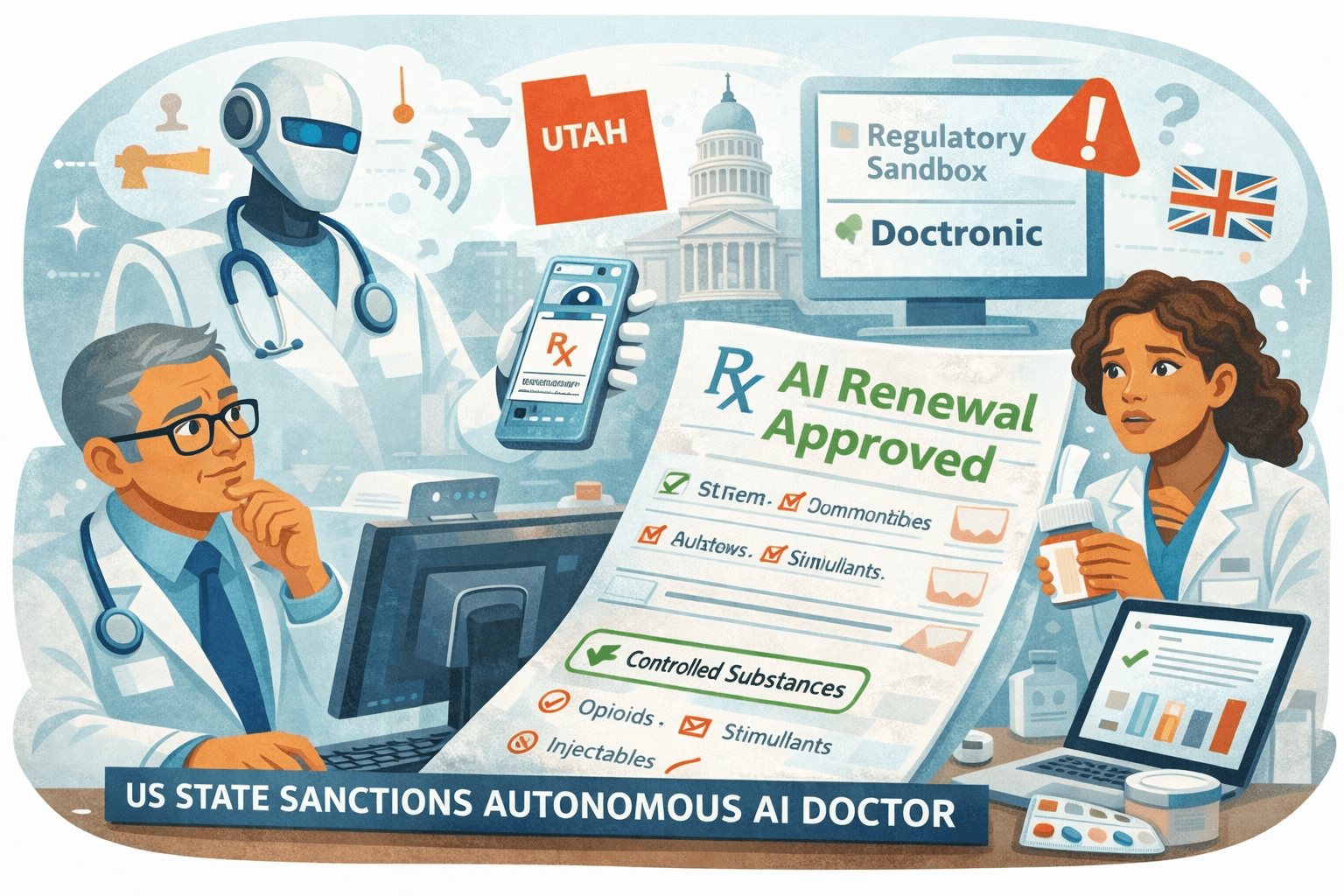
For years, the debate about "AI Doctors" has been theoretical. As of this month, it is legal practice.
The Utah Department of Commerce has announced a partnership with Doctronic to launch the first state-sanctioned pilot where an AI system can autonomously renew prescriptions without a human doctor signing the script.
This is the moment "AI advice" crosses into "AI action." While this is happening 4,000 miles away, the precedent it sets for automation, liability, and patient expectation will ripple into UK General Practice faster than you think.
What happened (facts only)
On January 6, 2026, Utah’s Office of Artificial Intelligence Policy approved Doctronic to operate within its "Regulatory Sandbox."
- The Scope: The AI is authorised to approve routine renewals for chronic conditions (e.g., hypertension, diabetes, hypothyroidism). It is not for new prescriptions.
- The Formulary: It covers roughly 190 common maintenance medications (statins, birth control, SSRIs). It explicitly excludes controlled substances (opioids, stimulants) and injectables.
- The Workflow: The AI verifies the patient's identity (via ID/selfie), checks adherence history, screens for red flags, and issues the renewal directly to the pharmacy.
- The Safeguards: The pilot requires the first 250 decisions in each drug class to be double-checked by a human clinician. Additionally, Doctronic carries malpractice insurance that specifically covers the AI's decisions—a regulatory first.
Callout: "This is about renewals, not new prescribing." The pilot is strictly limited to patients stable on therapy. It is an automation of the "repeat prescription" stack, not the diagnostic stack.
Why clinicians are split (support vs critique)
The medical community in the US is currently divided into two vocal camps.
The Support Argument (Access & Efficiency): Proponents argue that 80% of medication activity is routine refills. Automating this reduces the "admin tax" on physicians and prevents patients from running out of insulin because they couldn't get a GP appointment. They see it as "unblocking" access.
The Critique Argument (Safety & Fragmentation): Critics, including the AMA, argue that an AI lacks the "clinical intuition" to spot the subtle reason not to renew (e.g., a patient renewing a beta-blocker who mentions "feeling dizzy" in passing). They worry that removing the "human speed bump" will lead to medication errors at scale and that the "human-in-the-loop" safeguards will erode over time.
The UK lens: what would need to be true here?
Could this happen in the NHS? Not anytime soon. The regulatory gap is massive.
For a "Doctronic-style" pilot to launch in the UK, three things would need to change:
- Governance Thresholds: The MHRA would need to classify the AI not just as a medical device (Software as a Medical Device), but as an entity capable of "independent prescribing." Currently, prescribing rights are tied to people (HCPs), not software.
- Liability Reform: Who is sued if the AI renews a drug that causes harm? In Utah, Doctronic has bought insurance for the AI. In the UK, our indemnity models (CNSGP/MPS) are built around individual professional liability.
- Integration Realities: In Utah, this is a direct-to-consumer service. In the UK, "repeat dispensing" (eRD) is managed via the Spine and the GP record. An AI would need write-access to the patient's EMIS/SystmOne record to be safe—a huge integration hurdle.
What changes for UK GPs today
Even without a UK pilot, your patients read the news. Expect three immediate shifts:
- "Computer Says Yes" Pressure: Patients will question why you need to "review" their statin when "in America, the AI just does it." The expectation of friction-free renewal will rise.
- AI-Influenced Adherence: Patients may use Doctronic (via VPN or US accounts) to "check" their meds and stop taking them based on AI advice, before they even speak to you.
- Documentation Load: You will need to be more explicit in your notes about why you are refusing a renewal, as you are now competing against an algorithmic opinion that says "it's fine."
Where iatroX sits in this landscape (safe and defensible)
At iatroX, we watch these pilots with interest, but we stay in our lane.
iatroX is not a prescriber. We do not want to be.
- Brainstorm is designed to help you decide whether to renew. It surfaces the Red Flags and Monitoring Requirements (e.g., "Has U&E been checked in the last 12 months?") so you can click "Approve" with confidence.
- Ask iatroX allows you to verify the guideline changes (e.g., "What is the new target BP for over-80s?") in seconds.
We automate the safety check, not the signature.
Practical Step: If a patient demands a renewal based on an AI recommendation, use Brainstorm to run a quick safety pass: "Check monitoring requirements for [Drug X].". If a test is overdue, you have a defensible, safety-critical reason to pause.
FAQ
What exactly did Utah permit and under what oversight? Utah authorised Doctronic to autonomously renew prescriptions for ~190 common maintenance drugs under a regulatory sandbox. Safeguards include human review of the first 250 cases per drug class and specific malpractice insurance for the AI.
Could anything similar happen in the UK? Unlikely in the near future. UK prescribing laws tie authority to human professionals, and the MHRA has no current framework for "autonomous AI prescribers."
Should UK clinicians treat AI outputs as medical advice? No. Treat them as patient-supplied information. You remain professionally responsible for any prescription you sign, regardless of what an AI advised the patient.
Keep your prescribing safe, not just fast. Use Brainstorm to check the safety parameters before you sign.