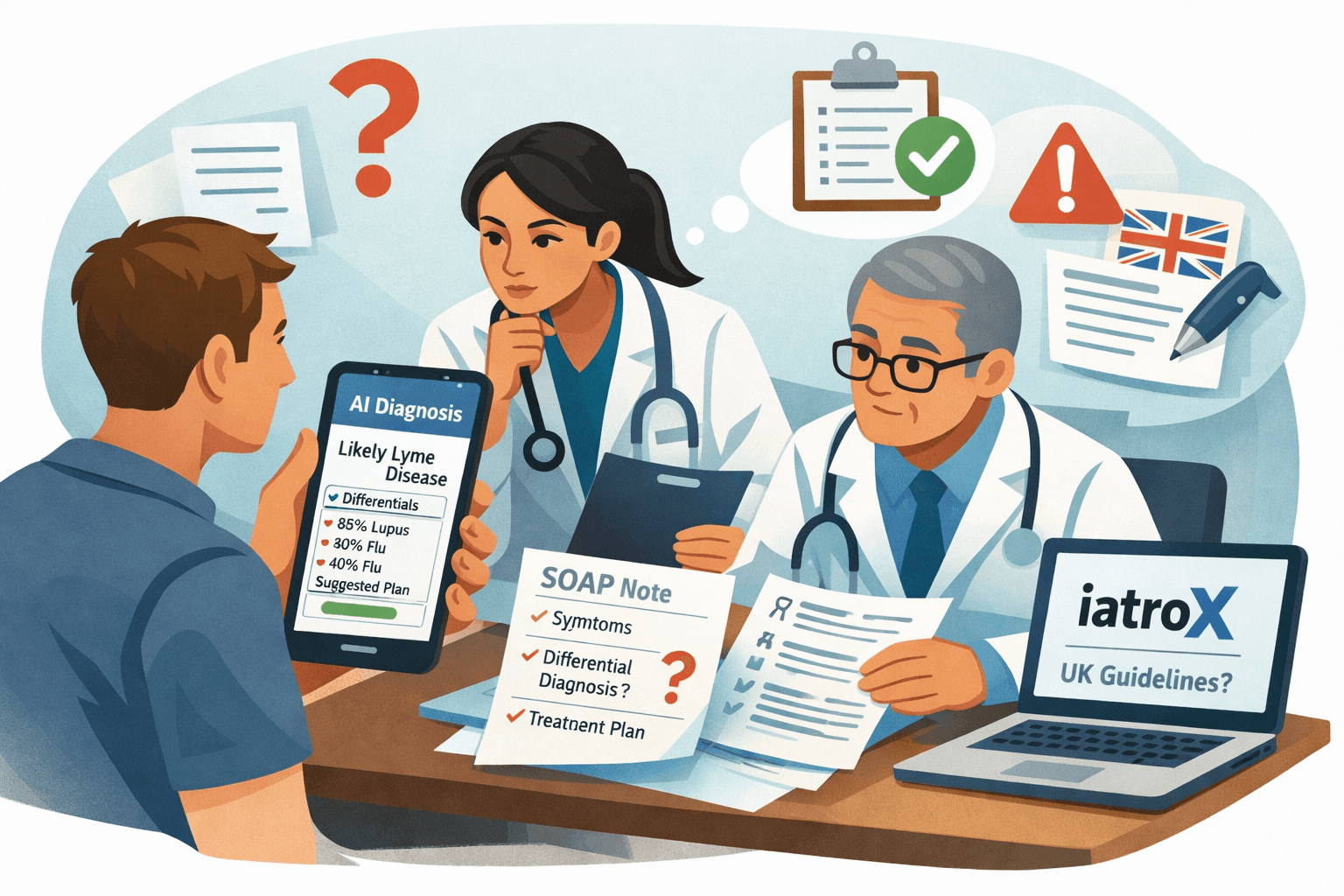
You have likely already seen it, even if you didn’t know the name. A patient sits down, places their phone on the desk, and presents a perfectly formatted history, a list of three differential diagnoses with percentages, and a suggested management plan.
"The AI doctor says it's likely Lyme disease," they tell you.
The tool is probably Doctronic. It is one of the most prominent "AI Doctors" on the market, positioning itself as an always-on primary care provider. Unlike simple symptom checkers of the past, Doctronic doesn't just triage; it attempts to consult.
The point of this article is not to dunk on it—patients find it genuinely useful. Instead, this is a guide to help UK clinicians triage the output safely, reduce anchoring bias, and protect your consultation flow.
What Doctronic actually is (plain English)
Doctronic is a US-based AI health platform that mimics the full consultation arc.
- AI Intake: The user chats with an AI about their symptoms.
- Output: It generates "possible diagnoses" (often with probability percentages) and "likely treatment plans."
- The Artifact: Crucially, it produces a SOAP Note (Subjective, Objective, Assessment, Plan) formatted specifically for a doctor to read.
- Escalation: Users can pay (approx. $39) for an instant video visit with a licensed US physician to get a prescription.
What this means for UK practice While the $39 video visit is a US service (and the prescriptions are valid there), the Free AI Chat is available globally. UK patients are using it as a "pre-consultation" tool to organise their thoughts and "check" their symptoms before they see you.
What it explicitly is not (read the disclaimers)
Despite the "AI Doctor" branding, the fine print is rigorous.
- Not Medical Advice: Doctronic’s Terms explicitly state it is not a physician and does not provide medical advice. All outputs should be discussed with a qualified provider.
- Data Privacy: Doctronic’s privacy notice references HIPAA and TEFCA compliance (US standards). While this indicates a serious approach to data security, UK clinicians should remember that this is US-hosted data, not an NHS-compliant record.
The practical strengths (why patients like it)
It is easy to dismiss these tools, but patients use them because they solve real problems:
- Frictionless Intake: It feels like a structured, empathetic triage interview, not a cold search bar.
- Narrative Clarity: It converts the patient’s "messy" internal monologue ("I feel a bit hot and my leg hurts") into a structured narrative ("Acute onset fever with localized calf pain").
- Action Orientation: It doesn't just say "See a doctor"; it gives a reason and a plan, which feels empowering.
- Availability: It answers at 3 AM on a Sunday when 111 is busy.
The clinical risks (UK clinician lens)
When a patient hands you a Doctronic SOAP note, watch out for these failure modes:
- Anchoring Bias: The patient arrives convinced they have the #1 diagnosis on the list (e.g., "It says 85% probability of Lupus"). It takes significant cognitive energy to un-anchor them.
- False Reassurance/Urgency: The algorithms are often tuned for US liability. It might suggest "Urgent Care" for a condition the NHS manages with "Self-care," or vice-versa.
- Context Loss: An AI summary creates a coherent story, sometimes at the expense of truth. It might edit out the subtle "red flag" remark the patient made because it didn't fit the AI's hypothesis.
- Jurisdiction Mismatch: The "Likely Treatment Plan" will reference US guidelines and drug names (e.g., Albuterol instead of Salbutamol, or antibiotics not first-line in the BNF).
The Rule: Treat Doctronic output as "Patient-Supplied Information"—equivalent to them writing notes on a piece of paper. It is a summary of their concerns, not a clinical referral.
Doctronic vs iatroX: they solve different problems
It is helpful to view these tools as sitting on opposite sides of the desk.
- Doctronic (The Patient's Tool):
- Goal: Narrative formation and reassurance.
- Output: A patient story and a suggestion of diagnosis.
- Logic: Consumer-first, US-centric.
- iatroX (The Clinician's Tool):
- Goal: Clinical reasoning and verification.
- Output: A Brainstorm of differentials and discriminating questions.
- Logic: Clinician-first, UK-grounded (NICE/CKS).
The distinction: Doctronic shapes the patient story. iatroX helps the clinician interrogate it.
A safe consultation workflow when a patient brings Doctronic output
Do not fight the technology. Use this workflow to regain control.
Step 1 (20s): Acknowledge "Thanks for showing me that summary—it’s really helpful to see what you’re worried about. Let’s use this as a starting point, and I’ll ask my own questions to fill in the gaps."
Step 2 (60–90s): Extract the problem representation Scan the SOAP note for the timeline and function, but re-take the history to check for red flags the AI might have smoothed over.
Step 3 (2 mins): Run discriminators Ask the 4–6 questions that actually change the management. This demonstrates that you are checking the AI's homework, not just copying it.
Step 4 (30–60s): Use iatroX Brainstorm (Optional) If the AI has suggested a plausible but rare diagnosis, use iatroX Brainstorm as your cognitive forcing function.
- Prompt: "Patient suggests [Rare Condition]. Give me 3 discriminating questions to rule this out vs [Common Condition]."
- This keeps you accountable for the exclusion.
Step 5: Verify decision-critical bits Use Ask iatroX to check the UK-specific management.
- "Doctronic suggests Doxycycline, but let me check the local NICE guidelines for your age group."
Step 6: Document the bridge
"Patient attended with AI-generated SOAP note. Clinical history re-taken. Exam normal. AI suggestions reviewed but ruled out based on [Clinical Findings]. Plan as per NICE CKS."
FAQ
Is Doctronic available in the UK? Yes, the web and app interface is available globally. While the paid "speak to a doctor" feature connects to US physicians, the AI chat and SOAP note generation are accessible to UK patients.
Does Doctronic provide medical advice? No. Its terms explicitly state it provides information for educational purposes and is not a substitute for professional medical advice.
What is the Doctronic SOAP note and should clinicians trust it? It is a summary of the patient's chat formatted into Subjective, Objective, Assessment, and Plan sections. Clinicians should trust it only as an accurate record of what the patient told the AI, not as an objective clinical finding.
What’s a safer clinician workflow if patients use AI doctors? Use the AI output to set the agenda, but perform your own independent history and exam. Use a clinician-facing tool like iatroX to verify differentials and guidelines, ensuring your decision is grounded in UK standards.
If your patients are using AI to prepare, you need the right tools to respond. Use iatroX to verify, reason, and decide with confidence.