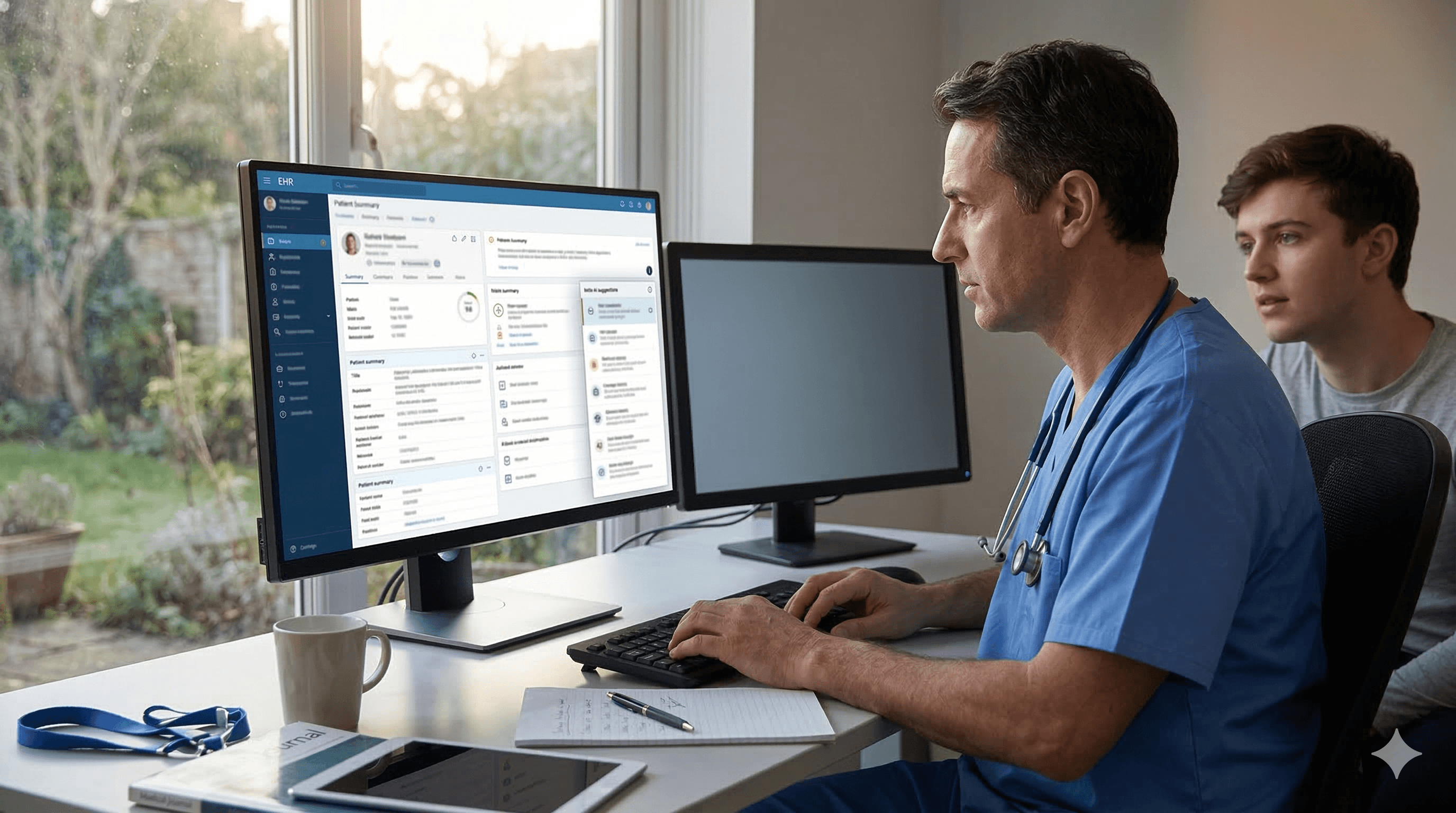
Today, many clinicians still use diagnostic AI as something slightly external to the real workflow. They open a separate tab, type in a symptom cluster, glance at the output, and then return to the record. That visible separation matters more than it seems. It reminds the user that they are consulting an adjunct, not receiving native guidance from the core clinical environment.
That boundary may not last.
This is no longer a purely hypothetical question. DxGPT’s current public materials now explicitly describe API access, structured diagnostic suggestions, integration into EHRs, apps, and patient portals, multilingual support, and a developer portal. At the same time, AHRQ’s recent summary of AI-supported clinical decision support notes that these tools are already used by clinicians in EHRs and by patients in portals and apps.
In other words, diagnostic AI is moving from “interesting website” territory toward workflow infrastructure.
That shift matters because embedded diagnostic AI is not just the same product with a better front end. Once suggestions appear inside the record, the nature of trust changes. The cognitive friction changes. The audit problem changes. And the line between “my reasoning” and “the system’s influence on my reasoning” becomes harder to see.
This is the real design challenge now. Clinical AI may well reduce friction. But if it hides reasoning while doing so, the bargain becomes more dangerous.
Why this is becoming plausible
The old mental model of diagnostic AI was browser-based and episodic. A clinician had to remember the tool existed, open it deliberately, enter enough context, and interpret the result outside the native workflow. That model limited use, but it also limited dependence.
The new model is more infrastructural. DxGPT’s public integration and API materials now advertise exactly the kind of capabilities that make embedded deployment realistic:
- natural-language clinical input
- structured diagnostic suggestions
- follow-up questions
- clinical summaries
- multilingual support
- integration into EHRs, apps, and patient portals
Its developer portal reinforces that this is not only a consumer-facing website story but an implementation story.
AHRQ’s framing makes the broader context even clearer. Clinical decision support is already used in EHRs, patient portals, and mobile apps, and AI-supported CDS is explicitly being discussed as part of that ecosystem. So the relevant strategic question is no longer only whether a diagnostic website can produce useful suggestions. It is whether diagnostic suggestion is becoming a reusable service layer inside other products and workflows.
That is why this topic deserves clinician attention now rather than later.
What clinicians may gain
There are real potential benefits if differential-diagnosis AI moves closer to the point of care.
Lower friction
If a clinician no longer has to leave the EHR, open a new tab, retype details, and manually reconstruct context, the threshold for getting a second diagnostic view falls sharply. That can make broadening the differential feel less like a special action and more like a normal part of cautious reasoning.
Timing
A standalone DDx website is often opened late, once uncertainty is already uncomfortable. An embedded layer could appear earlier, when the case is still taking shape and premature closure is still preventable.
Context
An embedded system may, in principle, have access to better-structured information than a manually typed symptom summary: current complaint framing, demographics, selected history, or other workflow-adjacent signals. Even when that context remains imperfect, the integration itself can make suggestions more timely and more relevant to the case as currently understood.
Continuity
Instead of one-off query behaviour, embedded DDx could support iterative refinement: suggestions that change as more history is gathered, follow-up questions that become easier to ask, and diagnostic broadening that occurs within the same working environment rather than as a detached side exercise.
Those are not trivial gains. They could make reasoning support more habitual, more accessible, and more clinically useful.
What clinicians may lose
The gains are real, but so are the losses.
The most important loss may be deliberateness.
When a clinician opens a separate tool, they are making an explicit decision to seek cognitive support. That act creates distance. It signals that the tool is external, optional, and subject to active interpretation. Once the same kind of suggestion appears inside the EHR itself, that separation weakens. The support feels less like consultation and more like environment.
That changes how reasoning feels.
A second loss is the visible boundary between one’s own thinking and machine suggestion. With a browser-based tool, the moment of AI influence is usually obvious. With embedded support, the moment of influence may become less distinct. The clinician may still be fully in control, but the felt experience of authorship becomes blurrier.
A third loss is self-awareness. When diagnostic suggestions are woven into normal workflow, it becomes easier to underestimate how much they are shaping your framing. The system’s influence can become ambient rather than memorable.
These losses do not show up easily in product demos. But they matter because reasoning is not only about accuracy. It is also about how judgment is formed and how influence is recognised.
The new risk of ambient authority
This may be the most important psychological shift in the whole category.
When a suggestion appears inside the clinical record, it can feel more legitimate than the same suggestion on a separate website. Not necessarily because the reasoning is better, but because the interface conveys institutional gravity. Proximity to the chart creates a kind of borrowed authority.
AHRQ’s 2025 summary of AI-supported patient-centred clinical decision support explicitly warns that increased use of AI-supported CDS can create automation bias, in which clinicians or patients accept AI-generated output too readily, even when it is wrong. The broader automation-bias literature in decision support says much the same thing: people can become over-reliant on automated recommendations, reducing vigilance in information seeking and processing.
Once diagnostic AI is embedded in the EHR, the risk is not only that clinicians will see suggestions more often. It is that they may scrutinise them less carefully because the system feels more native. That is what makes embedded DDx potentially powerful and potentially dangerous at the same time.
A better interface can create a worse cognitive habit if it lowers friction without preserving healthy scepticism.
Attribution, audit, and accountability
If diagnostic AI becomes part of the record environment, clinicians and organisations will need clearer answers to questions that are still easy to dodge when the tool lives in a separate browser tab.
- What exactly was machine-generated?
- What data did it use?
- Which follow-up questions came from the model?
- Which outputs were accepted, ignored, or overridden?
- Who owns the reasoning trail?
- What appears in the note, and what remains transient?
- Can the use of the tool be reconstructed later if a case is reviewed?
These are not abstract governance questions. They are practical questions about accountability.
They also intersect with FDA’s current 2026 guidance on clinical decision support software. That guidance reiterates that some CDS software functions can fall outside device regulation only when health professionals can independently review the basis for the recommendations and are not intended to rely primarily on the software’s output to make a clinical diagnosis or treatment decision.
The more deeply a diagnostic layer is embedded, the more important that independent review principle becomes in practice, not just in regulation.
The training effect on junior clinicians
Embedded diagnostic AI could be especially influential for trainees and junior clinicians.
Used well, an embedded DDx layer could scaffold better reasoning. It could encourage broader hypothesis generation, reduce early anchoring, and teach clinicians to ask better discriminating questions. For overwhelmed juniors, it could lower the barrier to considering alternatives at the right moment rather than after the case has already hardened into a narrative.
But the opposite risk is also real.
If suggestions arrive too easily, too authoritatively, or too opaquely, junior clinicians may begin to outsource early problem formulation instead of strengthening it. A system intended to broaden thinking could end up weakening the habit of generating and defending an initial differential independently.
AHRQ’s summary explicitly notes concern that overuse of AI-supported CDS could contribute to loss of clinician skills if users rely on the tools too much.
What safe adoption would need
If diagnostic AI is going to move into EHR workflows, safe adoption will require more than a good model and a smooth interface.
It will likely need visible provenance or, at minimum, a clear account of what inputs shaped the output. It will need a usable way to inspect or challenge the suggestion rather than merely accept its presence. It will need strong norms around what must still be verified elsewhere, especially when management-critical decisions follow from the diagnostic framing.
It will also need limits on automation. Not every output should become a default workflow event. In some situations, too much seamlessness is part of the danger.
And it will need training. Clinicians will need to know not only how to use the tool, but when not to trust it, when to treat it as a cognitive forcing function, and when to step back and rebuild the problem independently.
Why “not a medical device” becomes more salient, not less
DxGPT’s public materials repeatedly state that it is not a medical device and should support, not replace, professional judgment. In a standalone-website world, that disclaimer already mattered. In an embedded-EHR world, it matters even more.
Why?
Because deep workflow integration changes the felt authority of the tool even if its formal regulatory status does not change. A browser-based side tool is visibly auxiliary. An embedded suggestion can feel infrastructural.
This is also why FDA’s emphasis on enabling clinicians to independently review the basis of recommendations matters so much. Once diagnostic AI feels like part of the environment, the legal or regulatory label alone will not protect against over-trust. The design has to do some of that work.
Where iatroX fits
This is where iatroX should be framed with discipline rather than as a universal competitor.
If diagnostic AI becomes more deeply embedded in the workflow, clinicians will need adjacent layers that help them interpret, verify, and learn from what the system is suggesting rather than merely absorbing it.
iatroX is not best positioned here as “another embedded DDx engine”. A stronger and more credible framing is that it acts as a provenance-first clinical knowledge and education layer: something that helps clinicians move from machine-generated possibility lists into structured understanding, practical reasoning, and knowledge reinforcement.
The most natural internal routes here are:
- How iatroX works
- Clinical Q&A Library
- A-Z Clinical Knowledge Centre
- Academy
- Best AI tools for doctors in the UK
- Why differential-diagnosis AI is becoming infrastructure, not just a website
Conclusion
If diagnostic AI gets embedded into EHRs, the biggest change for clinicians will not simply be speed. It will be habit.
But the same shift changes trust dynamics. It can reduce deliberateness, blur attribution, increase automation bias, and make machine suggestions feel more authoritative simply because they appear inside the record. That raises the bar for safe design, auditability, and training.
The real question is no longer whether diagnostic AI can generate a differential. It is whether clinical systems can embed diagnostic support without hiding reasoning, weakening scrutiny, or confusing support with authority.