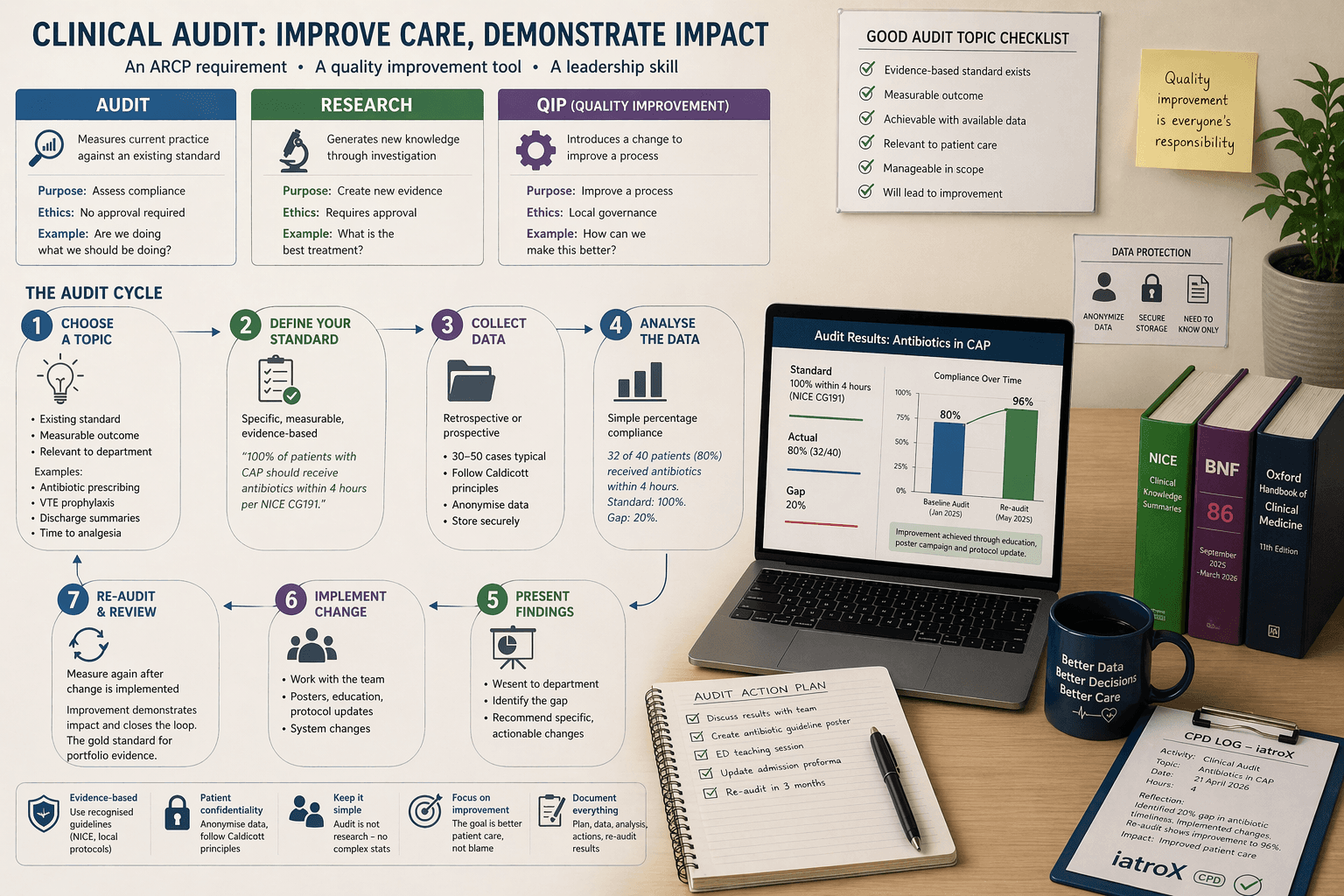
Clinical audit is an ARCP requirement and a valuable skill for quality improvement. Done well, it demonstrates clinical leadership, analytical thinking, and commitment to standards. Done badly, it wastes time and produces weak portfolio evidence.
Audit vs Research vs QIP
Audit measures current practice against an existing standard. Research generates new knowledge through investigation. QIP introduces a change to improve a process. The distinction matters: audit requires no ethics approval (you are measuring compliance, not conducting experiments), research requires ethics committee approval, and QIP follows PDSA methodology. Mis-classifying your project causes governance problems.
The Audit Cycle
Step 1: Choose a topic. Good audit topics have: an existing evidence-based standard (NICE guideline, local protocol, national quality standard), a measurable outcome (percentage compliance), and relevance to your department. Examples: antibiotic prescribing compliance with local formulary, VTE prophylaxis rates on admission, documentation completeness for discharge summaries, time to analgesia in the emergency department.
Step 2: Define your standard. Specific, measurable, evidence-based. "100% of patients admitted with community-acquired pneumonia should receive antibiotics within 4 hours per NICE CG191." The standard must come from a recognised guideline — not your personal opinion.
Step 3: Collect data. Retrospective (review existing records) or prospective (collect as cases present). Sample size: 30-50 cases is typically sufficient for a trainee audit. Follow Caldicott principles: anonymise all patient data, use only the minimum identifiable information necessary, store data securely.
Step 4: Analyse. Simple percentage compliance. "32 of 40 patients (80%) received antibiotics within 4 hours. Standard: 100%. Gap: 20%." No complex statistics required — this is clinical audit, not research.
Step 5: Present findings. Present to your department. Identify the gap between actual and expected practice. Recommend specific, actionable changes.
Step 6: Implement change. Work with the team to address the gap. Posters, protocol updates, education sessions, system changes.
Step 7: Re-audit. Close the cycle by measuring again after implementing change. A re-audit showing improvement is the gold standard for portfolio evidence — it demonstrates that your intervention produced a measurable outcome.