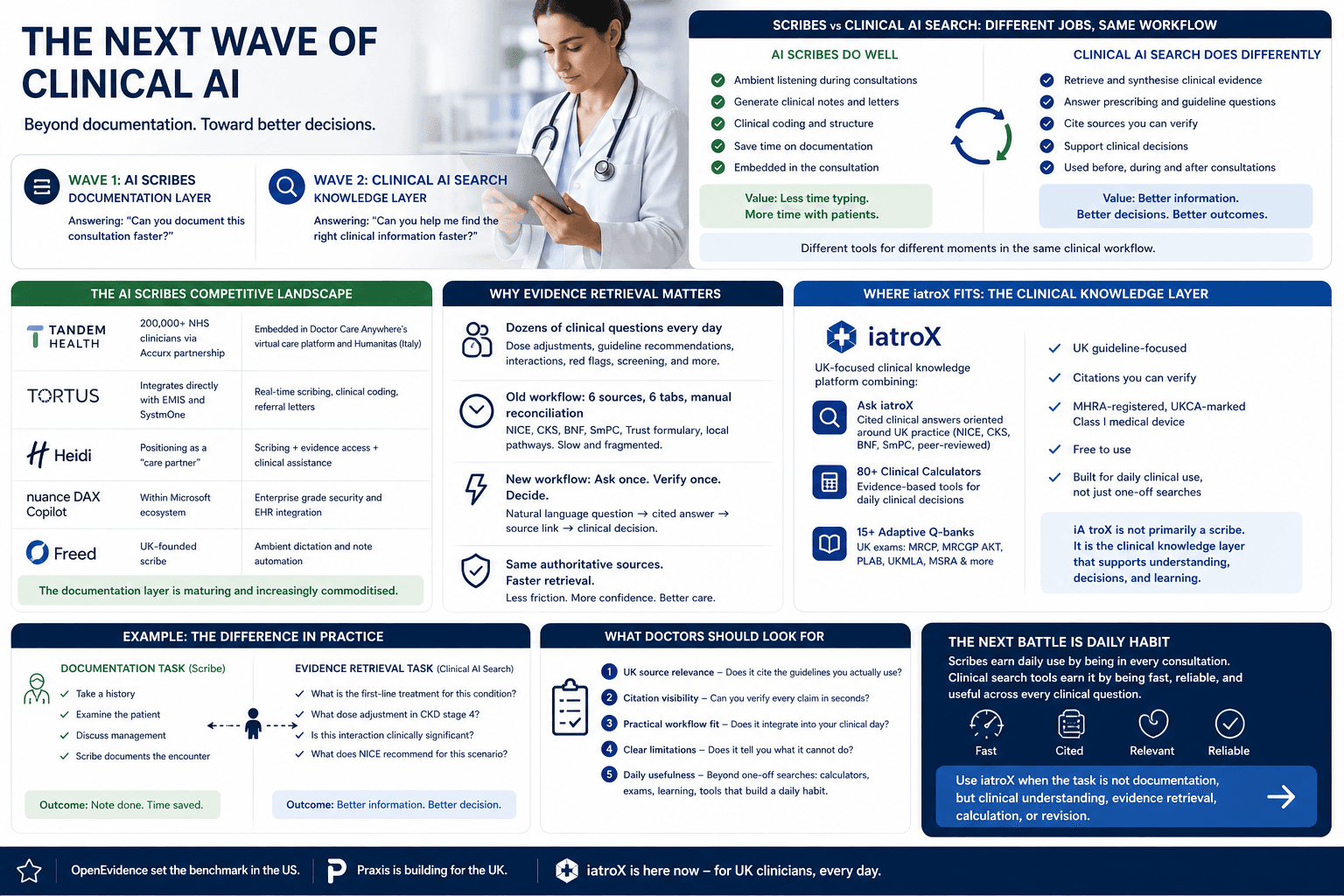
The first wave of clinical AI adoption focused on documentation. Ambient scribes — Heidi Health, Tortus AI, Tandem Health, Nuance DAX, Freed AI — listen to consultations and generate clinical notes. The value proposition is clear and immediate: less time typing, more time with patients. Adoption has been rapid — Tandem alone reaches 200,000+ NHS clinicians via its Accurx partnership.
The next wave is different. It focuses not on documenting what happened, but on retrieving the right clinical information before and during the clinical decision.
What AI Scribes Do Well
AI scribes answer one question: "Can you document this consultation faster?" They sit inside the consultation — ambient listening, structured note generation, clinical coding, referral letter drafting. The value is time saved on administrative documentation that clinicians universally dislike.
The market is maturing. Tandem has embedded into Doctor Care Anywhere's virtual care platform and Humanitas in Italy. Tortus integrates directly with EMIS and SystmOne. Heidi is positioning as a "care partner" with evidence access alongside scribing. Nuance DAX sits within the Microsoft ecosystem. The documentation layer is increasingly commoditised — the question is whether scribes remain standalone tools or become features within broader clinical platforms.
What Clinical AI Search Does Differently
Clinical AI search answers a different question: "Can you help me find the right clinical information faster?" It sits around clinical uncertainty — the prescribing question that arises mid-consultation, the guideline query during a ward round, the diagnostic reasoning question during exam preparation, the interaction check before writing a prescription.
OpenEvidence proved the demand. Reuters reported daily use by more than 40% of US physicians, $12 billion valuation, and 18 million consultations in a single month. Clinicians clearly want fast, cited, source-grounded answers — and they want them badly enough to adopt a new tool bottom-up, without institutional procurement.
Praxis Medicine shows the category is now attracting serious European capital — 70 million SEK from Balderton and Creandum for a UK-focused clinical search product. The European evidence-search market is becoming real.
Why Doctors Need Evidence Retrieval, Not Just Documentation
Documentation efficiency is necessary but not sufficient. Saving 5 minutes per consultation is valuable. Making a better clinical decision because you had faster access to the right guideline is potentially more valuable — for the patient.
The clinical queries that arise during a working day are constant: What is the dose adjustment for this drug in renal impairment? What does NICE recommend as first-line for this condition? Is this interaction clinically significant? What are the red flags for this presentation? What screening is due for this patient? These are not documentation tasks. They are evidence retrieval tasks — and they happen dozens of times per day.
The old workflow may involve opening NICE, CKS, the exact product’s SmPC on eMC, SPS or another specialist source, and the local formulary in separate tabs. Retrieval and reconciliation happen across several interfaces.
The new workflow: ask a natural-language question, receive a cited answer with source links, verify the relevant passage. Same authoritative sources, faster retrieval.
Where iatroX Fits in the Clinical Knowledge Layer
iatroX is not primarily an ambient scribe. Its role is closer to the clinical knowledge layer: answering questions, linking to sources, supporting revision, and providing practical tools such as calculators. The platform combines clinical search with exam preparation and clinical scoring — creating a daily-use clinician tool that sits alongside scribes, not in competition with them.
A clinician might use Tortus or Tandem to document a consultation, and Ask iatroX to check whether their management plan aligns with the relevant guideline. Different tools for different moments in the same clinical workflow.
Why the Next Battle Is Daily Habit
The tools that clinicians use daily become embedded in their practice. A scribe used during every consultation earns daily use automatically — it is built into the consultation workflow. A clinical search tool needs to earn daily use differently — through speed, reliability, and breadth of usefulness across clinical queries, exam preparation, and clinical scoring.
The next phase of clinical AI is not only documentation. It is evidence retrieval. Doctors do not need a chatbot that sounds confident. They need answers they can check.