Introduction
The question for UK GPs is no longer "should I use AI?" but "which AI should I use for what?"
General Large Language Models (LLMs) like ChatGPT have captured the public imagination with their ability to write poems and pass exams. But in a clinical setting, their "black box" nature creates significant risk. Conversely, specialised clinical tools like iatroX are built for safety but can feel less "magical" for creative tasks.
This guide provides a direct, head-to-head workflow comparison to help you choose the right tool for the right job, ensuring you stay efficient without compromising on safety or professional standards.
The core difference: general model vs grounded clinical assistant
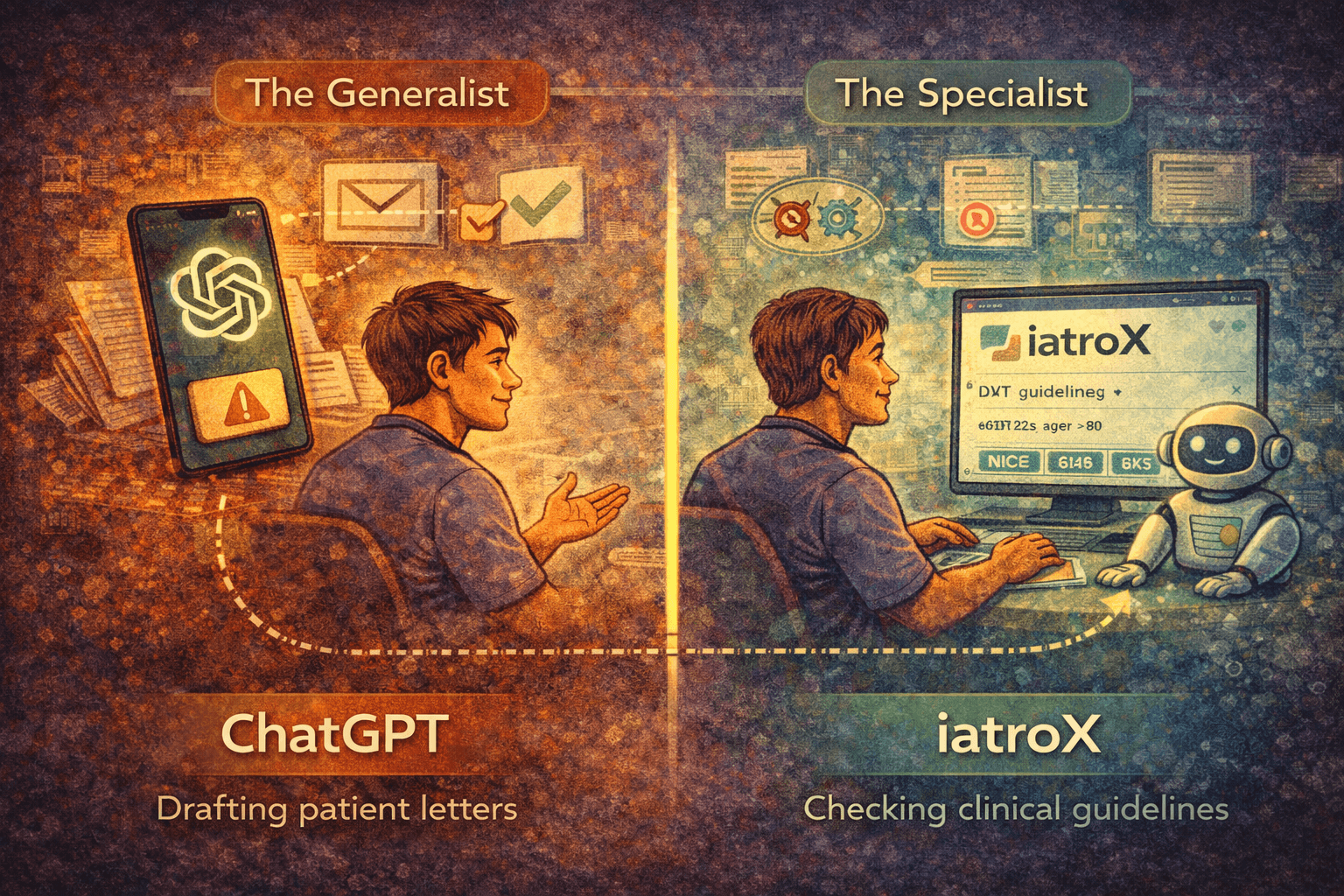
- ChatGPT (The Generalist): Think of ChatGPT as a brilliant but exhausted medical student who has read every book in the library but can't remember which specific page a fact came from. It is a probabilistic engine. It predicts the next most likely word in a sentence. This makes it incredible at fluency (writing letters, summarising text) but dangerous for facts (it can confidently invent a drug dose).
- iatroX (the specialist): iatroX uses retrieval-augmented generation to retrieve UK source material before producing a cited answer. Its source set includes NICE and CKS guidance and medicines information from relevant SmPCs on eMC. This improves traceability and UK relevance, but generated answers still require verification in the cited source.
5 common tasks GPs try to do with “ChatGPT for doctors”
In a typical surgery, you might reach for AI for five main tasks. Here is how the two platforms compare.
- Checking Clinical Guidelines: Quickly finding the first-line antibiotic for a pregnant patient with a UTI.
- Drafting Letters: Writing a compassionate but firm letter to a consultant or a patient support request.
- Differential Diagnosis: Brainstorming potential causes for a complex, undifferentiated presentation.
- Patient Information: simplifying complex medical jargon into a text message or leaflet.
- Summarising Notes: Turning a messy set of consultation notes into a clear summary.
Which tool is better for each task?
| Task | Best Tool | Why? |
|---|---|---|
| Checking Guidelines | iatroX | Safety. iatroX retrieves the actual NICE guidance and relevant SmPC text from eMC and provides a direct link. ChatGPT may hallucinate a guideline or give US-centric advice. |
| Drafting Letters | ChatGPT | Fluency. ChatGPT is a superior writer. Use it to draft the text of a letter (e.g., "Write a letter explaining why we cannot prescribe X"), but never include patient-identifiable data (PID). |
| Differential Diagnosis | iatroX | Relevance. iatroX's "Brainstorm" feature is grounded in UK clinical presentations and "don't miss" red flags. ChatGPT is useful for broad lateral thinking but requires heavy verification. |
| Patient Information | ChatGPT | Simplicity. ChatGPT excels at "explain like I'm 5." It can turn a complex diagnosis into a simple analogy. Just ensure you fact-check the medical details. |
| Summarising Notes | Neither | Privacy Risk. Pasting patient notes into ChatGPT is a GDPR breach. iatroX is not a scribe. For this, you need a dedicated, IG-compliant AI scribe tool (like Accurx or Heidi). |
Risk, privacy, and defensibility
- Privacy: The free version of ChatGPT uses your data to train its models. If you paste a patient's history into it, you are potentially exposing that data. iatroX is designed with clinical privacy standards in mind, but no AI tool should be used with PID unless it has a specific enterprise agreement.
- Defensibility: If you make a clinical error based on a ChatGPT answer, your defence is weak: "The chatbot told me." If you use iatroX, you have an audit trail: "I used a registered clinical tool which cited [NICE Guideline NG123], which I then verified."
A “safe stack” for clinicians
Don't look for one tool to do it all. Build a "safe stack" of three tools, each staying in its lane:
- The Writer (ChatGPT / Claude): Use for drafting non-patient-specific admin, policies, and difficult communication scripts. Rule: Zero PID.
- The Clinician (iatroX): Use for all clinical questions, dosing checks, and guideline retrieval. Rule: Verify the citation.
- The Scribe (Accurx / Heidi / Tortus): Use for listening to consultations and writing notes. Rule: Must be NHS-approved and IG-compliant.
FAQ
Is iatroX safer than ChatGPT? For UK clinical questions, iatroX offers a more source-constrained workflow than a general chatbot because it can retrieve NICE and CKS guidance and medicines information from relevant SmPCs on eMC and attach citations. This reduces reliance on unsupported recall but does not eliminate hallucinations, source gaps or clinical risk; verify the citation before acting.
Can I use ChatGPT if I anonymise the data? Technically, yes, but true anonymisation is harder than you think. A combination of age, condition, and location can be re-identified. It is safer to use ChatGPT for generic tasks (e.g., "Draft a letter for a patient with..." rather than "Draft a letter for Mrs Jones who has...").
Is iatroX a medical device? Yes, iatroX declares itself as a UKCA-marked and MHRA-registered medical device for informational purposes. ChatGPT makes no such claim and its terms of service explicitly warn against using it for medical advice.