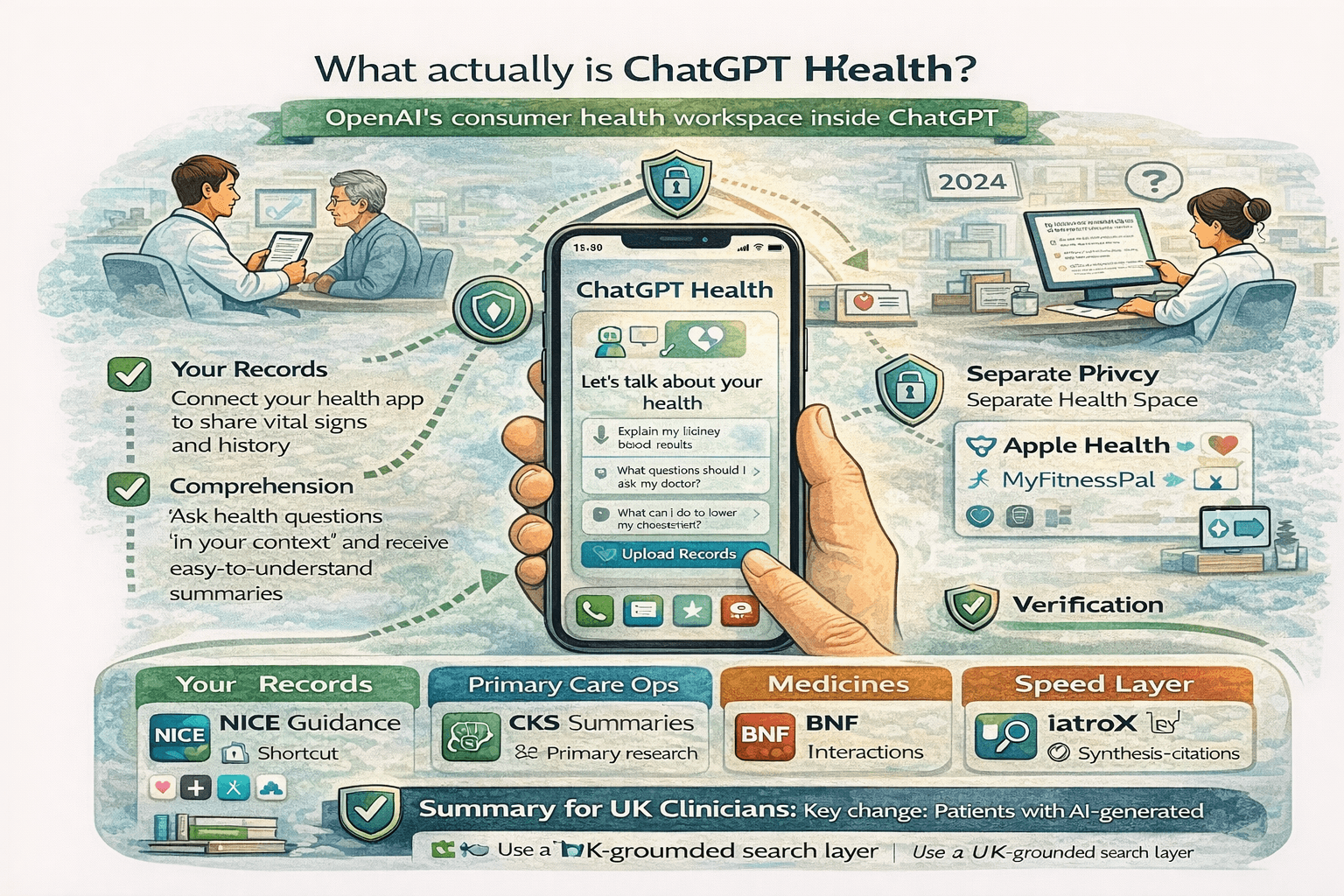
The headline: what OpenAI actually launched
ChatGPT Health is not just a "skin" on top of the standard chatbot. It is a technically distinct Health space inside the platform with separate memory and storage infrastructure.
- The Proposition: It allows users to upload health data and have conversations grounded in their own medical context.
- The Integrations: Users can connect third-party apps (e.g., Apple Health, MyFitnessPal, Function) and, in the US, direct electronic medical records via a partnership with b.well.
- The Guardrails: OpenAI frames this explicitly as "supporting—not replacing—care." It is designed for comprehension and preparation, not diagnosis or treatment.
What’s new vs “regular ChatGPT”
The most significant change is the privacy architecture. Previously, clinicians rightly advised patients that "anything you type into ChatGPT could be used to train the model." With ChatGPT Health, that rule has changed.
- Privacy Separation: Data, files, and chat history within the Health space are isolated. They do not flow back into the "general" ChatGPT conversations.
- No Training: OpenAI states that conversations and data inside the Health space are not used to train their foundation models.
- Security Posture: The Health space uses "purpose-built encryption and isolation" to compartmentalise sensitive data, and Multi-Factor Authentication (MFA) is heavily encouraged.
The record connection piece
The strategic leap here is the partnership with b.well, a platform that unifies patient data from disparate systems.
- US-First: In the US, this allows patients to connect their hospital portal credentials directly to ChatGPT, giving the AI read-access to their blood results, discharge summaries, and medication lists.
- The implication: The AI is no longer hallucinating from a blank slate; it is reading the actual HL7/FHIR data.
The evaluation story: “HealthBench”
OpenAI has anticipated the safety backlash. They have validated the model using HealthBench, a proprietary evaluation framework.
- Clinician-Led: The system was built in collaboration with over 260 physicians across 60 countries.
- Scale: It incorporates feedback from over 600,000 interactions across 30 clinical focus areas.
- The Rubric: Unlike standard exams (like passing the USMLE), HealthBench uses physician-written rubrics that prioritise safety behaviors, such as "knowing when to refuse to answer" and "appropriately escalating to a human doctor."
Availability (UK lens)
It is not here yet. The launch explicitly excludes the UK, EEA, and Switzerland. This regulatory air-gap gives UK clinicians a window of time to prepare. However, tech-savvy patients using VPNs or those with US app store accounts may access it sooner.
What clinicians should expect to change first
Even without direct NHS integration, the "behavioural" shift will impact your practice immediately. Expect to see:
- AI-Summarised Histories: Patients arriving with a bullet-pointed summary of their symptoms generated by ChatGPT, rather than a rambling narrative.
- "The AI said..." Questions: Patients asking specifically about "optimisation" or "longevity" protocols suggested by the AI based on their wearable data (Oura/Apple Watch).
- Pre-Visit Scripting: Patients using the tool to "roleplay" their appointment, meaning they arrive with a structured list of questions that may feel more interrogative than usual.
Where iatroX fits
While ChatGPT Health focuses on consumer comprehension (helping the patient understand you), iatroX remains the tool for clinician decision-making (helping you treat the patient).
When you are in a consultation and need a verifiable answer, you cannot rely on a consumer-facing US model. You need a UK-grounded, citation-first search engine.
- How iatroX works: We check a curated library of UK national guidelines (NICE, SIGN, CKS) to build an answer.
- Q&A Library: Browse precedents of how other UK clinicians have managed similar cases.
- GP 10-minute answer stack: Use iatroX as your professional "speed layer" to get cited answers, then verify them against primary guidance.
Summary for UK Clinicians ChatGPT Health is a consumer health workspace inside ChatGPT with separate memory, record/app connections, and enhanced privacy controls. For clinicians, the key change is not "AI diagnosis"—it is that patients will arrive with AI-generated summaries and interpretations. The safe response is a verification-first workflow: use authoritative sources for your decisions, and treat patient AI outputs as a tool for their comprehension, not your clinical direction.
If you want a UK clinician-grade search layer with citation-first outputs, compare your answer stack with iatroX.