Executive summary
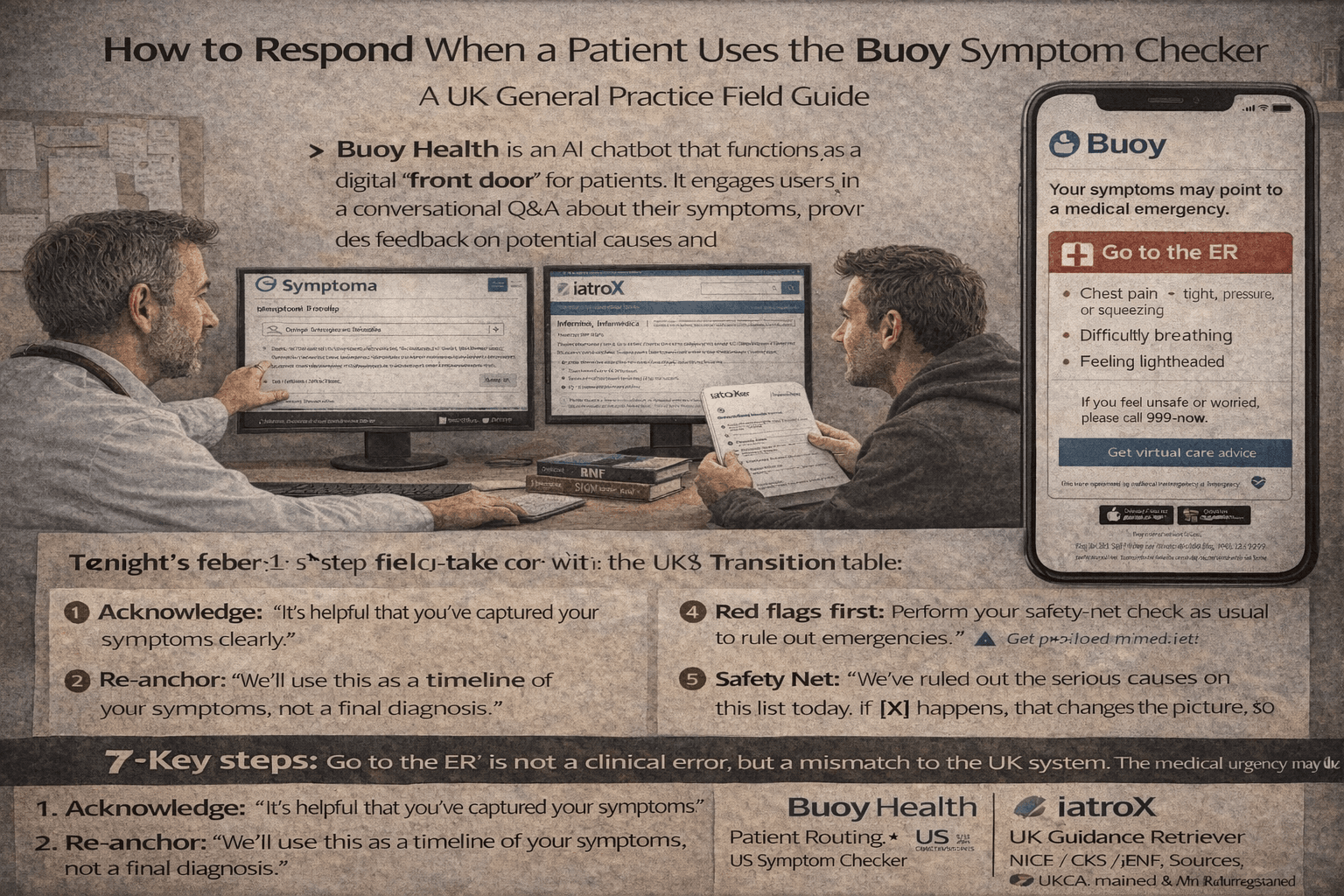
Buoy Health is an AI-driven symptom checker and care navigation tool. While popular globally, its primary logic is built for the US healthcare system. For UK GPs, the challenge arises when patients present with Buoy-generated advice that misaligns with NHS pathways (e.g., suggesting "Urgent Care" for a condition managed in primary care).
This guide provides a practical playbook for managing these consultations. We clarify what Buoy is, explain the "system mismatch" risk, and offer a 7-step protocol for safely integrating patient-generated data into your clinical assessment. Finally, we position UK-centric tools like iatroX as the professional alternative for evidence-based clinical decision support.
What Buoy is (in one paragraph)
Buoy Health is an AI chatbot that functions as a digital "front door" for patients. It engages users in a conversational Q&A about their symptoms, provides feedback on potential causes and severity, and suggests a level of care (e.g., "See a doctor," "Self-treatment"). Crucially, it presents consumer health content and includes explicit disclaimers that it is not a substitute for professional medical advice, diagnosis, or treatment (Buoy Health).
The UK reality check (availability + NHS mismatch)
The core friction for UK users is that Buoy's "right care option" logic is inherently system-dependent. It is optimised for a US payer/provider model, which can lead to confusion in an NHS context.
Translation Table for UK Practice:
| Buoy Suggestion | Likely NHS Equivalent |
|---|---|
| "Urgent Care" | NHS 111 / Urgent Treatment Centre (UTC) |
| "ER / Emergency Room" | A&E (Accident & Emergency) |
| "Primary Care Appointment" | GP Appointment / Same-day Hub |
| "Telemedicine" | eConsult / Online Triage |
Key Takeaway: If a patient says "The app told me to go to the ER," it is not necessarily a clinical error by the AI, but a pathway mismatch. The clinical risk is low if re-triaged correctly, but the operational risk (unnecessary A&E attendance) is high.
How Buoy claims it maintains quality
Buoy emphasises a rigorous editorial process, stating its content is written and vetted by clinicians to ensure accuracy and safety. Regarding data security, the platform highlights its commitment to privacy and references HITRUST certification, a US-based security framework (Buoy Health).
The core risk: “triage outputs can change behaviour”
Symptom checkers influence health-seeking behaviour. While they can empower patients, the literature highlights potential risks: over-triage can flood services, while under-triage can delay care. Real-world outcomes are still under-studied, and accuracy varies significantly across different tools (LSE International Development Review).
Practical stance: Treat the output as patient context (their story and concerns), not clinical evidence (a validated medical opinion).
If a patient shows you Buoy: 7 quick steps
Use this playbook to manage the consultation efficiently:
- Acknowledge: "It's helpful that you've documented your symptoms clearly."
- Re-anchor: "We’ll use this as a timeline of your symptoms, not a definitive diagnosis."
- Red flags first: Perform your standard safety-net sweep immediately to rule out emergencies.
- Clarify inputs: "You mentioned 'chest pain' to the app—can you describe exactly what that felt like?" (Address the 'garbage-in' problem).
- Identify behaviour change: Ask, "Did the app make you more worried, or less?" (Assess anxiety/cyberchondria).
- Document: "Patient used online symptom checker; concerns addressed; clinical assessment performed; safety-netting given."
- Offer a safer alternative: For future reference, signpost them to NHS 111 online or the NHS App for UK-aligned advice.
Where iatroX fits (positioning)
It is vital to distinguish between patient tools and professional tools.
- Buoy Health: Patient routing + general health information.
- iatroX: A UK clinician workflow tool. It provides cited sources from NICE, CKS, and SmPCs via eMC, structured reasoning via Brainstorm, and is positioned as a UKCA Class I, MHRA-registered device for informational/educational use (iatroX, Google Play).
The distinction: "If you want a symptom check, use the NHS App. If I need to check the evidence for your treatment, I use a professional tool built for that purpose."
FAQ
Is Buoy available in the UK? It is accessible online, but its care routing is not integrated with NHS systems.
Is Buoy a medical device? In the UK, symptom checkers that influence care decisions are generally classified as medical devices. You should check the MHRA registry for the specific status of any tool you recommend.
Can I rely on Buoy’s differential list? No. It is a probabilistic suggestion based on patient input, not a medical diagnosis. Use it as a prompt for your own history taking.
What should I say if a patient is anxious after using a symptom checker? Validate their anxiety ("It's normal to be worried when you see a list of conditions"), then use your physical exam and clinical reasoning to explain why the serious conditions on the list are unlikely.
Call to action
If you want UK-grounded, citation-linked answers during a consultation, use a clinician tool built for that purpose.