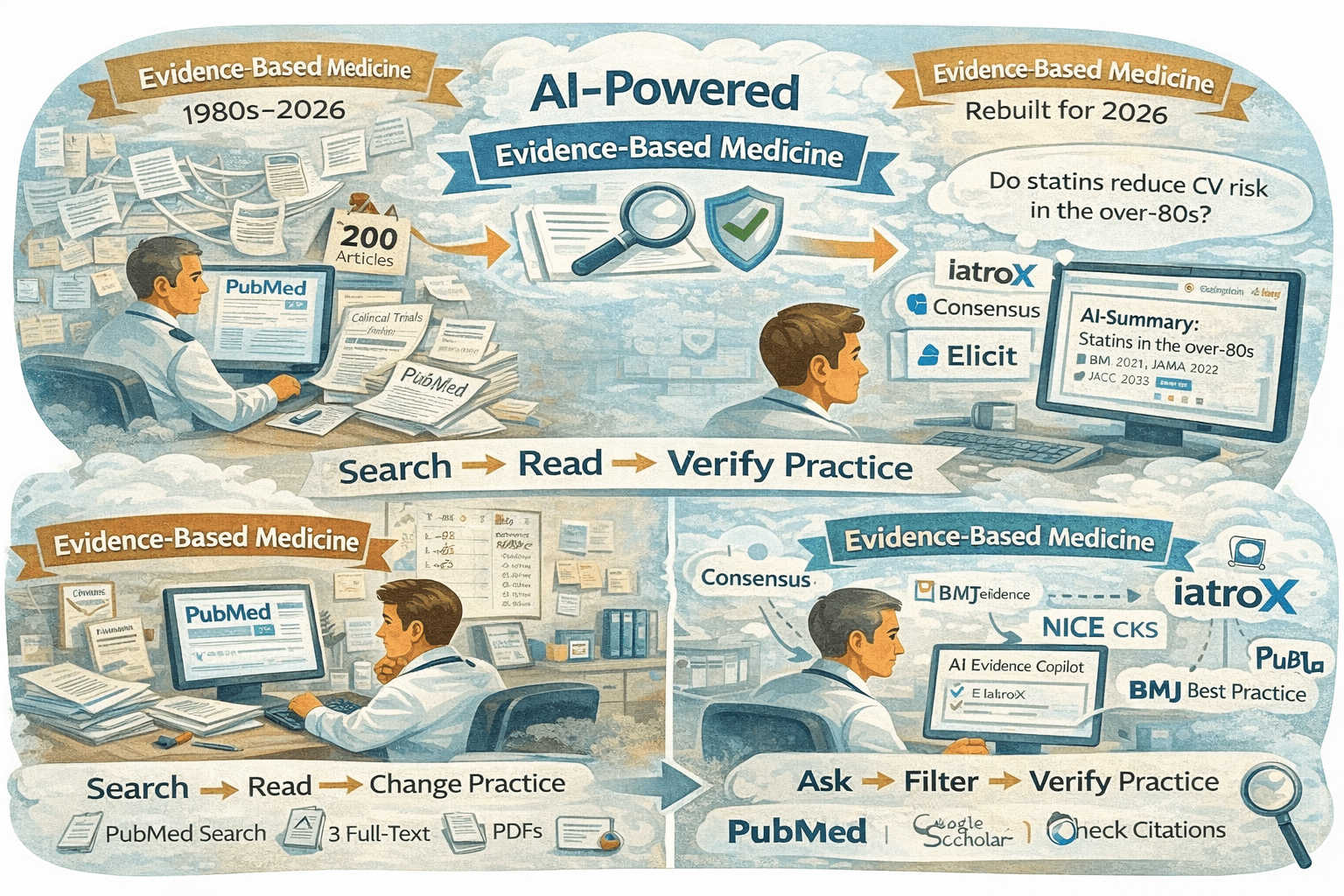
For fifty years, the "Gold Standard" of Evidence-Based Medicine (EBM) was a PubMed search. You typed a keyword, sifted through 200 abstracts, read three full-text PDFs, and then—maybe—changed your practice.
In 2026, that workflow is dead. The sheer volume of medical literature (doubling every 73 days) has made "keeping up" mathematically impossible for a working clinician.
The new interface for evidence is the AI Summary. Tools like Consensus, Elicit, and iatroX promise to read the papers for you. But while AI solves the volume problem, it introduces a veracity problem. Here is how to use these tools without compromising safety.
PubMed isn’t the problem — volume and translation into decisions is
The "evidence-to-action gap" is the time it takes for high-quality research to reach the bedside. Historically, this was blamed on slow guidelines. Today, it's often blamed on "cognitive bandwidth."
Clinicians don't lack access to papers (thanks to Open Access). They lack the 45 minutes required to critically appraise a single study to see if it applies to the patient in Room 4. We are drowning in information but starving for knowledge.
What AI summarisation is actually good at (today)
Don't use AI to "tell you the truth." Use it to "structure the data." Current Large Language Models (LLMs) excel at specific EBM tasks:
- First-pass synthesis: "Summarise the key findings of these 5 abstracts regarding statin use in the over-80s."
- Extracting PICO elements: "From this PDF, extract the Population, Intervention, Comparison, and Outcome."
- Drafting structured summaries: Turning a dense discussion section into bullet points for a journal club or teaching session.
- Surfacing related concepts: "What other papers cite this one to disagree with it?"
The big failure mode: overgeneralisation
The most dangerous thing about an AI summary is that it is persuasive.
LLMs are trained to write smooth, confident text. When summarising a study with weak p-values and wide confidence intervals, the AI often smooths out the hesitation.
- Study says: "We observed a modest, non-significant trend towards benefit in a sub-group..."
- AI Summary: "The study suggests the drug offers benefit."
This is Overgeneralisation Bias. The AI removes the nuance to make the summary "readable," stripping away the very limitations that define the evidence quality.
A clinician’s “AI Summary Verification Protocol” (fast, repeatable)
Never trust the summary alone. If the AI claims a finding, force it to show its work using this 6-point check.
- Ask for Population + Setting: "Who was studied? Was this secondary care or primary care?" (A drug that works in ICU might fail in GP).
- Ask for Effect Size + Absolute Risks: "Don't just say 'reduced risk'. Give me the Number Needed to Treat (NNT) and the absolute percentage change."
- Ask for Key Limitations: "Explicitly list the three biggest limitations mentioned by the authors."
- Confirm Endpoints: "Was this a surrogate marker (e.g., lower cholesterol) or a hard outcome (e.g., fewer heart attacks)?"
- Check External Validity: "Does this population match my 75-year-old multi-morbid patient?"
- Force an ‘If/Then’ Boundary: "When would this finding not apply?"
Tool categories (AI + non-AI)
In 2026, your "Evidence Stack" should have three layers:
- Layer 1: Traditional Index (The Source)
- Tools: PubMed, Google Scholar.
- Use: Deep dives, systematic reviews, and when you need the raw source file.
- Layer 2: Point-of-Care Summaries (The Standard)
- Tools: NICE CKS, BMJ Best Practice.
- Use: The "Gold Standard" curated by humans. Trusted, but slow to update.
- Layer 3: AI Evidence Copilots (The Accelerator)
- Tools: iatroX, Consensus, OpenEvidence.
- Use: "What does the latest literature say about X?" Rapid synthesis with citations.
Where iatroX fits
iatroX is built to be the safe "Layer 3" for UK clinicians.
We don't just "chat" with the internet. We use a Retrieval-Augmented Generation (RAG) engine that:
- Asks the question.
- Retrieves the specific UK guideline or high-quality abstract.
- Synthesises the answer with inline citations.
It allows you to move from Ask (What is the evidence?) → Verify (Check the link) → Save (Add to library) → Reflect (Log as CPD).
Summary AI doesn't replace critical appraisal; it accelerates it. But it requires a new skill: "Algorithmic Skepticism." Use the 6-point Verification Protocol to ensure you are acting on the evidence, not just the summary.
FAQ
Can I trust AI summaries for clinical decisions? Not blindly. AI summaries are excellent for scanning and filtering, but you must verify the key details (population, effect size, limitations) against the original abstract or full text before changing a clinical plan.
What’s the safest way to use AI in evidence-based practice? Use AI to find and structure the evidence (e.g., "Find papers on X and extract the PICO criteria"), but use your own judgment to appraise the quality and applicability of that evidence to your specific patient.
Need a faster way to find the facts? Use Ask iatroX to search trusted UK guidelines and evidence with instant citations.