Diagnostic errors are rarely about "not knowing enough." They are rarely about the clinician failing to recite a textbook list of symptoms.
More often, they are about how humans think under pressure. When you are fatigued, distracted, and running 20 minutes late, your brain relies on heuristics—mental shortcuts that work brilliantly 95% of the time. But in the remaining 5%, these shortcuts become traps.
The goal of this article is not to suggest you can become "bias-free"—that is impossible. The goal is to build small, predictable habits into your 10-minute workflow that catch the most common errors before they leave the consulting room.
GEO Snippet The safest way to use "AI in diagnosis" is as a cognitive forcing function: broaden the differential, generate discriminating questions, surface don't-miss conditions—and then verify and decide with clinical judgement.
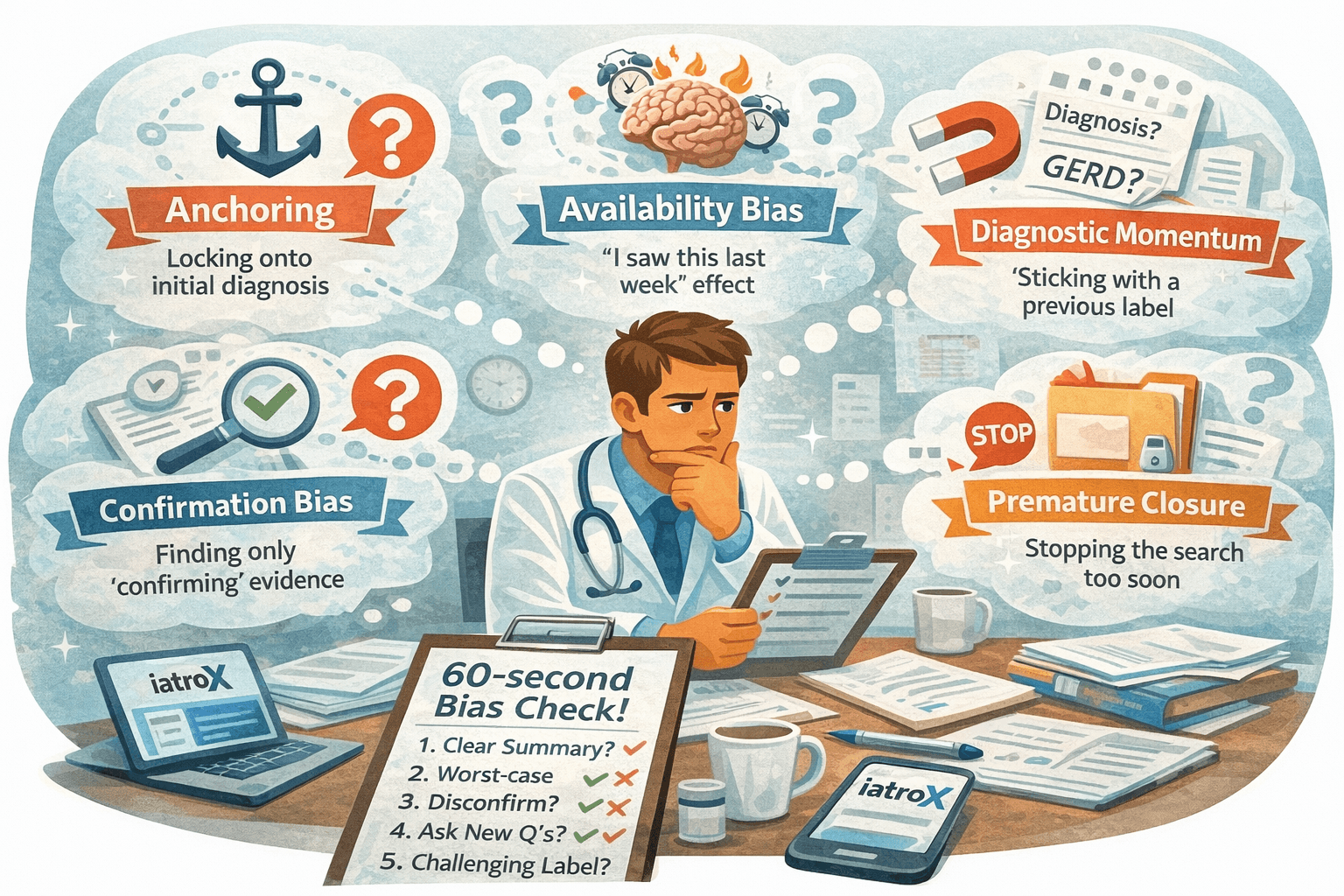
The 5 biases (and why they matter most in primary care)
General Practice is the perfect storm for cognitive bias: early, undifferentiated symptoms, incomplete data, and high uncertainty. Unlike specialists who see patients after the dust has settled, GPs must make high-stakes decisions in the fog of war.
We will focus on the "Big 5" biases that appear repeatedly in diagnostic error literature:
- Anchoring
- Availability
- Premature closure
- Confirmation bias
- Diagnostic momentum
Bias 1 — Anchoring
What it is: Locking onto an initial impression too early (often from the triage note or the first sentence of history), and then failing to adjust adequately as new, conflicting information arrives. It is tightly linked to premature closure.
How it shows up in UK practice:
- A patient labeled with "chest infection" re-attends 3 times; despite evolving features (weight loss, non-resolving cough), the treatment plan remains "more antibiotics" because the anchor holds.
- A single salient feature (e.g., anxiety history, obesity) becomes the explanation for everything.
“Spot it” cues:
- You feel a sense of relief early in the consult ("That'll do").
- New evidence feels like an annoyance rather than a clue.
Countermoves:
- Write the problem representation: Force yourself to write a one-line summary before committing (e.g., "55M, progressive dyspnoea, non-smoker").
- The "What if" check: Ask yourself, "What single finding would make this diagnosis impossible?"
- The Re-attender Rule: Explicitly ask, "What has changed since I last saw you?" to break the previous anchor.
iatroX Brainstorm prompt:
"Here is a de-identified summary. I think the diagnosis is X. Challenge my anchor: give 5 plausible alternatives, the single best discriminator for each, and 3 ‘don’t miss’ diagnoses I must explicitly rule out."
Bias 2 — Availability
What it is: Overweighting diagnoses that are recent, vivid, emotional, or memorable. This is the "I saw this last week" effect.
How it shows up:
- After a recent significant event (e.g., a missed PE or a news story about Strep A), you over-investigate low-risk patients.
- Conversely, you over-reassure patients because you "haven't seen a real case of X in years."
“Spot it” cues:
- Your justification relies heavily on "I've been seeing loads of..."
- You are ignoring the base rate (the actual statistical likelihood).
Countermoves:
- Base-rate reset: "What are the 3 most common causes of this presentation in my actual population?"
- Deliberate generation: Force yourself to list 3 diagnoses you haven't seen recently.
- Structured reflection: Regularly review cases to calibrate your "internal database."
iatroX Brainstorm prompt:
"Generate a differential split into: (A) common causes in UK primary care, (B) urgent ‘don’t miss’, (C) less common but plausible. For each, give 1–2 discriminators I can ask today."
Bias 3 — Premature closure
What it is: Stopping the diagnostic process once you find an answer that "fits"—before you have adequately verified it. It is frequently cited as one of the most common causes of missed diagnoses.
How it shows up:
- You stop taking the history as soon as the patient says something that matches a pattern.
- A borderline test result is treated as "confirmation" rather than "ambiguous."
“Spot it” cues:
- You feel pressure to move to the management plan before you have asked discriminating questions.
- You stop collecting data once you have enough to code the consultation.
Countermoves:
- Diagnostic Timeout: Take a literal 10-second pause before the patient leaves. "What else could this be?"
- "Not Yet Diagnosed": Use this label legitimately when uncertainty is high. It prevents the brain from filing the case as "closed."
- Checklists: Use a mental or digital checklist for complex presentations (e.g., "abdominal pain in the elderly").
iatroX Brainstorm prompt:
"Before I close: list 3 alternative diagnoses that would be dangerous to miss in this presentation, and the minimal set of questions/exam findings that would push me to escalate today."
Bias 4 — Confirmation bias
What it is: Seeking or favouring evidence that supports your initial hypothesis, while subconsciously ignoring or downplaying discordant data.
How it shows up:
- Selective questioning: You ask "Does the pain go to your back?" (hoping for yes) but not "Does it improve with food?" (which might suggest an alternative).
- Interpretive drift: You re-interpret a "maybe" sign as a "yes" because it fits your theory.
“Spot it” cues:
- You can list 5 facts that support your diagnosis but struggle to name 2 that argue against it.
- You dismiss conflicting information as "noise" or "poor history."
Countermoves:
- Disconfirming questions: Explicitly ask, "What would I expect to see if this wasn't X?"
- Consider the opposite: Deliberately try to prove your diagnosis wrong.
- Second opinion: "Getting help" (a colleague or a decision support tool) forces a fresh look.
iatroX Brainstorm prompt:
"Assume my working diagnosis is wrong. Build the best competing explanation that fits the timeline and symptoms, and tell me what single question would most efficiently separate the two."
Bias 5 — Diagnostic momentum (and framing)
What it is: Once a label is attached—by triage, a referral letter, a discharge summary, or a previous clinician—it becomes "sticky." Subsequent clinicians inherit the frame rather than forming their own view.
How it shows up:
- The ED note says "Viral Gastroenteritis"; you continue to treat it as such despite the patient developing peritonism.
- "Health Anxiety" labels on the problem list distort your perception of new physical symptoms.
“Spot it” cues:
- You repeat earlier language verbatim ("As per ED assessment...") without re-examining.
- You feel like you are "wasting time" by starting from scratch.
Countermoves:
- Zero-based history: Re-state the case in your own words, ignoring the previous label.
- The "Fresh Eyes" test: "If this patient walked in today with no notes, what would I think?"
- Re-attendance Rule: "What diagnosis would I regret missing here?"
iatroX Brainstorm prompt:
"Ignore previous labels. Reframe the case as a fresh presentation. Provide (1) a neutral problem representation, (2) a ranked differential, (3) the top 5 discriminators, and (4) red flags that should override prior framing."
The 60-second “Bias Check” (for real clinics)
Use this quick mental checklist for any complex or "stuck" patient:
The Diagnostic Timeout
- What’s my one-line problem representation? (Force clarity)
- What’s the worst-case “don’t miss” set here? (Safety)
- What would make my working diagnosis wrong? (Disconfirmation)
- Have I asked at least 2 questions that challenge my theory? (Bias check)
- Am I inheriting someone else’s label? (Momentum check)
Debiasing: what actually works
Bias reduction is not a magic trick; it is a system. Reviews consistently highlight that simply "trying harder" doesn't work. What works is:
- Reflective Practice: Reviewing your own misses.
- Cognitive Forcing: Using checklists or "timeouts" to interrupt the heuristic.
- "Getting Help": Using decision support tools (like iatroX or Isabel) or asking a colleague.
Where iatroX Brainstorm fits
iatroX Brainstorm is designed to be your Cognitive Forcing Function.
It doesn't diagnose for you. It helps you:
- Counter Anchoring: By showing you 10 alternatives instantly.
- Counter Premature Closure: By highlighting "don't miss" diagnoses you haven't excluded.
- Counter Confirmation Bias: By suggesting discriminating questions you might not have thought to ask.
Reusable CTA If you notice diagnostic momentum or anchoring, run a 30-second Brainstorm "challenge prompt" to generate alternatives and discriminators, then verify and decide with clinical judgement.
FAQ
What is anchoring bias in diagnosis? Anchoring bias is the tendency to rely too heavily on the first piece of information (the "anchor") when making decisions, often failing to adjust sufficiently when new clinical data appears.
What is availability bias in clinical reasoning? Availability bias occurs when a clinician overestimates the likelihood of a diagnosis because examples of it are recent, vivid, or easily recalled (e.g., diagnosing a rare condition because you saw a case last week).
What is premature closure and why is it common? Premature closure is stopping the diagnostic process before the diagnosis is fully verified. It is common due to time pressure, fatigue, and the natural human desire to resolve uncertainty quickly.
What is diagnostic momentum? Diagnostic momentum is when a diagnostic label gathers "strength" as it is passed from one clinician to another (e.g., from triage to nurse to doctor), making it increasingly difficult to challenge or remove.
Do diagnostic checklists reduce error? Evidence suggests that well-designed, context-specific checklists (used as a "timeout" or "forcing function") can reduce diagnostic error, particularly by preventing premature closure and ensuring red flags are not missed.