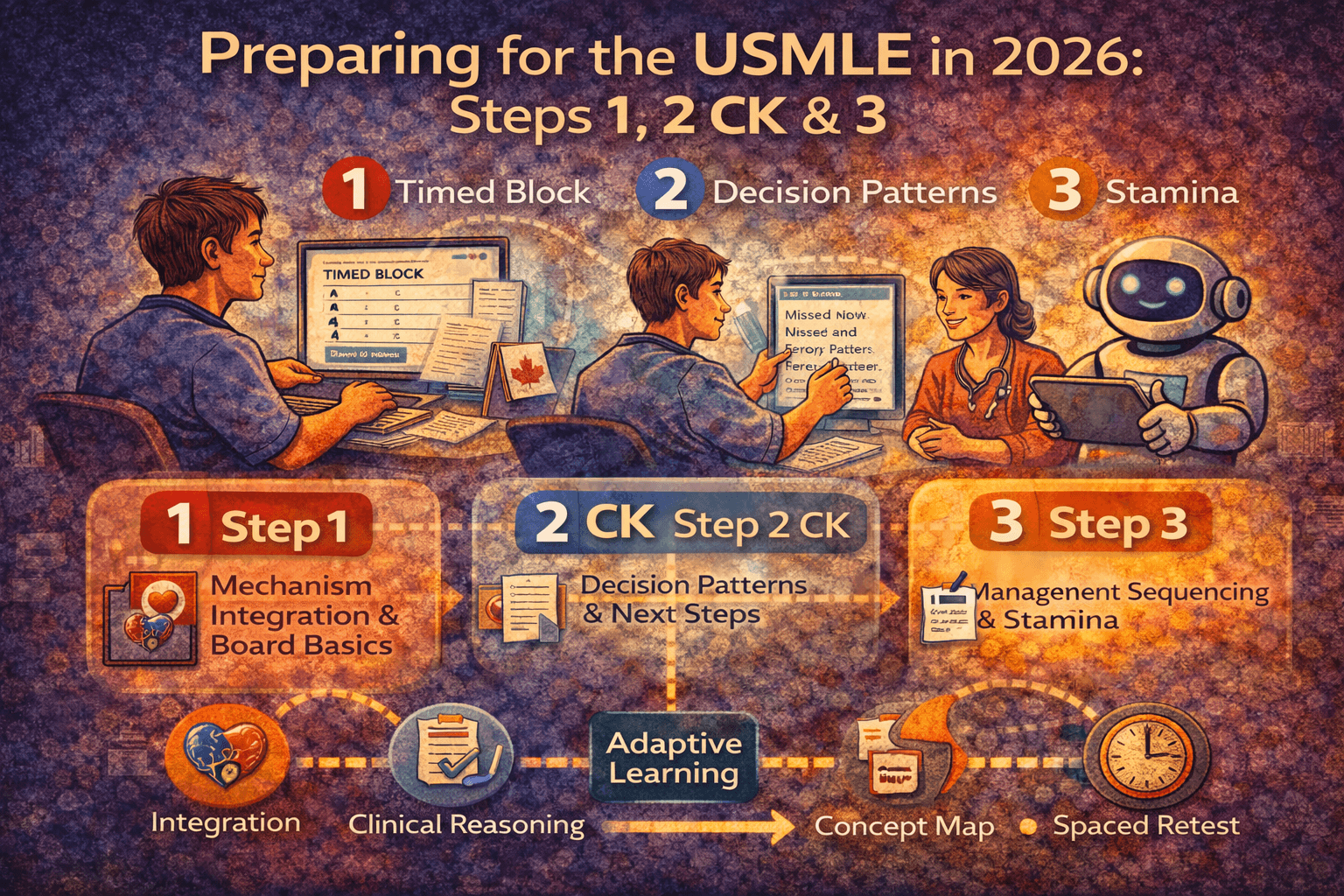
The USMLE ecosystem is crowded with question banks, “smart analytics”, and increasingly AI-driven study tools. The hard part in 2026 is no longer finding a USMLE qbank — it’s choosing a setup that reliably improves clinical reasoning, integration, and endurance across Step 1, Step 2 CK, and Step 3, without falling into the trap of “busy work”.
This article gives you an objective framework to compare q-banks, explains what adaptive learning should do in modern USMLE prep, and provides practical sample plans for each Step.
Who runs USMLE and what the Steps are
The United States Medical Licensing Examination (USMLE) is co-sponsored by the Federation of State Medical Boards (FSMB) and the National Board of Medical Examiners (NBME). The sequence comprises Step 1, Step 2 Clinical Knowledge (Step 2 CK), and Step 3.
At a high level, USMLE emphasises the ability to apply knowledge, concepts, and principles, and to demonstrate fundamental patient-centred skills that underpin safe and effective care.
What each Step is broadly about (in one breath)
- Step 1: foundational mechanisms and principles applied to health and disease (your “why does this happen?” layer, tested through clinical framing).
- Step 2 CK: clinical knowledge and decision-making across patient presentations (your “what do I do next?” layer).
- Step 3: readiness for unsupervised practice with emphasis on patient management and responsibility (your “own the plan” layer, across broader settings).
What USMLE q-banks must do well (integration, clinical reasoning, endurance)
A good Step 1 question bank is not primarily about “facts”; it is about learning to integrate systems and mechanisms into exam decisions.
A good Step 2 CK qbank is not “more questions”; it is about repeatedly training best-next-step logic under realistic stems.
A good Step 3 qbank is not just MCQs; it is also about management sequencing, prioritisation, and (for many candidates) simulation-style thinking.
Across all Steps, the q-bank you choose should deliver these three things:
1) Integration (not silo learning)
- mixed practice by system and presentation
- “two-step reasoning” prompts (pathophys → diagnosis → management)
- teaching that connects mechanisms to bedside decisions (especially for Step 1)
2) Clinical reasoning under pressure
- realistic distractors (the “two plausible answers” problem)
- strong explanations that teach decision rules you can reuse
- repetition of decision patterns (not repetition of identical questions)
3) Endurance and pacing
- timed blocks that match real exam rhythm
- stamina sessions that train focus late in long blocks
- analytics that highlight time sinks (overthinking, stem misreads, slow elimination)
If your qbank cannot train timing realistically, it is not “complete”, even if the content is excellent.
Adaptive learning: “miss → concept map → spaced retest”
In 2026, “adaptive learning” is everywhere — but only a minority of platforms truly change your trajectory. Real adaptivity is not “random questions”. It is a closed loop:
Step 1: miss (capture the error type, not just the topic)
When you miss an item, label it as both:
- topic area (e.g., renal, endocrine, ID), and
- error type (e.g., wrong first step, missed red flag, misread stem, management sequencing, biostats interpretation).
This is where most candidates lose time: they record “cardiology” instead of “I consistently choose the wrong next investigation”.
Step 2: concept map (turn misses into decision patterns)
A “concept map” here does not need to be fancy. It’s simply:
- the key rule,
- the trigger features in stems,
- and the common trap.
Example:
- Pattern: “unstable patient”
- Trigger: hypotension + altered mental state + tachycardia
- Rule: resuscitate/stabilise first, then diagnose
- Trap: ordering definitive tests before initial management
Step 3: spaced retest (lock it in)
You only “own” a concept when you can apply it under time pressure repeatedly. A simple spacing schedule works well:
- retest within 48 hours
- retest at 7 days
- retest at 14 days
- then reintroduce into mixed timed blocks (transfer)
This loop is what changes the game: fewer repeated mistakes, faster score stability, and less late-stage panic.
How to compare q-banks objectively (coverage, explanations, analytics, mocks, update cadence)
Rather than asking “which is best?”, ask “which is best for my gap and timeline?”. Use the same objective checklist for any USMLE qbank.
1) Coverage and alignment
- does it clearly support Step 1 vs Step 2 CK vs Step 3 (separate modes, tags, or banks)?
- does it cover breadth without being dominated by niche minutiae?
- does it support mixed practice by system and by presentation?
2) Explanation quality (the silent score multiplier)
Look for explanations that do all three:
- explain why the correct answer is correct
- explain why the distractors are wrong
- teach a transferable “rule” you can reuse
If explanations are weak, you will compensate by overusing external resources and slowing your loop.
3) Analytics that translate into action
Good analytics are not dashboards; they are decision support:
- performance by topic and subtopic
- performance by question style (next best step vs diagnosis vs mechanism)
- filters for incorrect / flagged / unseen
- timing metrics (time per question, slowest categories, late-block decline)
4) Mock readiness and test-day simulation
Many candidates underestimate how much score is lost to pacing.
- does the platform offer exam-like timed modes?
- are self-assessments available and realistic?
- can you simulate a full-length session without fiddling?
5) Update cadence and corrections
- does the platform correct errors quickly?
- is there a visible errata or feedback mechanism?
- do explanations and stems get updated (especially for Step 2 CK and Step 3)?
Shortlist: common q-bank “types” you will see (and what they’re best for)
Most candidates end up with a “stack” rather than a single tool. Here is how the market typically breaks down:
High-intensity “core qbank” systems
Often used as the main engine for timed blocks, explanations, and self-assessment readiness.
- Many candidates choose platforms that emphasise realistic blocks and readiness testing (including self-assessments that simulate exam interface, difficulty, and format).
Integrated qbank + library systems
Often used for faster clarification and linking concepts while doing questions (useful for Step 1 integration and Step 2 CK rapid reinforcement).
- Some platforms explicitly position a side-by-side Qbank + knowledge library workflow, with embedded definitions and linked learning.
Early-phase “foundation-building” qbanks
Often used to build Step 1 base before switching to a more exam-sim intensive platform.
- Some tools position themselves as aligned with core review content and “first pass” learning.
Budget/alternative qbanks
Can be helpful as supplementary volume, but quality varies more. Use the checklist ruthlessly.
Where iatroX fits (AI-adaptive scheduling + explanation workflow; US exam tagging)
iatroX is most useful as the layer that turns “missed questions” into “fixed decision patterns”.
In a USMLE workflow, iatroX can sit in two places:
1) AI-adaptive scheduling layer
- automatically prioritise weak clusters
- resurface repeat-error patterns on a spaced schedule
- balance breadth vs repair work so you don’t “overfit” to comfort topics
2) Explanation and consolidation layer
- convert missed items into short “rules” and quick concept summaries
- generate targeted micro-sessions to retest a pattern (rather than random review)
- keep Step-specific scope via US exam tagging (so Step 1-style mechanism work doesn’t drown Step 2 CK decision training, etc.)
The practical outcome is a tighter loop: timed blocks → pattern diagnosis → targeted retest → spaced reinforcement → mixed transfer
Sample plans
Below are practical templates you can adapt to your schedule. They assume you already have core resources and are using a qbank as the centrepiece.
12-week Step 1 plan (integration-first, then performance mode)
Weeks 1–4: build integration + identify weak systems
- 5–6 days/week: 1–2 timed blocks/day (start smaller, build)
- daily review: convert misses into decision patterns and mechanism links
- end of each week: one mixed “audit block” to prevent comfort-topic drift
Weeks 5–8: adaptive build (where scores move)
- 5–6 days/week: timed mixed blocks as default
- 2–3 sessions/week: targeted clusters (weak systems + repeat error types)
- spaced retests (48h / 7d / 14d) for top error patterns
Weeks 9–12: performance mode
- 2 stamina sessions/week (longer mixed timed work)
- fewer new notes; more retesting of weak clusters until stable
- final fortnight: aggressive incorrect/flagged review and pacing discipline
8-week Step 2 CK plan (decision-making and pacing as the centrepiece)
Weeks 1–2: baseline and pacing discipline
- daily timed mixed blocks (even if smaller)
- identify top 10 weak presentations and top 5 error patterns
Weeks 3–6: targeted repair + mixed transfer
- 4–5 days/week: mixed timed blocks
- 2–3 days/week: weakness clusters (next best step, investigations, management sequencing)
- weekly stamina session to train late-block accuracy
Weeks 7–8: exam simulation
- increase simulation frequency
- focus on eliminating repeat errors and improving time per question
- keep review short and rule-based (not long essays)
6-week Step 3 plan (management sequencing and “own the plan” thinking)
Weeks 1–2: build the management backbone
- timed blocks most days
- explicitly practise: prioritisation, outpatient vs inpatient decisions, follow-up planning
- convert misses into management rules and ordering sequences
Weeks 3–5: targeted clusters + simulation
- mixed timed work with heavy emphasis on repeated management patterns
- spaced retests of the same errors until stable
- practise “what is the safest next step?” reasoning relentlessly
Week 6: consolidation
- compress into short rules, stabilise pacing, avoid tool switching
- focus on preventing avoidable mistakes (misreads, rushing, wrong first step)
FAQ
“Best USMLE qbank in 2026: what should I pick?”
Use the objective checklist:
- explanation quality
- realistic timed modes / self-assessment readiness
- analytics you can act on
- correction/update cadence Then pick the platform you will actually use daily.
“Step 1 question bank: should I do topic blocks or mixed blocks?”
Do both, in this order:
- mixed blocks early to expose true weaknesses
- targeted clusters to repair weak systems and repeat errors
- mixed blocks again for transfer under time pressure
“Step 2 CK qbank: how do I improve fastest?”
The biggest gains come from:
- building best-next-step decision patterns
- drilling management sequencing
- fixing repeat errors with spaced retests
- training pacing from week 1
“Step 3 qbank: what changes?”
Step 3 prep rewards:
- management ownership
- prioritisation and follow-up planning
- “safe care” decisions under ambiguity
Your review should focus less on rare facts and more on robust management rules.
“How do I know if a platform’s ‘adaptive learning’ is real?”
It’s real if it reliably:
- identifies weakness clusters
- schedules spaced retests automatically (or supports you doing it easily)
- shows you repeated error patterns, not just topic percentages
- improves your mixed-block stability over time