Introduction
"I'll just Google it." For a busy clinician, this is often the default. But in 2026, the volume of medical noise online is deafening. Relying on a generic search engine for clinical decisions is inefficient at best and dangerous at worst.
To practice evidence-based medicine efficiently, you need to understand the hierarchy of search tools. Not all search engines are built for the same "job." Some are for deep academic dives, some are for quick clinical answers, and some are for broad orientation. This guide compares the four heavyweights—PubMed, TRIP, Cochrane, and Google Scholar—and explains where new AI tools like iatroX fit into the modern workflow.
What clinicians actually mean by “search”
Before choosing a tool, define your goal. Clinical search usually falls into three buckets:
- Orientation: "I need a quick refresher on the management of hypercalcaemia." (You need a summary).
- Point-of-Care: "What is the NNT for DOACs vs Warfarin in AF?" (You need a specific fact).
- Citation-Grade Evidence: "I am writing a guideline/audit and need the primary papers." (You need a bibliography).
The 4 evidence layers
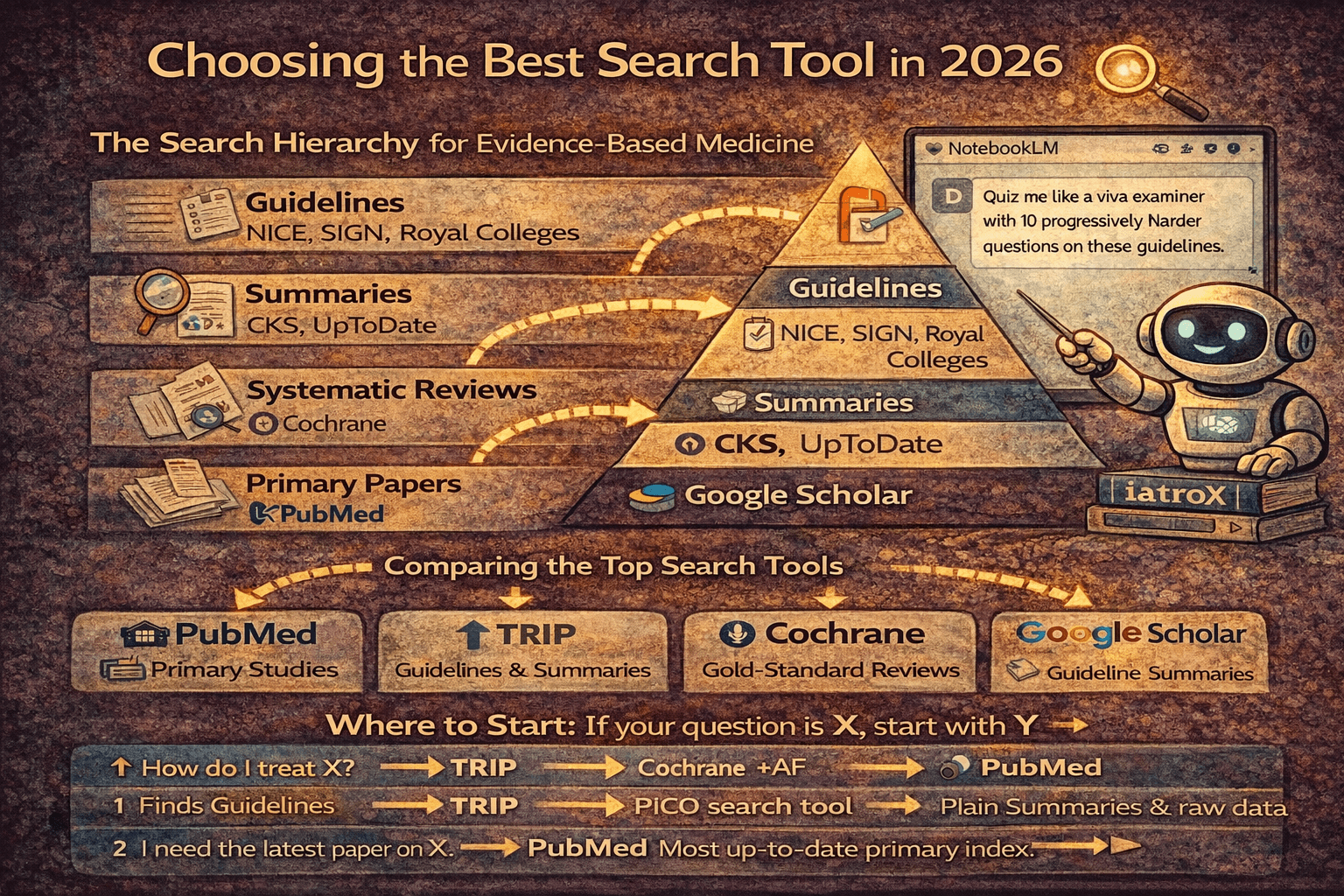
Efficient search means starting at the top of the pyramid and working down:
- Guidelines: (NICE, SIGN, Royal Colleges) - Start here for management.
- Summaries: (CKS, UpToDate) - Start here for background.
- Systematic Reviews: (Cochrane) - Start here for specific therapy questions.
- Primary Papers: (PubMed) - Go here only if the above don't answer it.
Tool-by-tool: what it’s best for
PubMed (The Archive)
- Best for: Finding primary literature, specific trial data, and obscure case reports.
- The Power Move: Use "Clinical Queries" filters to narrow results to "Therapy," "Diagnosis," or "Prognosis" studies immediately.
- The Downside: It is unopinionated. It will show you a low-quality study alongside a landmark trial. You have to do the appraisal.
TRIP Database (The Clinical Filter)
- Best for: Fast clinical evidence. TRIP (Turning Research Into Practice) is built for clinicians, not academics.
- The Power Move: Its "PICO" search tool allows you to structure your query (Patient, Intervention, Comparison, Outcome) to get highly relevant results instantly.
- The Upside: It prioritises high-level evidence like Guidelines and Systematic Reviews at the top of the list, saving you scroll time.
Cochrane Library (The Gold Standard)
- Best for: Definitive answers on therapeutic interventions.
- The Power Move: Use the "Plain Language Summary" if you need to explain risk/benefit to a patient. Use the "Forest Plot" if you need to see the raw data for a presentation.
- The Downside: It is narrow. If there isn't a systematic review on your topic, you will find nothing.
Google Scholar (The Broad Net)
- Best for: "Grey literature," finding free PDFs of paywalled papers, and seeing who cited whom.
- The Power Move: The "Cited by" link is invaluable for finding newer research that updates an older paper.
- The Downside: It indexes everything, including predatory journals and non-peer-reviewed content. High noise-to-signal ratio.
Decision table: “If your question is X, start with Y”
| Your Question | Start With | Why? |
|---|---|---|
| "How do I treat X?" | TRIP | Finds Guidelines & Summaries first. |
| "Does drug A work better than B?" | Cochrane | Gold-standard comparative reviews. |
| "I need the latest paper on X." | PubMed | Most up-to-date primary index. |
| "I can't find this paper anywhere." | Google Scholar | Best at finding free full-text PDFs. |
| "I need a quick overview of X." | iatroX | Summarises guidelines with citations. |
Where AI fits safely
AI has changed search, but it hasn't replaced it.
- Fast Orientation (Perplexity): Great for "getting the gist" of a topic or finding a list of papers to read. But treat it as a Wikipedia page—a starting point, not a source.
- Grounded Workflow (iatroX): When you need to turn a search into a clinical plan, use iatroX. It doesn't just find the guideline; it extracts the relevant section, allows you to query it ("what is the dose?"), and helps you log the learning for your CPD. It bridges the gap between "search" and "practice."
Workflow example: “answer in 5 minutes”
You have a specific question: "Is magnesium effective for rate control in rapid AF?"
- Start: TRIP Database. Search "Magnesium AF rate control." Filter by "Systematic Review."
- Verify: Click the top Cochrane result. Read the "Authors' Conclusions."
- Deepen: If Cochrane is old, jump to PubMed via the "Cited by" link to see newer trials.
- Synthesise: Use iatroX to summarise the current UK guideline position (NICE) on magnesium in AF to see if it aligns with the evidence.
- Result: A fully evidenced, guideline-compliant answer in under 5 minutes.
FAQ
Is Google Scholar better than PubMed? No, they are different. PubMed is a curated database of biomedical literature (high specificity). Google Scholar is a crawler of the web (high sensitivity). Use PubMed for precision; use Scholar for breadth.
Why use TRIP instead of Google? TRIP filters out the noise. A Google search for "Asthma guidelines" gives you patient forums and US news sites. TRIP gives you the BTS/SIGN guideline as the first hit.
Can I trust AI search summaries? Only if they provide clickable citations to trusted sources. Always verify the primary document before making a clinical decision.