Introduction
The medical student's digital backpack has never been heavier. In 2025, the challenge isn't finding resources; it's filtering them. With the UKMLA now the standard and clinical rotations more demanding than ever, choosing the best medical question bank is a strategic decision that defines your daily workflow.
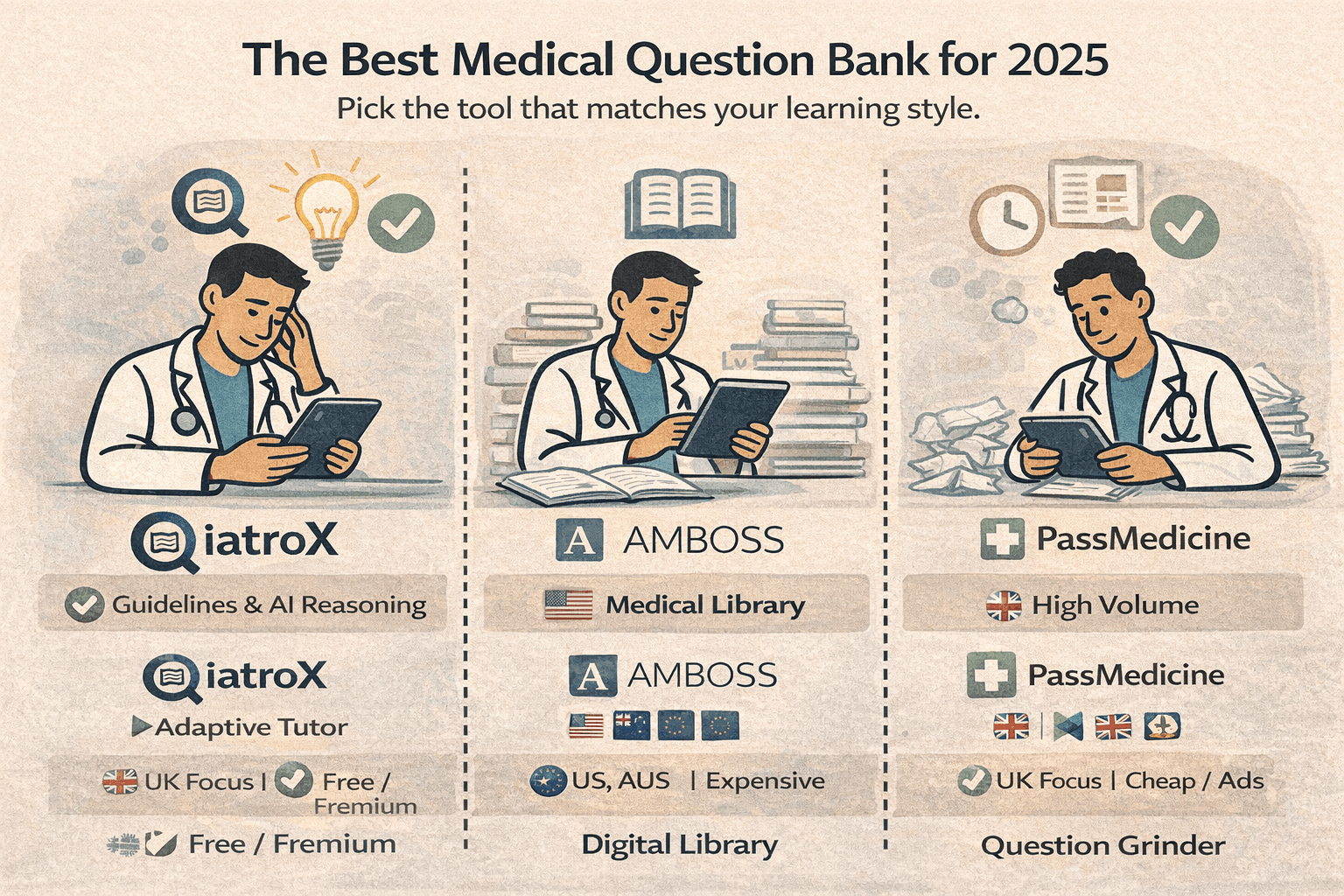
For years, the market has been dominated by two giants: the encyclopaedic Amboss and the high-volume PassMedicine. But a new category has emerged—AI-driven adaptive learning—led by iatroX.
This article breaks down the three contenders to help you decide which tool fits your learning style.
At a glance: the comparison matrix
| Feature | iatroX | Amboss | PassMedicine |
|---|---|---|---|
| Primary Strength | AI Reasoning & Guidelines | Library/Textbook | Volume of Questions |
| UK Support | Native (NICE/CKS) | Good (Adapted) | Native |
| US/Can/Aus Support | Yes (Region Switching) | Excellent (US Focused) | Poor/None |
| Pricing | Free / Freemium | Expensive Subscription | Cheap Subscription |
| Best For | Deep Understanding & Ward Work | Looking up obscure facts | Cramming for exams |
The core argument
If you take nothing else away from this review, remember this distinction:
- Amboss is a library you have to read.
- PassMedicine is a quiz you have to grind.
- iatroX is a tutor you can talk to.
Amboss: the digital encyclopaedia
Amboss is an engineering marvel. It is arguably the most comprehensive medical library in existence.
- The Pro: If you need to know the pathophysiology of a rare genetic disorder, Amboss has a beautifully illustrated article on it. Their "Knowledge Library" is seamless, and the "Attending Tip" overlay on questions is a clever feature.
- The Con: It is passive. To learn from Amboss, you must be willing to read dense text. It requires high motivation to sift through the "High Yield" toggle to find what actually matters for your exam. It is also the most expensive option, often pricing out students who don't have institutional access.
- Verdict: Excellent for reference, but heavy for revision.
PassMedicine: the volume king
PassMedicine is a rite of passage for UK medical students. It is unashamedly a question bank, nothing more, nothing less.
- The Pro: It is cheap and effective for pattern recognition. If you do all 8,000 questions, you will likely pass because you will have seen every possible variation of "old lady with hip pain."
- The Con: It is a grind. The explanations are static, often user-generated comments are more helpful than the official text, and it doesn't "know" you. It cannot explain why you are wrong; it can only tell you that you are wrong. It trains you to pass exams, not necessarily to understand medicine.
- Verdict: The budget choice for brute-force repetition.
iatroX: the intelligent tutor
iatroX represents the shift from "static" to "dynamic" learning. It doesn't just present information; it interacts with you.
- The Pro: AI Reasoning. When you are stuck on a concept, you don't have to leave the app to Google it. You can ask iatroX to explain the underlying mechanism or the specific NICE guideline. It bridges the gap between a question bank and a mentor.
- The Region Switching: Unlike PassMed (UK only) or Amboss (US biased), iatroX allows you to toggle your region. This makes it the only viable tool for students sitting the UKMLA who also want to keep one eye on the USMLE or Australian pathways.
- The "Ward Work" Factor: Because iatroX is grounded in guidelines (NICE/CKS), it is as useful on a ward round as it is in the library. It translates exam knowledge into clinical safety.
Conclusion
The best medical question bank for 2025 depends on your goal. If you want to read a textbook on your screen, buy Amboss. If you want to click through 100 questions an hour to memorise patterns, buy PassMedicine. If you want to understand the medicine, query the guidelines, and have a tutor in your pocket, download iatroX.