The problem with "legacy" revision
For a generation of UK medical students and doctors, revision has meant one thing: PassMedicine. It is the institution of British medical exams. But it has a flaw.
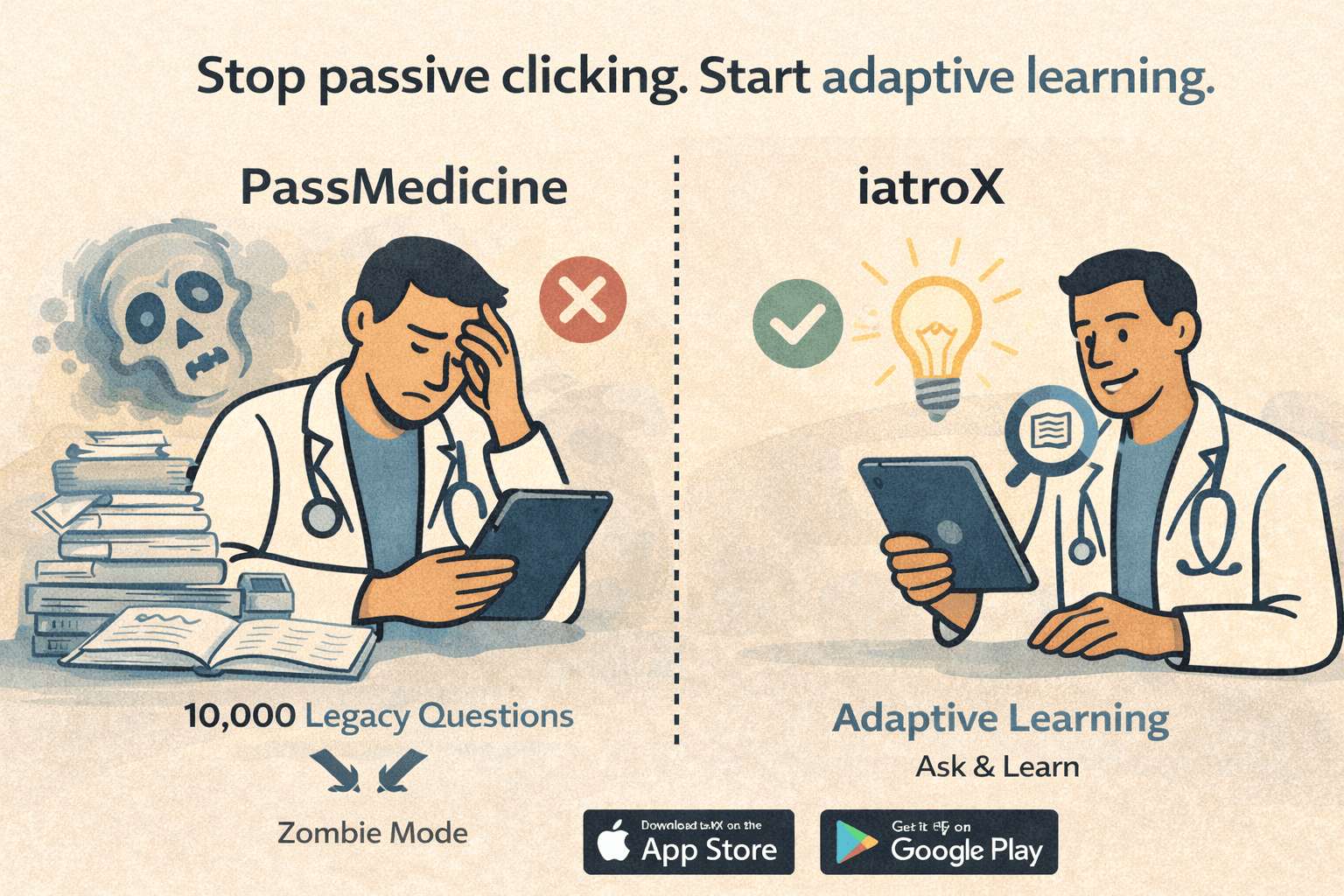
The "legacy" method of revision relies on brute force. You buy a subscription, you are presented with a bank of 10,000 static questions, and you start grinding. After 300 questions in a row, you enter "zombie mode." You are clicking answers based on pattern recognition of the question stem ("I remember this patient, the answer is C"), rather than clinical reasoning.
This creates the problem of disconnected knowledge. You learn the answer to the question, but you don't necessarily learn the topic. You memorise that a certain vignette equals "Amoxicillin," but you struggle to apply the underlying antibiotic guidelines when the vignette changes slightly.
The iatroX solution: smart, not just big
iatroX is not just a question bank; it is an intelligent revision partner designed to break the cycle of passive clicking.
1. Adaptive learning
Legacy apps give you random questions. iatroX gives you the right question. Its adaptive engine analyses your performance in real-time. If you consistently answer Cardiology questions correctly but fail on Respiratory, iatroX stops serving you the stuff you know.
Instead, it targets your weak spots. It notices you are struggling with Heart Failure management and adapts your session to drill those specific concepts until you prove mastery. It turns revision from a memory test into a targeted workout.
2. The "Ask & Learn" loop
This is the game-changer. In a traditional app, if you don't understand an explanation, you have to close the app, open Google, search for the guideline, filter through the ads, read the PDF, and then try to remember what the original question was.
With iatroX, you stay in the flow. Uniquely, you can use Ask iatroX to query the concept immediately without leaving the revision session.
- Stuck on a question? Ask: "Explain the 2025 BTS Asthma ladder changes."
- Confused by a distractor? Ask: "Why is D-dimer not appropriate here?"
You get an instant, cited answer, clarify the concept, and return to your questions in seconds.
Specific exam use-cases
UKMLA / Medical Finals
The new MLA content map is broad and can feel random. Legacy banks often struggle to balance this breadth. iatroX's adaptive engine ensures that you are not over-revising common topics while neglecting the niche areas that often appear in the new format exams.
MRCGP AKT
The AKT is famous for being pedantic about guidelines. It doesn't care what you do in your practice; it cares what the specific paragraph in the NICE guideline says.
- The Legacy Problem: Traditional Q-bank explanations are summaries written by humans. They can be out of date or slightly paraphrased.
- The iatroX Advantage: iatroX retrieves the exact NICE guideline paragraph. When you ask "What is the driving rule for a first seizure?", it doesn't give you an opinion; it gives you the DVLA/NICE citation. For the AKT, this precision is the difference between a pass and a fail.
MSRA
For the Clinical Problem Solving paper, rote memorisation fails because the scenarios are designed to test judgement. iatroX's ability to explain the rationale behind a management hierarchy helps you understand the "why," which is essential for the MSRA's specific question style.
Verdict
If you want to brute-force your way through 10,000 questions and hope enough stick, use the legacy tools. PassMedicine is for volume.
If you want to target your weaknesses, understand the guidelines, and revise efficiently, use the modern tool. iatroX is for understanding.