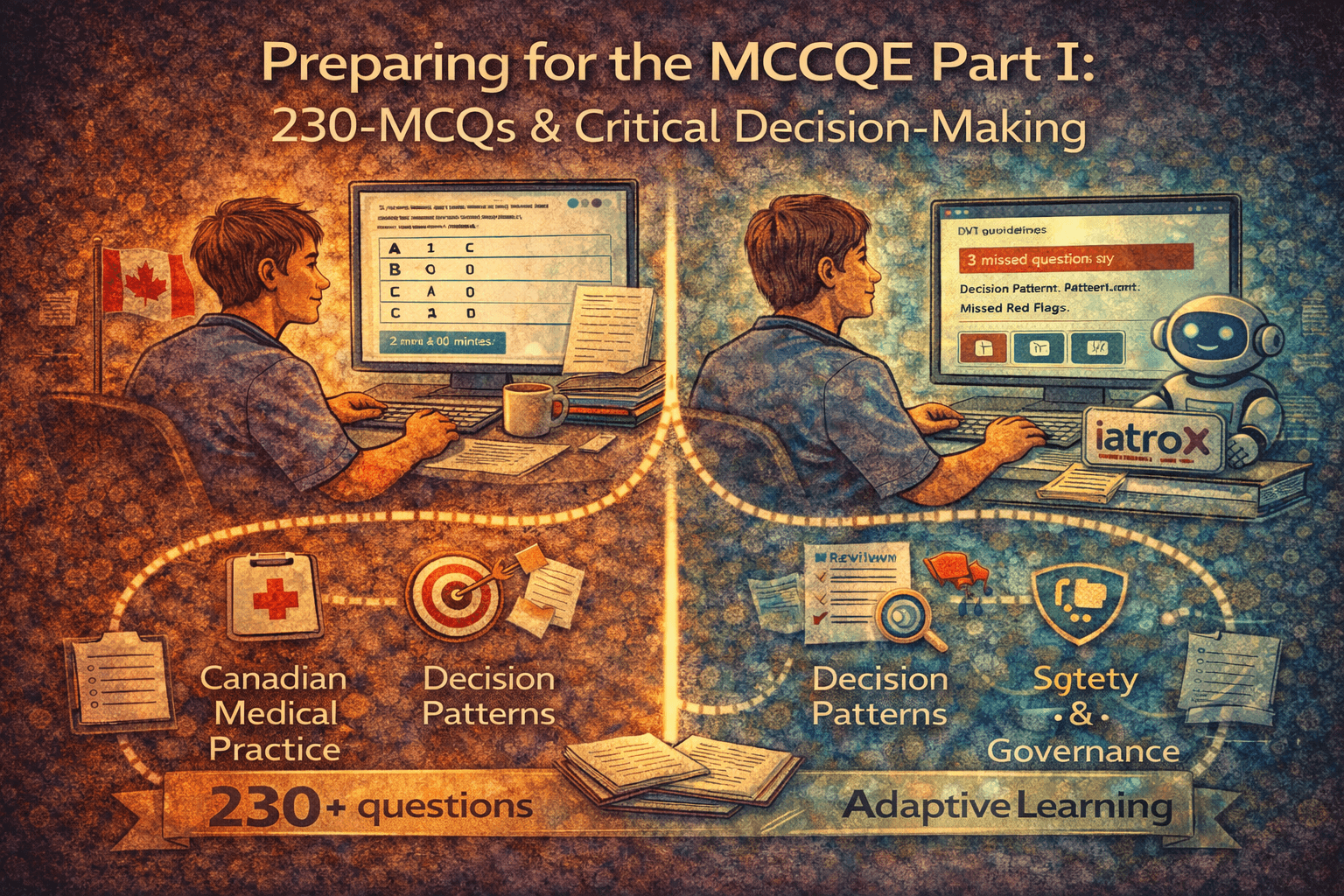
If you’re searching for the best MCCQE Part I qbank, it helps to be clear about what the exam is actually designed to measure.
MCCQE Part I is not a “memorise and regurgitate” test. It is built to assess critical medical knowledge and clinical decision-making at the level expected of a graduating Canadian medical student, using a blueprint grounded in Canadian practice expectations.
This guide explains what MCCQE Part I is testing, what your MCCQE practice questions platform must include, how adaptive learning can accelerate progress (without “false progress”), and how to build a practical 10-week plan.
This is educational guidance, not official exam or licensing advice. Always confirm details with the Medical Council of Canada (MCC).
What MCCQE Part I is testing (clinical decision-making, not rote facts)
The Medical Council of Canada describes MCCQE Part I as a summative exam assessing critical medical knowledge and clinical decision-making ability at the level expected of a medical student completing their MD in Canada, and it explicitly frames the assessment in terms of decision-making rather than recall alone.
The 2025+ format change you must know
As of April 2025, MCCQE Part I moved to a 230-MCQ format divided into two sections of 115 questions (with up to 2 hours 40 minutes per section) and the MCC reports that the prior clinical decision-making (CDM) component was removed, with decision-making continuing to be assessed through MCQs.
This matters because it changes what “exam readiness” looks like:
- you still need clinical reasoning, but you must train it inside MCQ-style decisions
- pacing and fatigue management become core skills
- you need systems that prevent repeated errors across mixed topics
What “Canadian-style decision-making” means in practice
For revision purposes, you should assume the exam rewards:
- best next step decisions under uncertainty
- safe prioritisation (what cannot be missed, what must be actioned first)
- appropriate test selection and management sequencing
- communication/professional judgement themes (as mapped through MCC Objectives and CanMEDS-aligned expectations)
MCC’s published materials emphasise that the exam blueprint and objectives guide question development, and that the objectives are organised under CanMEDS roles.
What your q-bank must include (case-based stems, mixed topics, timed blocks)
A strong Canada medical exam qbank for MCCQE Part I should train two things simultaneously:
- breadth across the blueprint, and
- repeatable decision-making under timed conditions.
1) case-based stems that force decisions
The best MCCQE practice questions look like clinical vignettes that demand an action:
- choose the most appropriate next investigation
- choose immediate management
- recognise red flags and prioritise escalation
- weigh benefits/harms and contraindications
If a qbank is mostly “definition recall”, it will not match the exam’s intent.
2) mixed-topic blocks (because the exam is mixed)
You need mixed blocks early. Topic-only practice creates comfort, not competence.
A good qbank should let you build sets by:
- mixed blueprint categories
- mixed systems
- mixed difficulty
- “missed/flagged” queues
3) timed blocks that match the real rhythm
Because the exam is delivered in two timed sections, you should train:
- sustained concentration
- pacing discipline (not over-investing on early questions)
- fast elimination of distractors
- decision confidence under time pressure
A qbank that lacks realistic timed modes is leaving marks on the table.
Adaptive learning: building “decision patterns” and fixing repeat errors
Adaptive learning is most useful when it produces a closed loop:
performance data → decision pattern diagnosis → targeted question clusters → retest schedule
In MCCQE Part I prep, “adaptivity” should not just mean “more questions”. It should mean you are deliberately building repeatable decision patterns.
Step 1: convert missed questions into decision patterns
Instead of tagging misses as “cardiology” or “ID”, tag them as decision patterns, for example:
- “missed red flags / unsafe reassurance”
- “wrong first-line management”
- “wrong next investigation”
- “poor risk stratification”
- “misread the stem / anchored too early”
This is how you move from knowledge to exam performance.
Step 2: cluster questions by the pattern, not just the topic
The fastest score gains come when you practise a cluster that targets one pattern repeatedly (across different topics), such as:
- 20 questions where the key decision is “next best test”
- 20 questions where the key decision is “acute vs outpatient”
- 20 questions with “contraindication traps”
Step 3: schedule retests (48 hours / 7 days / 14 days)
Use an explicit schedule to prevent “I learned it yesterday” illusions:
- retest within 48 hours (rapid consolidation)
- retest at 7 days (spaced repetition)
- retest at 14 days (retention under time pressure)
- then reintegrate into mixed timed blocks (transfer)
If your platform doesn’t support this, you need to build it with manual flagged lists and calendar reminders.
How to avoid “false progress” (the traps that waste weeks)
Most candidates can increase “questions completed” while their actual exam readiness stays flat.
Trap 1: doing only familiar topics
Symptom: high % correct in favourite areas, but mixed mocks remain volatile.
Fix: keep 60–80% of practice in mixed timed blocks from week 1.
Trap 2: untimed practice until late
Symptom: you know content but run out of time, panic, or make careless errors.
Fix: timed practice from the start, even if blocks are shorter initially.
Trap 3: reading explanations without changing behaviour
Symptom: you miss the same concept in a new stem.
Fix: turn misses into a one-line “rule”, e.g.:
- “If unstable, resuscitate before diagnosing.”
- “If X red flag appears, escalation beats reassurance.”
- “If two options are close, choose the one that changes management.”
Trap 4: no errata awareness
Symptom: you internalise incorrect content because the platform doesn’t correct errors.
Fix: choose tools with a visible correction/errata process and user reporting.
Tool evaluation checklist (analytics, explanations, content mapping, mock readiness)
Use this as a purchase and commitment checklist for an MCCQE Part 1 qbank.
Analytics
- topic breakdown plus trend-over-time (not just total score)
- “repeat error” tracking (pattern-level analytics)
- filters for incorrect / flagged / unseen
- pacing metrics (time per question, time pressure errors)
Explanations
- explains why the correct option is correct
- explains why distractors are wrong
- teaches a transferable rule you can reapply
Content mapping
- mapping to MCC blueprint logic (or an explicit Canadian exam blueprint)
- mixed blocks across care settings and physician activities (not only organ systems)
Mock readiness
- realistic timed modes and stamina sessions
- the ability to simulate “two-section” pacing
- stable UX on mobile (for daily repetition)
Where iatroX fits (adaptive question selection + tracking; Canada exam tagging)
iatroX is designed to support an adaptive workflow rather than “question grinding”.
In a Canadian exam context, the practical fit is:
- adaptive question selection that targets weak clusters and repeat error patterns
- tracking and analytics that convert performance into an action plan
- Canada-specific exam tagging so your revision stays aligned to MCCQE Part I rather than mixing regions
A high-yield workflow looks like:
- timed mixed block (qbank)
- review misses and label the decision pattern
- use iatroX to clarify the underlying concept and common traps
- retest a targeted cluster within 48 hours
- schedule spaced retests at 7 and 14 days
- reintegrate into mixed timed blocks until stable
The aim is simple: fewer repeated mistakes, faster convergence on exam-ready decisions.
A 10-week plan (plus a final 2-week consolidation sprint)
Below is a realistic template for people balancing rotations, electives, or work.
Weeks 1–2: baseline + habits
- 4–5 days/week: timed mixed blocks (start modest, build)
- 2 days/week: deep review of incorrects
- build your “top 10 weaknesses” and “top 5 decision patterns”
- start retest scheduling (48h / 7d)
Minimum viable target:
- one timed block most days
- review loop that prevents repeated errors
Weeks 3–6: adaptive build (where scores move)
- 4–5 days/week: timed mixed blocks
- 2–3 sessions/week: targeted clusters (weak topics + repeat patterns)
- 1 stamina session every 7–10 days (longer timed run)
Rule for this phase:
- you do not “finish” a weakness until it stays stable across mixed blocks.
Weeks 7–8: mock readiness + error elimination
- 2 longer timed sessions/week (simulate section pacing and fatigue)
- tighten review: incorrects within 24–48 hours
- compress notes into short rules (not essays)
Weeks 9–10: performance mode
- reduce new content chasing
- prioritise repeated retesting of the remaining weak clusters
- increase mixed blocks and timed decision practice
Final 2-week consolidation (the pass-protection sprint)
This is about preventing avoidable errors and stabilising decisions:
- daily mixed timed blocks (shorter but consistent)
- aggressive review of flagged and incorrect queues
- rapid retests of weak clusters (48h + 7d loop)
- one or two longer stamina sessions (only if it helps your pacing confidence)
What you should avoid in the final two weeks:
- switching tools repeatedly
- rewriting notes endlessly
- “learning new topics” at the expense of stabilising the ones you keep missing
FAQ (real queries)
“Best MCCQE Part 1 qbank: how do I choose?”
Pick the tool that best supports:
- mixed timed blocks
- high-quality explanations
- analytics you can act on
- visible correction/errata process
- blueprint-aware coverage
If two qbanks are similar, choose the one you will use daily.
“MCCQE practice questions: how many should I do?”
There is no magic number, but most candidates do better when they prioritise:
- timed practice early
- ruthless review loops
- repeated retesting of weak clusters
Volume without review creates false confidence.
“Canada medical exam qbank: should I do topics or mixed sets?”
Do both, in this order:
- mixed sets to reveal true weaknesses
- targeted clusters to repair weaknesses
- mixed sets again to ensure transfer under time pressure
“Is MCCQE Part I still CDM + MCQ?”
MCC’s 2025 documentation reports that the prior CDM component was removed and the exam is now assessed through MCQs, while continuing to assess clinical decision-making through that format.
“How should I use AI tools safely while revising?”
Use AI to:
- clarify explanations after you attempt questions
- identify decision patterns in your errors
- create short rules and spaced review prompts
Avoid:
- using AI to shortcut decision-making without verification
- pasting identifiable patient information into tools that are not approved for that purpose
Sources (official starting points)
- MCCQE Part I overview (MCC): https://mcc.ca/examinations-assessments/mccqe-part-i/
- MCCQE Part I MCQ format and timing (MCC): https://mcc.ca/examinations-assessments/mccqe-part-i/exam-day/multiple-choice-questions/
- Technical report: MCCQE Part I standard-setting report 2025 (includes April 2025 format and removal of CDM): https://mcc.ca/wp-content/uploads/MCCQE-Part-I-Standard-setting-report-2025.pdf
- MCC examination objectives (CanMEDS-aligned): https://mcc.ca/objectives/
- Studying for the MCCQE Part I (MCC overview of blueprint/objectives/resources): https://mcc.ca/news/studying-for-the-mccqe-part-i/