Executive summary
In 2025, the appetite for artificial intelligence in the NHS is high. Three-quarters of NHS staff support the use of AI for patient care, and even more for administrative tasks, signalling a readiness for adoption if the tools are low-friction and low-cost (health.org.uk). This is happening just as the economics of AI are fundamentally shifting. The price of large language model (LLM) inference is collapsing, making high-quality, free-at-point-of-use pricing models for clinicians not just possible, but sustainable (Andreessen Horowitz).
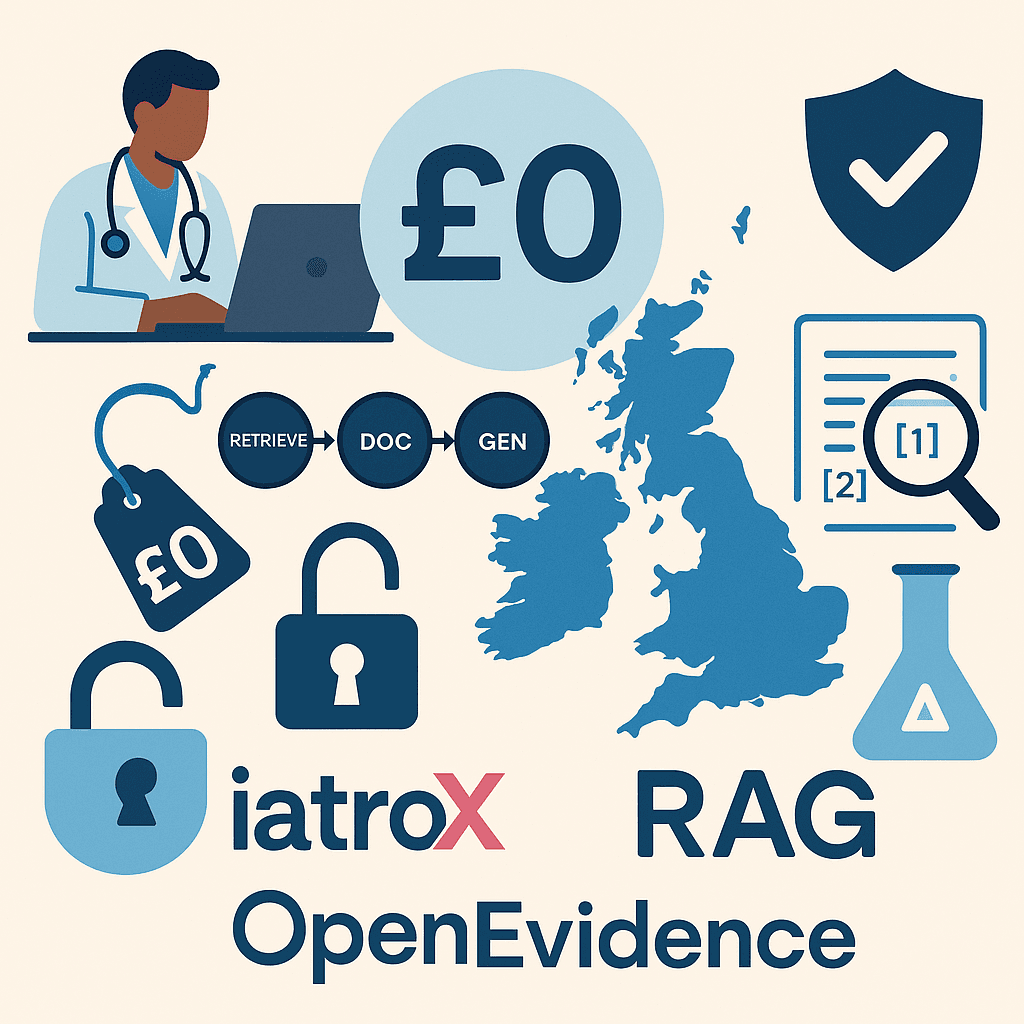
Crucially, effectiveness is a function of design, not price. Accuracy in clinical AI hinges on a "provenance-first" architecture, such as Retrieval-Augmented Generation (RAG), which uses gated, authoritative sources and transparent citations—principles endorsed by the World Health Organization (WHO). In this new landscape, a new guard of free leaders is emerging. iatroX, a UK-centric and citation-first platform with an adaptive quiz, and OpenEvidence, which offers free access for verified clinicians, are demonstrating how "free at point of use" can meet and exceed clinical expectations.
Why “free at point of use” matters in the NHS
- Adoption without procurement drag: Free access for individual clinicians removes the significant licensing hurdles that can slow down pilots and grassroots adoption. This model aligns perfectly with the NHS culture and the positive sentiment staff have towards AI.
- Equity & consistency: When a high-quality clinical tool costs £0 to the end-user, every ward, practice, and department can access the same standard of knowledge support. This is particularly powerful when the product, like iatroX, is designed with a UK-specific context in mind, helping to level the playing field for all.
The macro-economics: why powerful AI can be free
The idea of a powerful, enterprise-grade tool being free might seem counterintuitive, but it's driven by powerful economic and technological trends.
- LLM “deflation”: Independent analyses from firms like Andreessen Horowitz have shown that the price to achieve a given level of LLM performance is plunging, with order-of-magnitude cost reductions per year on some benchmarks. This dramatically lowers the marginal cost of answering each clinical query.
- Competition from strong open models: The performance of open-source AI models is rapidly catching up to proprietary ones, putting downward pressure on commercial pricing across the board.
- Freemium cross-subsidy: Platforms can build a sustainable business model by charging enterprises for deep integrations, advanced analytics, and compliance support, while keeping the core clinician-facing features completely free.
Effectiveness is engineered: RAG, gated sources, audit trails
What makes a clinical answer trustworthy has nothing to do with its price tag. The WHO’s guidance on large multimodal models in health makes it clear that trust is built on transparency, human oversight, and provenance. In practice, this means a safe clinical AI must be built on a foundation of:
- Retrieval-Augmented Generation (RAG): The AI must ground its answers in an external, verifiable knowledge base.
- Gated, authoritative corpora: The knowledge base itself must be a "walled garden" of trusted sources, such as national guidelines and peer-reviewed literature.
- Clear citations and date-stamps: The AI must always show its work.
With a robust retrieval and curation pipeline, even smaller, more cost-effective models can outperform "bigger" ones on clinical Q&A, because they are grounded in the right, high-quality sources.
Today’s free front-runners
iatroX (UK-centric; free for everyone)
- What it is: A UKCA-marked, MHRA-registered clinical tool with the Ask iatroX Q&A engine, a Knowledge Centre, and the iatroX Quiz for adaptive and spaced repetition revision—with free clinical reference and selected banks; other learning tools require all-access, with no ads.
- Why it’s effective: It uses an architecture of algorithmic search and RAG over a library of UK-accepted guidance and peer-reviewed research. It provides visible citations and is designed to help clinicians navigate UK practice. Its spaced repetition feature is backed by strong evidence from medical education.
- When to use: For daily look-ups in UK practice, for the rapid debrief of questions after an MCQ session, and for capturing learning for your CPD portfolio.
OpenEvidence (free for verified clinicians)
- What it is: A medical reference platform that synthesises research into point-of-care answers with references. It is explicitly free and unlimited for verified healthcare professionals.
- When to use: It is a powerful tool for literature-heavy queries, broad evidence scans, and for exploring US-focused content.
Cheap ≠ risky: meeting UK assurance while staying free
Free tools are not exempt from governance. When used in an NHS setting, they must still align with the principles of the UK's safety and assurance frameworks.
- Follow the rulebook: NHS England’s 2025 guidance for AI and ambient scribing sets clear expectations on clinical safety, data protection, and the non-negotiable need for human oversight.
- The practical bar: Demand visible citations, version history, and a clear "abstention" behaviour for uncertain queries. Prefer tools that have published governance notes or hold relevant regulatory markings.
Where free AI saves time (and money) today
- Reference/search time: Free, citation-first Q&A tools like iatroX can collapse a time-consuming, multi-tab search into a single, efficient answer flow.
- Learning efficiency: Free adaptive and spaced repetition tools improve knowledge retention and reduce the total time needed to re-study topics, a benefit well-documented in medical education literature (PubMed).
- Zero-licence pilots: Teams can run low-risk, high-value trials of these tools to generate local evidence and build a business case before committing to any wider, enterprise-grade integrations.
FAQs
- Is “free” sustainable for these companies?
- Yes. The costs of running these AI models are falling rapidly. Vendors can monetise enterprise-level features (like deep EHR integrations or advanced analytics) while keeping the core tools for clinicians free.
- Will a free tool be accurate?
- Yes, if it is designed correctly. A tool that uses RAG technology over a high-quality, gated knowledge base and provides clear citations can be highly accurate, in line with WHO guidance for safe health AI. Price is not a proxy for accuracy.
- Which free tools should I try first in the UK?
- Start with iatroX for its UK-centric guideline look-ups and its adaptive quiz. You can complement this with OpenEvidence for rapid, literature-based answers from a global perspective.