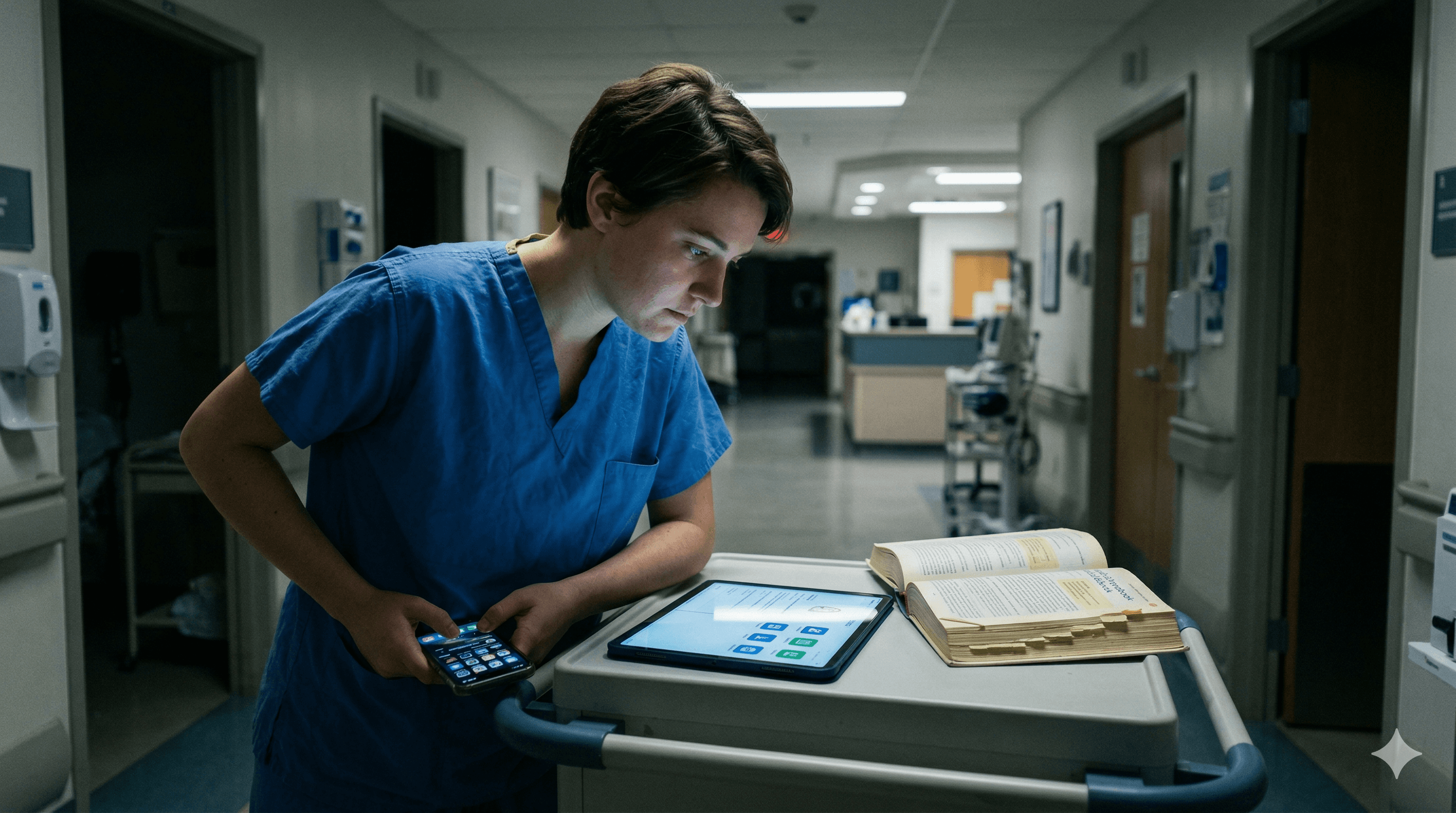
The transition from medical student to junior doctor is also a transition in what you need from technology. You're no longer studying medicine — you're doing it, often at 3am with nobody to ask. Here's what actually helps.
Clinical decision-making
iatroX (iatrox.com) — AI clinical search for real-time guideline queries. "What's the first-line antibiotic for community-acquired pneumonia in penicillin allergy?" answered in seconds with NICE/CKS references. Faster than opening CKS on a ward computer. Free core features, iOS/Android/web.
Medicines-reference access — before starting work, confirm which current service your organisation supports and how to access it on the ward. Check product-specific licensed information in the relevant SmPC on eMC and use NICE, SPS and local guidance for clinical recommendations.
MDCalc — clinical calculators. CHA₂DS₂-VASc for AF, Wells for PE, CURB-65 for pneumonia severity, Glasgow-Blatchford for upper GI bleeds. You'll use these on every acute take.
Microguide — local antimicrobial guidelines. Many trusts publish their own antibiotic formulary through Microguide. Check if your trust uses it — local guidelines trump national ones for prescribing.
Induction (now Pando) — hospital communication app used by many NHS trusts. Secure messaging, team directories, handover tools. Check what your trust uses before your first day.
Rota and scheduling
Messly — locum shifts and rota management. If you're picking up extra shifts for income (or swapping shifts for sanity), this is the most widely used platform.
Google Calendar / Outlook — sync your rota to your phone calendar. This sounds basic but the number of junior doctors who don't have their on-call schedule accessible at a glance is surprisingly high.
Career and portfolio
NHS ePortfolio / Horus — mandatory for recording curriculum evidence, supervised learning events, and workplace-based assessments. Not an app you choose but one you must use.
iatroX CPD (CPD tracking) — if you want to track learning reflections beyond the minimum portfolio requirements, particularly for GP trainees.
On-call survival
Oxford Handbook of Clinical Medicine — many juniors prefer the physical book, but the app version is searchable and always in your pocket. Worth the cost for on-call reference.
Toxbase — if your trust gives you access, this is the definitive UK resource for poisoning management. Essential for A&E and acute medicine.
Resus Council UK algorithms — the ALS, paediatric, and anaphylaxis algorithms in your pocket. You will need these on call. Photograph the posters in resus or download the official app.
The one piece of advice
On your first day, ask the FY2 you're replacing: "What apps do you actually use?" They'll give you the three that matter for your specific trust, specialty, and rota. Everything else is noise.
iatroX is built by a practising NHS GP for clinicians at every career stage. AI clinical search, UK qbanks, and CPD tracking.