Introduction
In 2026, the phrase "AI for doctors" is no longer specific enough. The market has splintered into distinct categories, each solving a different clinical problem. Using a deep-research engine for a quick prescribing check is as inefficient as using a textbook to write a discharge summary.
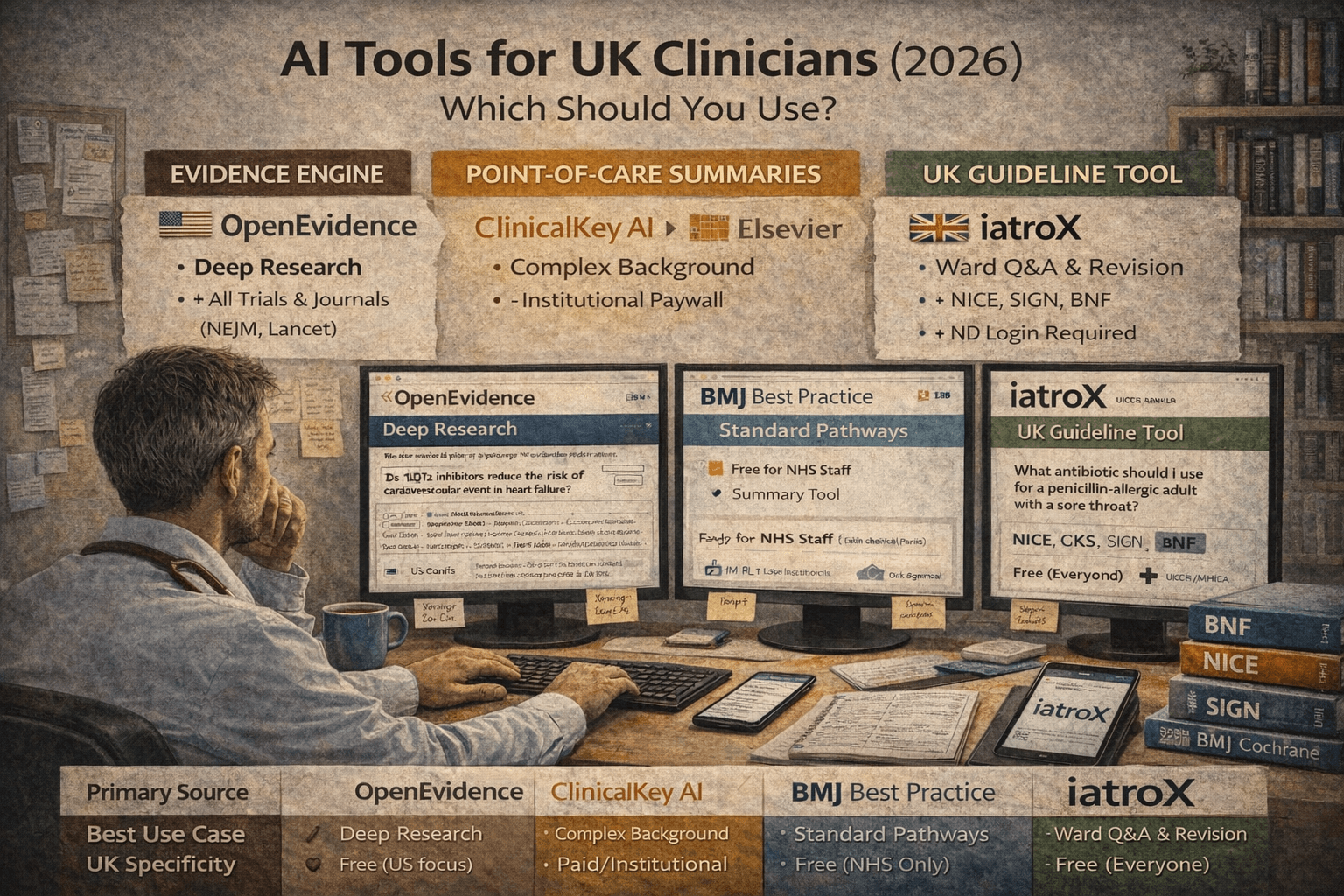
For UK clinicians, the choice now lies between three main types of tool: Evidence Engines (for deep literature), Point-of-Care Summaries (for structured management plans), and UK Guideline Tools (for instant, compliant answers). This guide compares the leaders in each category—OpenEvidence, ClinicalKey AI, BMJ Best Practice, and iatroX—to help you build the right stack.
1. The evidence engine: OpenEvidence
Best for: Deep dives, academic research, and complex questions where guidelines are silent.
- What it is: OpenEvidence is the "Google Scholar" of the AI world. It doesn't just read guidelines; it reads the raw, peer-reviewed literature (NEJM, JAMA, The Lancet) and synthesises an answer with inline citations.
- The Pros: It is incredibly powerful for "grey area" questions. If you ask, "What is the evidence for DOACs in antiphospholipid syndrome?", it will summarise the latest trials, not just the standard protocol.
- The Cons: It is US-centric. Access is often gated by NPI (National Provider Identifier) verification, which locks out many UK clinicians. It can also be "too much information" for a busy ward round—you often get a literature review when you just wanted a dosage.
2. The point-of-care summaries: ClinicalKey AI & BMJ Best Practice
Best for: Structured management plans and authoritative background reading.
- ClinicalKey AI (Elsevier): This tool layers conversational AI over Elsevier’s massive library of textbooks and journals.
- Pros: Trusted content from definitive texts.
- Cons: It is usually behind an expensive institutional paywall. If your Trust doesn't subscribe, you can't use it.
- BMJ Best Practice: The NHS standard.
- Pros: Free for NHS staff (via OpenAthens). It is structured perfectly for the consultation (History, Exam, Management).
- Cons: It is a "summary" tool, not a "search" tool. You are navigating a digital textbook, not asking a dynamic question. It tells you the "standard" patient pathway, but might struggle with specific, nuanced queries about a unique patient.
3. The UK guideline tool: iatroX
Best for: Daily ward work, rapid guideline checks, and exam revision.
- What it is: iatroX is a free, UK-centric clinical assistant. It is designed to bridge the gap between a search engine and a guideline repository.
- The Pros:
- UK-oriented retrieval: Configured sources include NICE, CKS and SIGN guidance and medicines information from relevant product SmPCs on eMC. Open each citation and check its date, scope and local applicability.
- Regulatory Confidence: Uniquely for a free tool, it states it is UKCA-marked and MHRA-registered for informational use, offering a level of governance that consumer chatbots lack.
- Multi-Modal: It isn't just for search. The Brainstorm feature helps with differential diagnosis, and the Quiz engine turns your clinical queries into adaptive revision questions for the UKMLA or MRCP.
- The Price: It is completely free with no ads, making it the most accessible tool for students and trainees.
Comparison matrix
| Feature | OpenEvidence | ClinicalKey AI | BMJ Best Practice | iatroX |
|---|---|---|---|---|
| Primary Source | Raw Literature | Textbooks/Journals | Editorial Summaries | UK clinical sources (NICE guidance and medicines information from SmPCs via eMC) |
| Best Use Case | Deep Research | Complex Background | Standard Pathways | Ward Q&A & Revision |
| UK Specificity | Low (US focus) | Medium | High | Very High |
| Access | Free (Verified US HCPs) | Paid/Institutional | Free (NHS Only) | Free (Everyone) |
| Regulatory | HIPAA (US) | Enterprise | NHS Approved | UKCA / MHRA |
Verdict
- For the Academic: Use OpenEvidence (if you can get access) to stay on top of trials.
- For the Trust Protocol: Use BMJ Best Practice for the definitive, approved summary.
- For the Daily Grind: Use iatroX. Its unique combination of UK-specific guideline retrieval, regulatory assurance, and zero cost makes it the essential "pocket registrar" for the modern NHS clinician.