AI scribes (also called ambient scribes or ambient voice technologies (AVTs)) can convert speech during a consultation into structured documentation such as notes and letters. NHS England has published national guidance to support safe adoption, including the expectation that services are transparent about how information is used and shared, and that patients are given a chance to object.
If you are deploying (or considering) an AI scribe in UK primary care, the single most important operational question is not “does it work?” — it is:
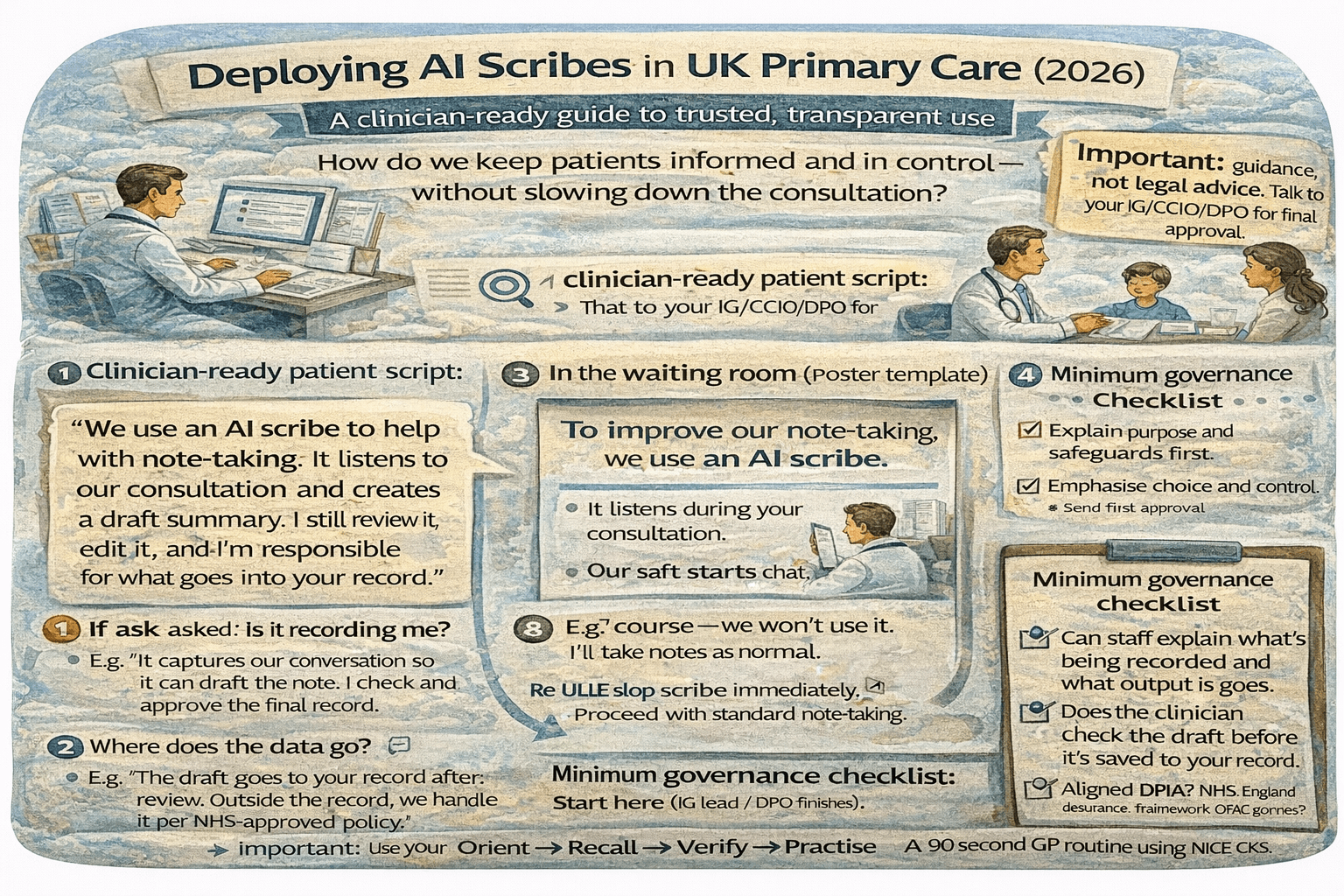
How do we keep patients informed, comfortable, and in control — without slowing down the consultation?
This guide gives you:
- A clinician-ready 30‑second script for patients.
- A poster/website wording template.
- A one-line clinical record template (plus an “objection” code line).
- A minimum governance checklist aligned with NHS England and CQC thinking.
Important: This is practical guidance for clinical services. It is not legal advice. Use your local IG lead / DPO / CCIO/CSO process for final approval.
The mindset: consent is not always the point — transparency is
A common misconception is that every AI tool requires a brand-new consent workflow. That is not how regulators frame it.
CQC’s GP Mythbuster 109 is explicit that the type of consent (implied vs explicit) depends on the use-case, and that because AI tools are new you should tell people you’re using them, focusing on transparency and the ability to object rather than automatically seeking explicit consent for direct care.
NHS England’s ambient scribing guidance is similarly clear: you should be transparent about how information is used and shared, explain it before processing takes place, and give people the chance to object.
So the practical aim is:
- Tell patients what is happening (in plain English).
- Make refusal easy (no detriment to care).
- Document that you informed them and that you reviewed the output.
What patients should be told (the “4 truths”)
Your message should cover four things, consistently, every time:
-
What is being captured
- “We use an AI scribe that listens to our conversation to draft notes.”
-
What the output is
- “It produces a draft summary/transcript/letter draft — not a final record.”
-
Who uses it and where it goes
- “Only the clinical team uses the draft, and it is stored in your health record the same way a normal note is (after review).”
-
Choice and control
- “If you’d prefer not to use it, that’s completely fine — I’ll type as usual.”
NHS England’s guidance suggests transparency materials may include: what is being recorded, what the output will be, who will use it and how it will be stored, and relevant IG statements.
The 30-second patient script (clinic-ready)
Use this verbatim if you like.
“We use an AI scribe to help with note‑taking. It listens to our consultation
and creates a draft summary. I still review it, edit it, and I’m responsible
for what goes into your record.

If you’d rather we don’t use it today, just tell me — it won’t affect your care.
Would you like me to use it?”
If the patient asks “Is it recording me?”
“It captures our conversation so it can draft the note. What matters is that I
check and approve the final record. If you prefer not to have it used, we can
switch it off immediately.”
If the patient asks “Where does the data go?”
Use a service-approved answer based on your vendor + DPIA. The structure:
“The draft note goes into your clinical record after my review.
Our practice uses approved systems and follows NHS information governance.
If anything is stored outside the record (like temporary audio/transcripts), it
is handled according to our policy and security controls.”
(Your privacy notice should carry the precise details; see template below.)
The refusal pathway (make it effortless)
A patient objection should be treated like any other reasonable preference in a consultation:
- No debate.
- No coercion.
- No impact on access.
Micro-script:
“Of course — we won’t use it. I’ll take notes as normal.”
What to do operationally:
- Stop the scribe immediately.
- Ensure no unintended capture continues.
- Proceed with standard documentation.
- Add a one-line record entry (template below).
How to document it (templates you can paste into the record)
Choose the variants that match your local policy and your vendor behaviour.
A) Default documentation line (no objection)
AI scribe (ambient documentation) used to draft consultation note.
Patient informed; opportunity to object offered; no objection raised.
Clinician reviewed/edited output prior to filing in record.
B) Patient declined
AI scribe discussed; patient declined. Standard note-taking used.
C) If your workflow retains audio/transcripts temporarily (only if true)
AI scribe used. Patient informed about capture and retention per practice policy.
Clinician reviewed/edited output prior to filing.
Tip: keep the note factual and short. The goal is a defensible audit trail, not a legal essay.
Poster / waiting-room screen / website wording (copy/paste)
NHS England’s guidance notes that information can be shared via direct conversation, public areas, and online channels.
Short poster (plain English)
We use an AI scribe to help clinicians write accurate notes.

• It listens during the consultation to create a draft summary.
• Your clinician checks and edits the draft before it’s saved to your record.
• You can ask us not to use it at any time — this won’t affect your care.

Ask a member of staff if you have questions.
Website / privacy notice paragraph (more detailed)
Our service may use an AI-enabled ambient scribing tool to support clinical
documentation. This tool may capture audio of the consultation and generate a
draft transcript or summary to help your clinician write notes or letters.

Your clinician remains responsible for the clinical record and reviews and edits
any draft before it is saved.

We are transparent about how information is used and shared. Details of what is
captured, what outputs are produced, who can access them, how long they are kept,
and how they are secured are described in this privacy notice and our information
governance documentation.

You can object to the use of this tool at any time; we will document the
consultation in the usual way.
When you may need something stronger than “implied consent”
CQC’s framing is practical: consent requirements depend on what the AI is doing.
In many direct-care settings, you may rely on implied consent under the common law duty of confidentiality — but you should still tell patients and allow them to object.
However, you may need a different approach (and potentially explicit consent or another lawful basis) if your deployment involves any of the following:
- Using consultation audio/transcripts for model training or product development.
- Retaining audio for long periods without a clear direct-care necessity.
- Using outputs beyond direct care (e.g., research, marketing, non-care analytics).
- Sharing identifiable data beyond the care team in ways not covered by your DPIA/contracts.
If any of the above applies, treat transparency materials and your DPIA as non-negotiable, and involve your IG/DPO early.
The minimum transparency checklist (aligned with NHS England + CQC thinking)
Before “go live”, ensure you can answer these questions clearly and consistently:
Patient-facing transparency
- Can staff explain what is being recorded and what output is generated?
- Can staff explain who uses the output and how it is stored?
- Is there a clear “you can say no” pathway?
- Do posters/website wording match reality?
Documentation integrity
- Is the clinician reviewing/editing the output before filing?
- Are there safeguards against “automation bias” and copy-paste errors?
Information governance (service-level)
- Have you completed/updated a DPIA and documented lawful basis?
- Have you reviewed vendor assurances on how data is shared, stored, used, and secured?
- Have you aligned to relevant NHS safety and assurance processes (e.g., DCB0129/DCB0160, DTAC, DSPT) as appropriate for your setting?
Clinical safety
- Is there a named clinical safety lead and a hazard log/safety case approach?
- Is there a clear incident pathway (including learning from errors and appropriate reporting)?
A practical way to use iatroX alongside AI scribes (to stay defensible)
AI scribes help you produce a better draft note. They do not replace the need to anchor decisions to authoritative guidance.
A simple, defensible pattern:
- Use iatroX Knowledge Centre to orient quickly to the relevant NICE/CKS/SIGN leaf page.
- If the case is nuanced, use a /shared scenario explanation for referenced reasoning.
- Add a brief documentation line: “Aligned with NICE/CKS; date checked; safety net given.”
This keeps your record anchored to sources of truth — and keeps the audit trail clean.
Sources and further reading (UK)
-
CQC GP Mythbuster 109 (AI in GP services; includes consent/transparency expectations): https://www.cqc.org.uk/guidance-providers/gps/gp-mythbusters/gp-mythbuster-109-artificial-intelligence-gp-services
-
NHS England guidance on AI-enabled ambient scribing products (updated January 2026; includes transparency “chance to object” checklist): https://www.england.nhs.uk/long-read/guidance-on-the-use-of-ai-enabled-ambient-scribing-products-in-health-and-care-settings/
-
NHS Transformation Directorate page: adopting ambient scribing products (updated February 2026): https://transform.england.nhs.uk/digitise-connect-transform/digitising-the-frontline/adopting-ambient-scribing-products-in-health-and-care-settings/
-
ICO (transparency in AI and data protection expectations): https://ico.org.uk/for-organisations/uk-gdpr-guidance-and-resources/artificial-intelligence/guidance-on-ai-and-data-protection/how-do-we-ensure-transparency-in-ai/
-
Londonwide LMCs guidance (AI ambient scribes in general practice; includes examples of products used in London): https://www.lmc.org.uk/resources/use-and-adoption-of-ai-ambient-scribes-in-general-practice/