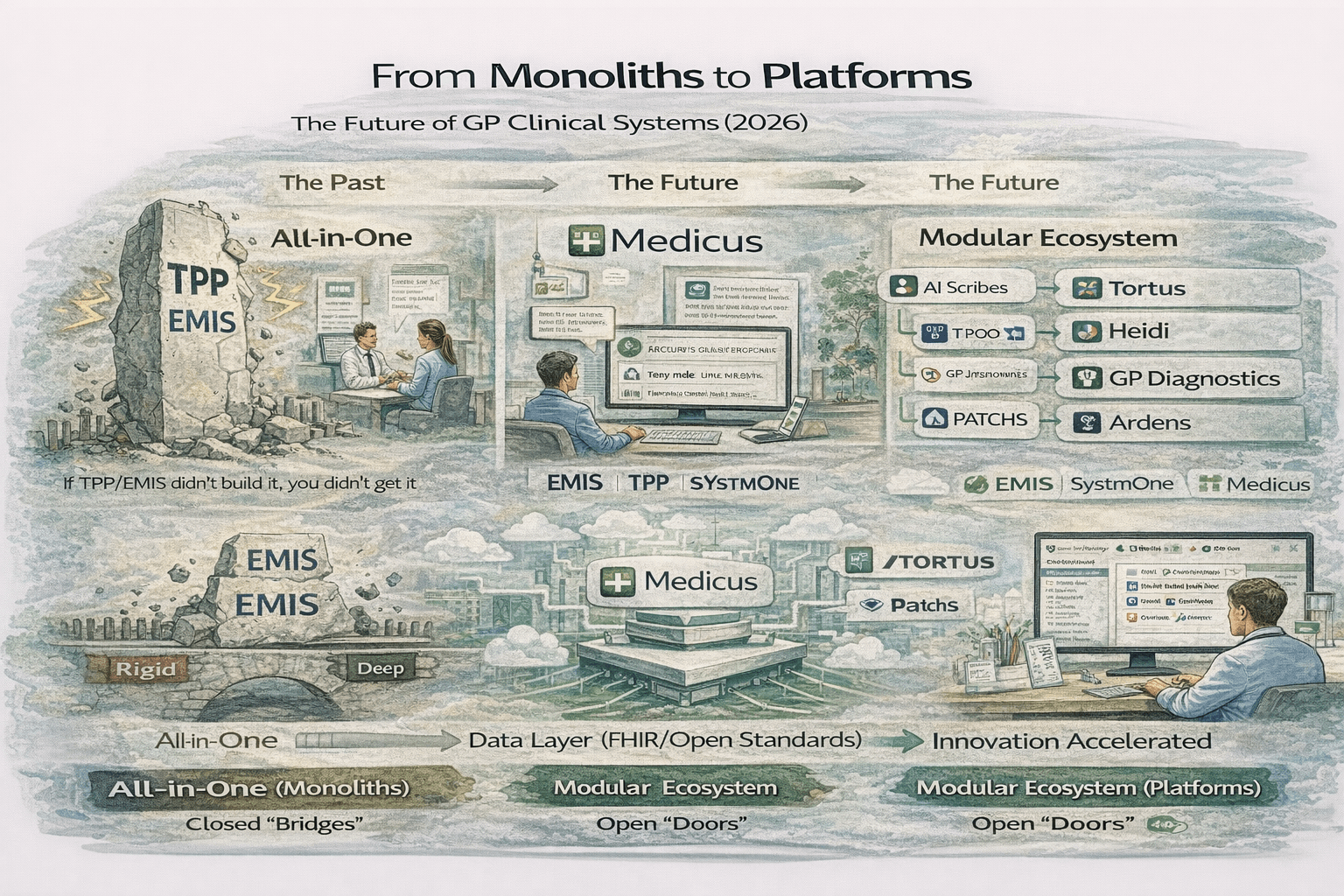
For the last two decades, "innovation" in GP IT meant waiting 18 months for your clinical system supplier to release a patch. If EMIS or TPP didn't build it, you didn't get it.
In 2026, that logic is inverting. The most exciting AI tools—ambient scribes, diagnostic decision support, population health predictors—are being built outside the core Electronic Health Record (EHR). The defining characteristic of a modern GP system is no longer "what features does it have?" but "how easily does it let other features in?"
The arrival of Medicus Health, the first new core clinical system approved in 25 years, signals the shift from Monoliths to Platforms.
Medicus’ approval and what it signals
Medicus Health’s approval under the NHS Tech Innovation Framework is a watershed moment. It breaks the long-standing EMIS/TPP duopoly, but more importantly, it validates a new architectural philosophy.
Medicus was built natively on the cloud with open standards (FHIR) from day one. Unlike legacy systems that have to build "bridges" to let data out, modern platforms are built with "doors" (APIs) open by default. This signals to the market that the GP record is becoming a data layer, upon which agile startups can build the intelligence layer.
Why “integration catalogues” are the future
In the old world, if you wanted a smarter appointment book, you lobbied your system supplier. In the new world, you browse an Integration Catalogue.
Medicus has explicitly positioned itself as a hub. Their integrations page reads like a "Who's Who" of the AI startup scene:
- AI Scribes: Native integrations with tools like Heidi, TORTUS, and T-Pro.
- Telephony: Seamless links with Surgery Connect and Babblevoice.
- Workflow: Connections to Ardens and eConsult.
This "App Store" model allows a practice to upgrade their scribing capability without changing their clinical record. It decouples the pace of AI innovation from the slow pace of core infrastructure regulation.
The second-order effects
This shift creates three massive second-order effects for General Practice:
- Faster Iteration: An AI scribe startup can release weekly updates. A GP system supplier releases quarterly. By decoupling them, GPs get feature improvements at the speed of the startup, not the speed of the EHR.
- Niche Tooling: We will see hyper-specialised tools emerge. Instead of a generic "Search," you might plug in a "Cardiology Risk Engine" that pulls data, calculates risk, and writes back to the notes—all without the EHR builder having to write a line of code.
- Reduced Lock-in: If your data is standard (FHIR) and your tools are modular, switching core systems becomes less terrifying. You can swap Medicus for EMIS (or vice versa) and keep your favourite AI scribe, provided both support the open standard.
What this means for EMIS/TPP incumbents
The giants are not sleeping; they are pivoting.
- EMIS (The Partner Ecosystem): EMIS has aggressively pursued its Partner Programme (now under Optum). They are effectively becoming the "iOS of GP IT"—a stable, secure platform that encourages a rich ecosystem of approved apps (like Ardens and Accurx) to provide the functionality.
- TPP (The Integrated Fortress): TPP has historically favoured building features in-house ("One Patient, One Record"). However, the pressure of the IM1 and GP Connect mandates has forced open the doors. While TPP still prefers native functionality (e.g., their own DNA prediction AI), they are increasingly having to coexist with third-party innovators who offer features TPP cannot match in speed.
Where iatroX fits
In a modular world, iatroX fits as the Independent Reasoning Layer.
Whether your practice runs EMIS, TPP, or Medicus, the need for "thinking support" remains constant.
- Brainstorm operates alongside your EHR. You use it to reason through the complexity of the case, generating a differential and a plan.
- The Write-Back: You then copy the structured output into your notes—regardless of which logo is on the screen.
Because iatroX is an independent clinical reasoning engine, it survives the "platform wars." It ensures that even if your practice swaps IT providers next year, your cognitive support system remains stable.
The future of GP IT isn't one giant brain; it's a network of smart tools talking to each other. Experience the independent reasoning layer today with iatroX.