For the last six months, we have talked about the "AI-Prepared Patient" as a niche phenomenon—the tech-savvy early adopter using ChatGPT.
With the rollout of the new NHS App features this week, that niche has just become the norm. The government’s explicit goal is to put a "doctor in your pocket," using AI to help millions of patients articulate their needs, understand their options, and arrive at your door with a structured agenda.
This is no longer just "Dr Google." This is a state-sponsored shift in consultation dynamics. The patient isn't just arriving with a symptom; they are arriving with a My Companion summary.
Here is how to adapt your 10-minute workflow to survive—and actually benefit from—this shift.
Why this is happening (and why it’s not inherently bad)
The intent behind features like My Companion is to ensure there are "two experts in every consulting room."
- Empowerment: Patients often forget their key questions due to anxiety. The App ensures they articulate what matters to them.
- The "Digital Front Door": With the move towards the "NHS Online" hospital model, the App is being positioned as the primary triage point. By the time they see you, they have likely already navigated My NHS GP (triage) and My Choices (provider selection).
The failure modes (what goes wrong if you don’t adjust)
If you treat an AI-prepared patient like a standard patient, the consultation will derail in predictable ways.
- Agenda Overload: The patient reads out 12 questions generated by the App because "it told me to ask these."
- Anchoring: "The App said it’s likely reflux, so I just want the pills," (premature closure by the patient).
- Service Shopping: "I checked My Choices and I want a referral to Hospital X because their outcome data is better," (shifting the consult into admin negotiation).
- Safety Netting Dilution: "I’m not too worried about the chest pain because the App said my risk score was low."
- Digital Exclusion Tension: You may see family members aggressively mediating for elderly relatives, using the App on their behalf and demanding the same "AI-validated" care pathway.
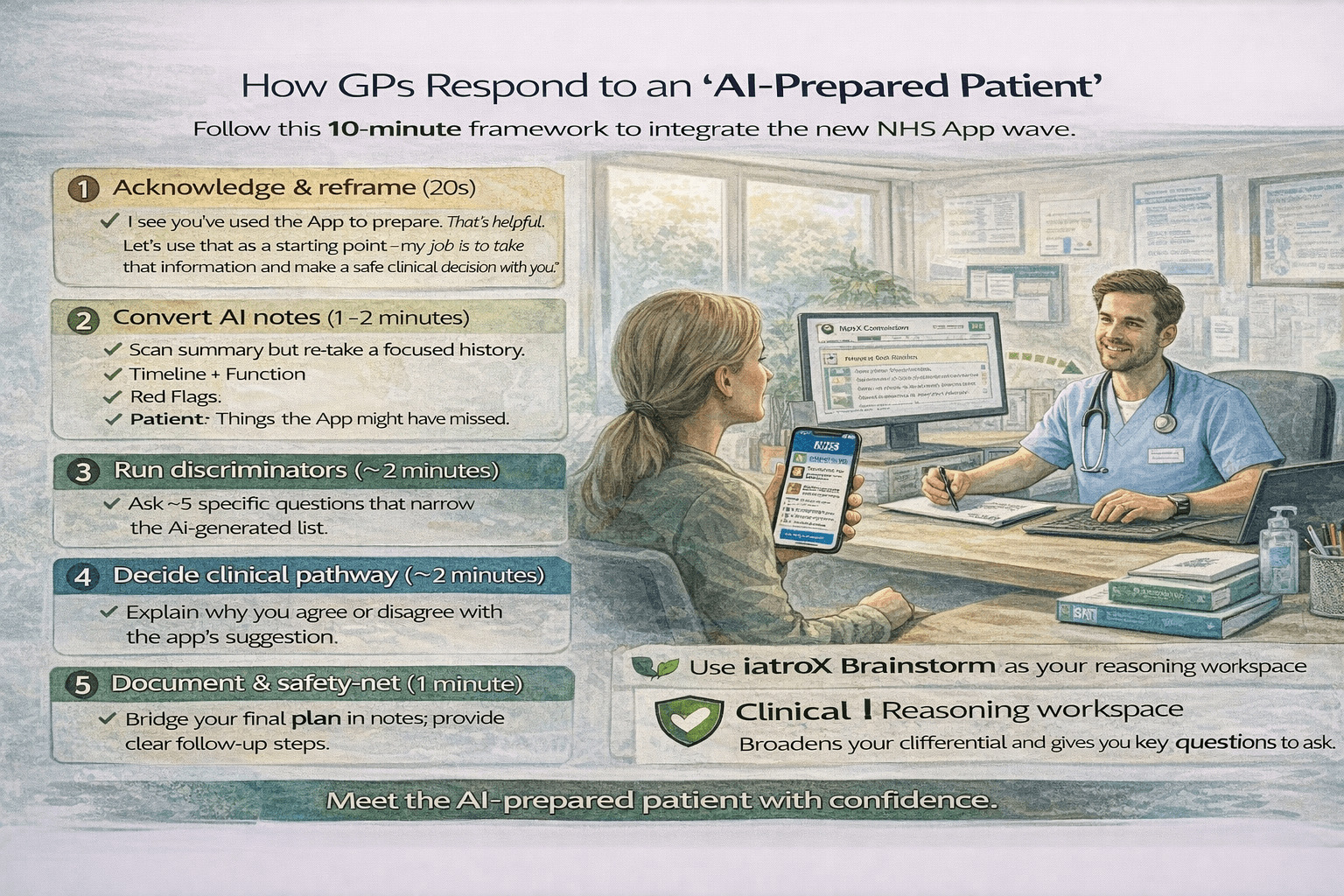
The 10-minute workflow (a simple, repeatable script)
You cannot fight the technology. You must wrap your workflow around it.
Step 1 — Acknowledge & reframe (20 seconds) Don't ignore the phone in their hand. Validate it immediately.
"I see you’ve used the App to prepare. That’s helpful. Let’s use that as a starting point—my job is to take that information and make a safe clinical decision with you."
Step 2 — Convert the AI output into a structured problem representation (60–90 seconds) Scan their summary but do not rely on it. Re-take the history with a focus on:
- Timeline + Function: "When did it start and what does it stop you doing?"
- Red Flags: Check the things the App might have missed.
- Patient Priority: "Of the questions the App suggested, which one is the most important to you today?"
Step 3 — Run a “discriminator pass” (2 minutes) The App gives you a broad list. You need to narrow it. Ask the 4–6 specific questions that actually change the management pathway. This is where you demonstrate that the "human expert" is superior to the "pocket doctor."
Step 4 — Decide the clinical pathway (2 minutes) Explain your reasoning clearly to manage the uncertainty the App may have created.
"The App was right to flag reflux, but because of your age and weight loss, I need to rule out other causes first."
Step 5 — Safety-net + follow-up logic (1 minute) Be explicit. "If X happens, call us." Do not let them rely on the App for deterioration monitoring unless it is a specific, commissioned remote monitoring tool.
Step 6 — Document the bridge (60 seconds) Protect your licence.
"Patient attended with NHS App/AI-prepared questions. Clinical assessment performed; history and exam [Findings]. Plan made based on clinical findings, not App triage."
Step 7 — Patient handout / recap (30 seconds) "Here is the plan. If the App gives you conflicting advice later, please follow these written instructions."
Where iatroX Brainstorm becomes the clinician’s “reasoning workspace”
If the patient is using AI to prepare, you need to use AI to think.
When a patient presents with a dense, App-generated list of "rare causes" for their headache, you don't have time to browse CKS manually. You need a fast way to broaden your differential without spiralling.
iatroX Brainstorm is your reasoning workspace. It sits beside your EHR, separate from the patient's noise.
The 30-Second Brainstorm Pattern
- Input: "45F, headache, App suggests asking about giant cell arteritis and idiopathic intracranial hypertension."
- Prompt: "Give me 6 discriminators for these features vs tension headache."
- Result: iatroX gives you the specific history/exam points to rule these out efficiently.
- Action: You ask the questions, document the negatives, and reassure the patient with confidence.
This is not about "getting the answer"—it is about getting the discriminators so you can manage the agenda density safely.
Practice-level operating model (so this scales)
You cannot do this alone. Your practice needs a policy.
- Reception/Triage: Train staff to handle "The App told me to book." (Script: "We treat patients, not apps. We will triage you based on your symptoms.")
- Same-Day Duty: Agree on criteria. Just because My NHS GP suggests "urgent review" does not automatically grant a same-day slot if the clinical symptoms don't match your local protocol.
- Digital Exclusion: Ensure your message to patients is clear: "You do not need the App to see a doctor. We are always here for you via phone or walk-in."
FAQ
What is an AI-prepared patient? A patient who arrives at a consultation having used AI tools (like the NHS App's My Companion or ChatGPT) to triage their symptoms, generate a differential diagnosis, and prepare a list of questions.
Will the NHS App give diagnoses? No. The NHS App's AI tools are designed for triage (directing to the right service) and preparation (helping articulate symptoms). They do not provide a definitive medical diagnosis.
How should GPs respond when patients bring AI advice? Acknowledge the preparation, use it as a history-taking aid, but explicitly state that your clinical assessment takes precedence. Verify any "red flags" the App raised and safety-net based on your own judgement.
How should I document it? Record that the patient used an AI tool to prepare. Document your independent history and examination findings separately. Explicitly note if your management plan differs from the App's advice and why.
Meet the AI-prepared patient with confidence. Use iatroX Brainstorm to sharpen your clinical reasoning in the moment.