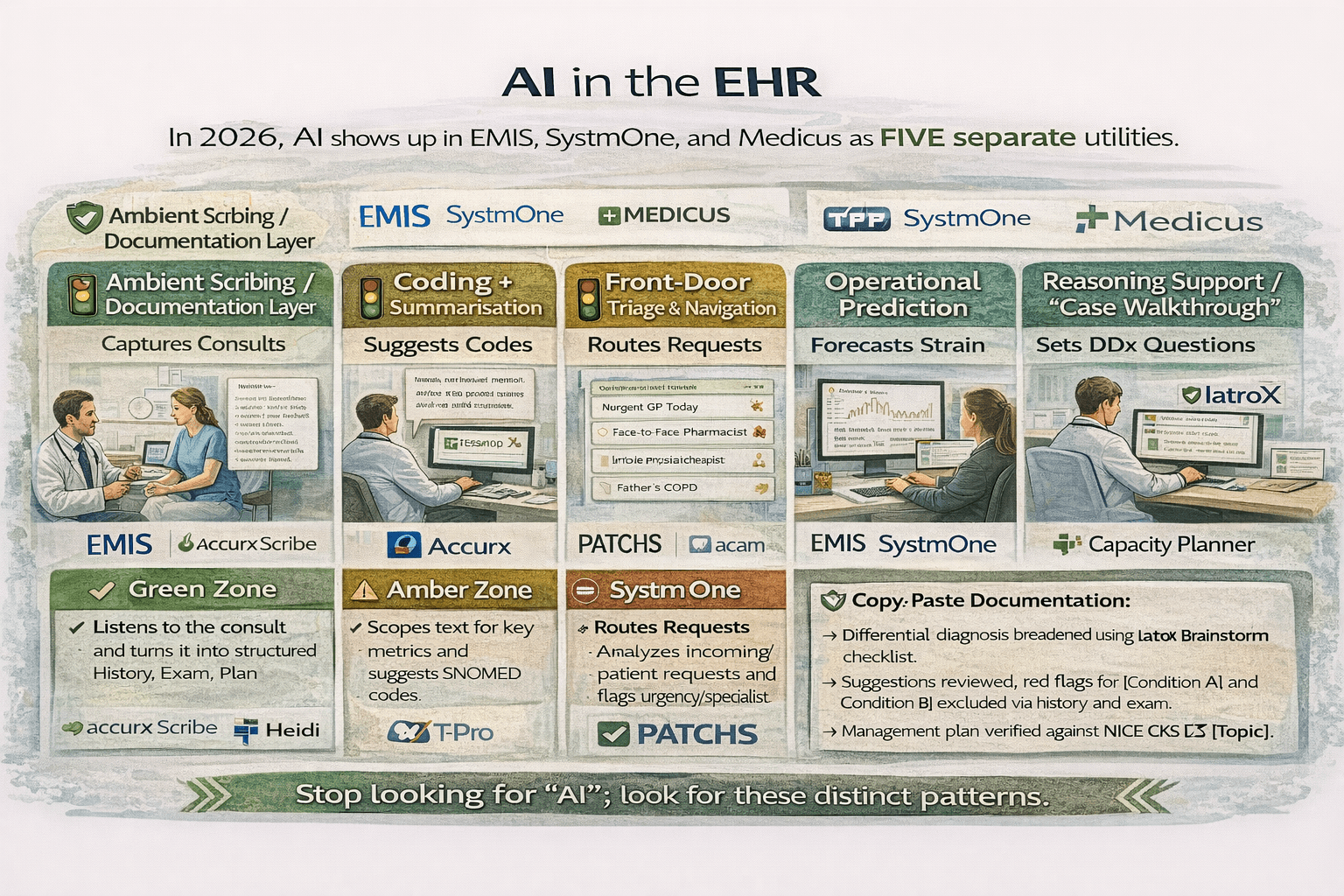
The conversation about "AI in the EHR" is often lazy. It treats AI as a monolithic "brain" that will take over the computer.
In reality, by 2026, AI is showing up in EMIS, SystmOne, and Medicus in five distinct, boring, and highly specific patterns. It is not one big brain; it is five separate utilities.
If you are a partner or practice manager, stop looking for "AI." Look for these five integration patterns to understand what you are actually buying.
Pattern 1 — Ambient scribing / documentation layer
This is the most visible shift in 2026. The keyboard is no longer the primary input device for the consultation.
- The Mechanism: The software listens to the consult (with consent), separates speaker voices, and converts the audio into a structured consultation note (History, Exam, Plan).
- EMIS Web: The dominant model here is Partnership. EMIS has opened its "partner programme" to tools like Accurx Scribe, Heidi, and T-Pro. These tools sit as an "overlay"—you open them alongside EMIS, they capture the text, and then "write back" the finished note into the consultation via an API or a smart paste.
- SystmOne: TPP has traditionally built in-house. Expect to see native speech-to-text features that are deeply embedded, alongside integrations for third-party giants like Accurx.
- Medicus: As the newer challenger, Medicus positions AI as "native, not bolt-on." In Medicus, ambient scribing is often a core feature of the UI itself, rather than a third-party plugin you have to launch separately.
Pattern 2 — Coding + summarisation
This is the "invisible" AI that solves the QOF/IIF headache.
- The Mechanism: Instead of a human manually selecting "Asthma annual review" from a dropdown, the AI reads the free-text note and suggests the SNOMED code.
- Accurx Scribe: Explicitly positions itself here. It doesn't just transcribe; it parses the text for key metrics (BP, weight, smoking status) and offers them as "one-click" SNOMED codes to save to the record.
- The value: It turns "narrative" into "data" without the clinician having to be a coding expert.
Pattern 3 — Front-door triage & navigation
This happens before the patient enters the consulting room.
- The Mechanism: An "AI receptionist" that reads the patient's online request, assesses urgency, and routes it to the right slot (GP vs Pharmacist vs Physio).
- Example: Patchs (often integrated with EMIS/SystmOne) uses AI to analyse the narrative. It doesn't just look for keywords; it attempts to understand the sentiment and clinical urgency.
- OneAdvanced: Providers like Advanced are increasingly integrating these "smart front doors" to prevent the 8am bottleneck, automating the "signposting" that receptionists used to do manually.
Pattern 4 — Operational prediction
This is AI for the Practice Manager, not the GP.
- The Mechanism: Predictive analytics that look at historical data to forecast future strain.
- TPP SystmOne: TPP has led the way here with its DNA (Did Not Attend) Prediction tools. By analysing a patient's history, age, and distance, the system flags the appointment as "High risk of DNA," prompting the admin team to send an extra reminder.
- Capacity Planning: Newer tools are predicting "winter pressure" surges based on local viral prevalence, allowing practices to adjust rota capacity weeks in advance.
Pattern 5 — Reasoning support / “case walkthrough”
This is the missing link. The EHR (EMIS/SystmOne) is a System of Record (storage). It is not a System of Reasoning (thinking).
- The Gap: Ambient scribes are great at recording what you said, but they are terrible at helping you decide what to do. They lack the clinical reasoning capability to say, "Have you considered this differential?"
- Where iatroX fits: This is the role of Brainstorm.
- The Workflow: You use Brainstorm alongside the EHR as a "de-identified clinical reasoning layer."
- The Action: You input the problem representation (e.g., "45F, RUQ pain, fever") into Brainstorm to generate a differential checklist and discriminators.
- The Integration: You make the decision in your head, then document the outcome in EMIS/SystmOne.
- Why separate? Because you want a "sandbox" to think safely without polluting the permanent legal record with your messy thought process.
The procurement/governance reality
How do you know which tools are legal? In 2026, two acronyms shape the market:
- DTAC (Digital Technology Assessment Criteria): The NHS baseline. If a tool doesn't have a DTAC score, do not let it near your patient data. It covers clinical safety (DCB0129), data protection (GDPR), and technical security.
- AVT (Ambient Voice Technology) Registries: As ambient scribes explode, ICBs are moving towards "Assured Supplier Lists." They are scrutinising the "listening" governance—does the audio leave the UK? Is it deleted immediately after processing? (For tools like Accurx Scribe and others, the answer must be "Yes" to survive).