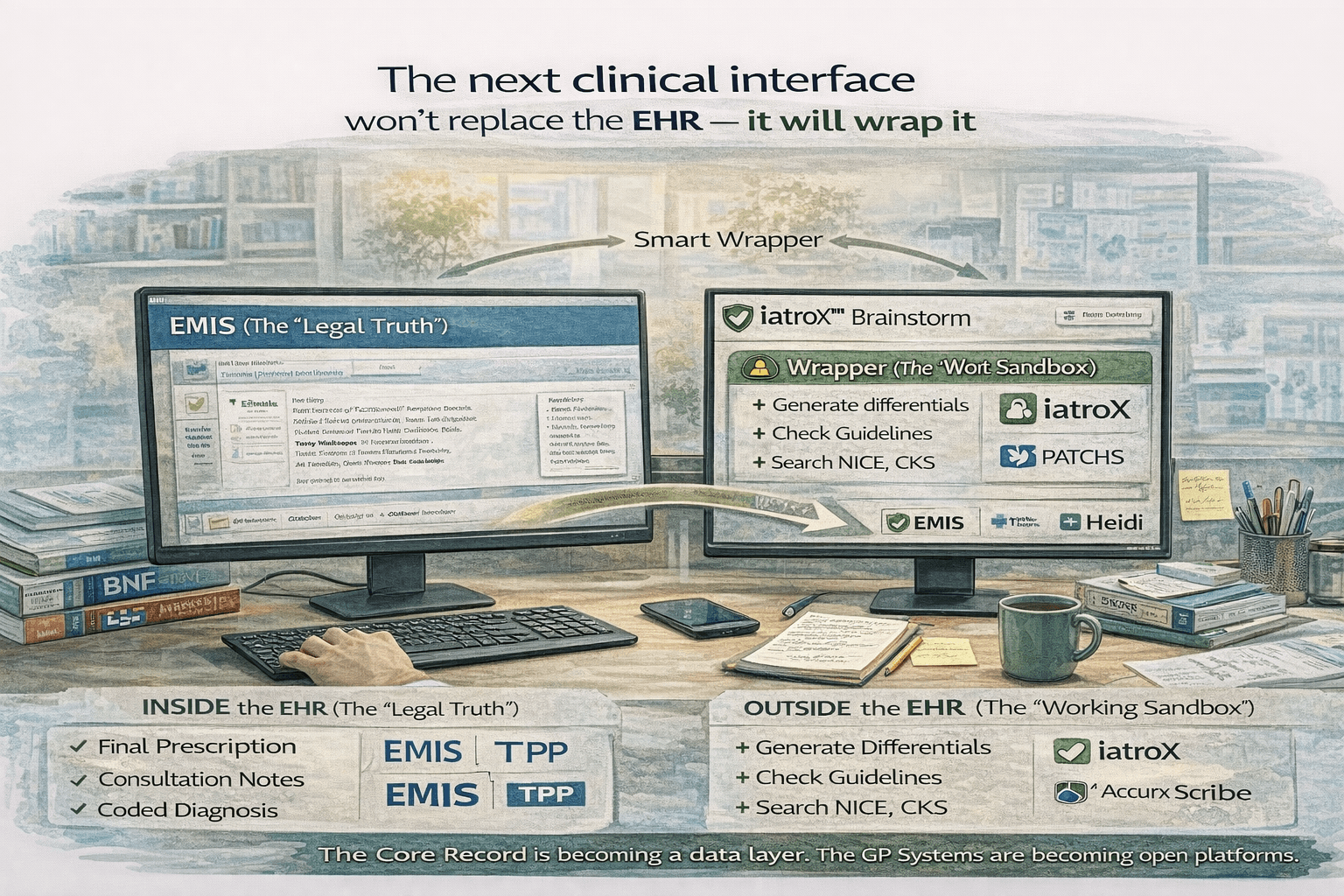
The next clinical interface won’t replace the EHR — it will wrap it
For the last decade, the dream of "Interoperability" was a single screen where everything lived inside EMIS Web or SystmOne. If it wasn't a tab in the clinical system, it didn't exist.
In 2026, that dogma is dead. The sheer pace of AI innovation has outstripped the procurement cycles of the major EHR suppliers. We are moving to a "Second Screen" architecture.
The future of clinical work isn't a better EHR; it's a smart wrapper that sits alongside the EHR, handling the thinking, listening, and searching, before pushing the final data into the record.
Why EHR replacement is rare
You might ask: "Why doesn't EMIS just build a ChatGPT button?"
- Safety Cases (DCB0129): Modifying a core Class I medical device (the EHR) requires massive regulatory validation. Every update takes months. AI startups iterate weekly.
- Workflow Risk: If the EHR goes down, the practice stops. Monolithic systems are fragile.
- Specialisation: An EHR is a database (System of Record). AI is a processor (System of Intelligence). They require fundamentally different architectures.
The “wrapper” approach: scribes + reasoning assistants + automation
The "Wrapper" sits on top of or beside the clinical system. It does the messy work, then "writes back" the clean result.
- The Listening Wrapper: Ambient scribes like Accurx Scribe (an EMIS partner) or Heidi don't live inside the consultation box. They float over it. They listen, process, and structured the text outside the record, then paste the SNOMED-coded result into the record.
- The Reasoning Wrapper: Tools that help you diagnose or decide (like Isabel or iatroX) act as a "cognitive sidecar." You don't want your messy brainstorming process ("Could this be cancer?") to be part of the permanent legal record until you have made a decision.
- The Automation Wrapper: Tools like Automate It or Robotic Process Automation (RPA) scripts sit outside the EHR, logging in as a "ghost user" to file bloods or send letters, wrapping the legacy software in a modern automation layer.
What stays inside the record vs outside it
To practice safely in 2026, understand the division of labour.
INSIDE the EHR (The "Legal Truth"):
- The final consultation entry.
- The prescription.
- The referral letter.
- The coded diagnosis (QOF).
OUTSIDE the EHR (The "Working Sandbox"):
- The raw audio of the consultation (processed and deleted).
- The draft versions of the notes.
- The Clinical Reasoning process (the "Brainstorming").
- The guidelines search (NICE/CKS lookups).
Where iatroX Brainstorm fits
iatroX Brainstorm is the definitive "Reasoning Wrapper."
It allows you to keep your "Thinking Space" separate from your "Recording Space."
- Open Brainstorm on your second screen (or phone).
- Input the messy problem: "45M, acute abdo pain, weird LFTs."
- Run the reasoning: Generate differentials, identify red flags, and select the right investigations.
- Commit to the Record: Once you have a clear plan, you type that clean, defensible decision into EMIS/TPP.
This separation protects you. It allows you to explore the differential broadly without cluttering the patient's permanent record with 20 hypothetical diagnoses that you subsequently ruled out.
Separate your thinking from your filing. Use iatroX Brainstorm as your clinical reasoning wrapper today.