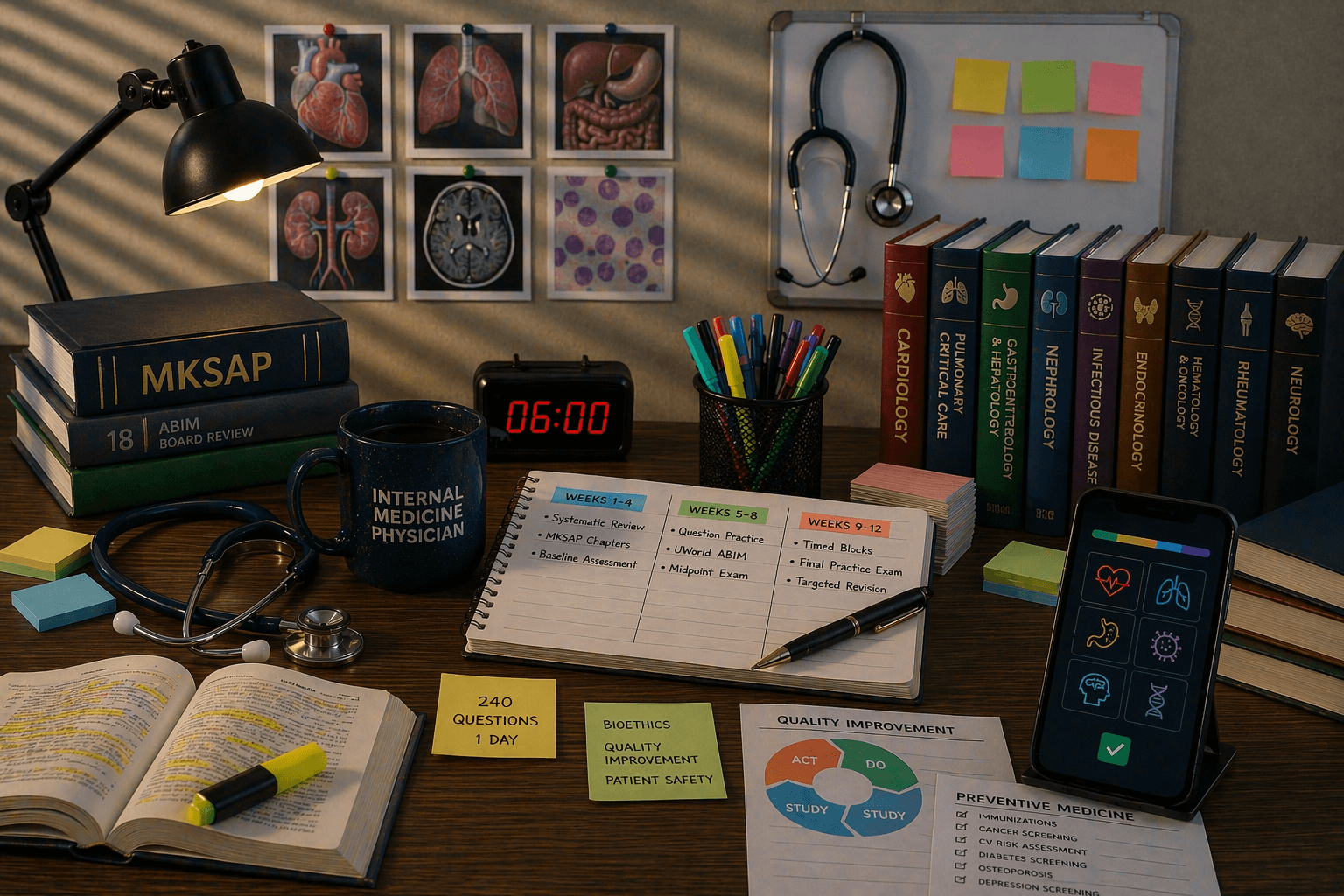
The ABIM certifying exam tests 240 questions across the full breadth of internal medicine in a single day. The blueprint covers every IM subspecialty — cardiology, pulmonology, gastroenterology, nephrology, infectious disease, endocrinology, haematology/oncology, rheumatology, neurology, general internal medicine, and cross-cutting topics (bioethics, quality improvement, patient safety).
Weeks 1-4 (Systematic Review)
MKSAP chapters — one subspecialty per week. Start with the highest-yield and most commonly tested: cardiology, pulmonology/critical care, gastroenterology/hepatology, infectious disease. Do 20-30 questions daily from MKSAP or UWorld ABIM. Take a baseline assessment to establish your starting point. Run iatroX adaptive mode for 15 minutes daily targeting your weakest subspecialties from the start.
Weeks 5-8 (Question Practice)
Transition to UWorld ABIM as your primary question source — 40-50 questions daily in timed blocks. Focus on subspecialties that your baseline assessment showed as weakest. Take a mid-point practice exam at the end of week 8 to calibrate progress. Continue iatroX adaptive sessions daily — the spaced repetition ensures that cardiology content from week 1 is still retrievable when you are studying nephrology in week 7.
Weeks 9-12 (Performance)
Full timed blocks simulating exam conditions (60-question blocks, 1 hour each). Final practice exam in week 11. Targeted revision of persistent weak areas using adaptive mode. High-yield final review: bioethics and end-of-life care (reliably tested), quality improvement methodology, preventive medicine guidelines, US-specific pharmacology. Last week: review only, rest.
Daily Schedule
1-2 hours on workdays (pre-rounds morning study is highest quality). 3-4 hours on off days. Spaced repetition via iatroX mobile between patient encounters — 15-minute sessions maintaining knowledge without requiring dedicated study blocks.