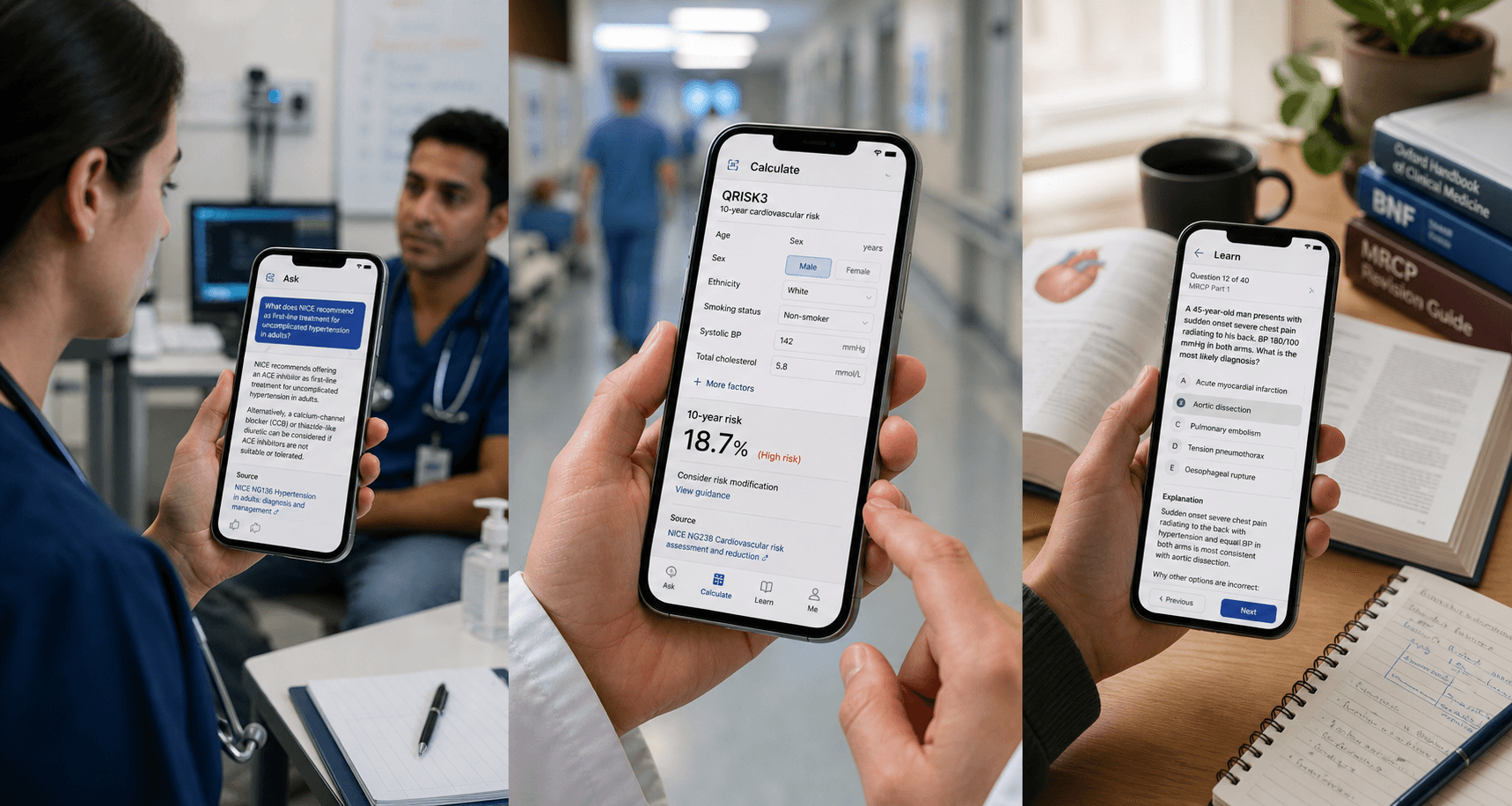
Ask. Calculate. Learn. These three workflows define how doctors interact with medical knowledge every day. A clinical question during a consultation. A risk score on a ward round. An exam question during a study session. A brainstorming exercise about a complex patient. A pharmacology lookup before prescribing. Three workflows — traditionally served by three or more separate tools — that iatroX brings together.
The Problem with Fragmented Medical Tools
A typical clinician's phone contains a collection of disconnected medical apps: a calculator app (or several — one for cardiovascular risk, another for hepatology scores, a third for paediatric tools), a guideline bookmarks folder in the browser, a Q-bank app for exam revision, a generic AI chatbot for general questions, a drug reference app, and assorted downloaded PDFs of local protocols and guidelines.
Each app serves one narrow purpose. Each requires a separate login. Each has a different interface. Each occupies mental space in the clinician's workflow — remembering which app handles which type of question, navigating to it, waiting for it to load, finding the relevant section.
The result is predictable: clinicians default to the fastest option available — usually a general search engine or a generic AI chatbot — rather than the most clinically appropriate one. Not because the purpose-built tools are not better, but because the friction of finding and switching to the right tool exceeds the time available in the clinical moment.
Workflow fragmentation wastes time, increases cognitive load, and reduces the quality of clinical information retrieval. The solution is not more specialised apps — it is fewer, broader, better-integrated ones.
Ask: Clinical Questions and Retrieval
Ask iatroX provides cited clinical answers — short, structured responses to natural-language clinical questions oriented around UK practice. The workflow is designed for the speed of clinical practice: ask in seconds, receive a cited answer, verify the source, apply judgment.
The clinical retrieval function supports both specific lookups ("What does NICE recommend as first-line for X?") and open-ended brainstorming ("Help me think through the differential for this presentation"). Both are designed for the micro-moments of clinical work — the 30 seconds between patients, the minute during a ward round, the brief pause before prescribing.
Core clinical information-retrieval and brainstorming workflows are designed to be accessible — these are the workflows clinicians need most frequently and that should not require a subscription to access at the point of clinical need.
Calculate: Risk Scores and Clinical Calculators
iatroX calculators include 80+ clinical scoring tools with editorial content, evidence summaries, and guideline references. Not just the score — the context. When to use the calculator. What the score means clinically. Which guideline recommends it. What action the score should trigger.
NEWS2 for acute deterioration assessment. QRISK3 for 10-year cardiovascular risk. Glasgow-Blatchford for upper GI bleeding severity. CHA₂DS₂-VASc for stroke risk in atrial fibrillation. MELD and MELD-Na for liver disease severity and transplant prioritisation. Wells and YEARS criteria for pulmonary embolism probability. PECARN for paediatric head injury decision-making. Canadian C-Spine for cervical spine clearance. SOFA for organ dysfunction. CURB-65 for pneumonia severity. And many others.
Having calculators in the same app as clinical search creates workflow continuity. Check the guideline recommendation → calculate the relevant risk score → verify the clinical threshold → make the prescribing or referral decision. All in one environment, in one session, without switching apps or losing the clinical thought process.
Learn: Q-Banks, Explanations, and Revision
iatroX exam Q-banks include 15+ adaptive banks covering UK, US, Italian, and international medical exams. PLAB, UKMLA, MRCP, MRCGP AKT, MRCEM, PSA, MSRA (accessible), plus specialist diplomas and international boards. AI-adaptive question selection driven by cumulative performance data identifies weak areas automatically and targets them with increasing frequency. Spaced repetition schedules review at evidence-backed intervals. Mock exam modes simulate real test conditions with realistic timing and deferred explanations.
Each question includes a detailed clinical explanation — not just the correct answer, but the reasoning that leads to it and why the alternatives are wrong. These explanations teach clinical reasoning, not just facts — the same cognitive skill that underpins both exam performance and clinical practice.
Exam-preparation products may include paid components depending on the exam and region. The distinction is transparent: structured Q-banks with curriculum mapping, adaptive algorithms, and performance analytics require sustained investment to build and maintain.
Brainstorm: Structured Clinical Thinking
Beyond specific lookups and exam practice, iatroX supports open-ended clinical brainstorming. "Help me structure a differential for this presentation." "What red flags should I consider?" "What investigations would help distinguish between these diagnoses?" "How should I approach this complex patient?"
The AI supports the thinking process. The clinician retains the judgment. This is the same cognitive workflow that happens in corridor conversations with colleagues — structured by AI, at any time of day, without depending on colleague availability.
Why Mobile Access Matters
Clinical knowledge needs arise in corridors, on ward rounds, in clinic rooms, between patients, during commutes, in the GP surgery, in the hospital on-call room, and in study sessions at home. A desktop-first tool misses most of these moments. iatroX is mobile-optimised — designed for the fragmented, fast-paced, unpredictable reality of clinical and training workflows.
The app does not try to replicate a desktop experience on a small screen. It is designed from the ground up for mobile interactions: fast loading, large touch targets, minimal navigation, and workflows optimised for one-handed use during a ward round or between patients.
How iatroX Brings the Workflow Together
iatroX brings together the workflows clinicians already use separately: asking, searching, calculating, brainstorming, revising, and learning. One app. Multiple workflows. Daily use across the full breadth of clinical and learning moments.
The platform is not trying to do everything — it is trying to do the knowledge workflows well, in one place, at clinical speed. Ask. Calculate. Learn. That is the core — and it is enough to transform how clinicians interact with medical knowledge every day.
Use iatroX as your medical knowledge app: ask, calculate, and learn in one place →