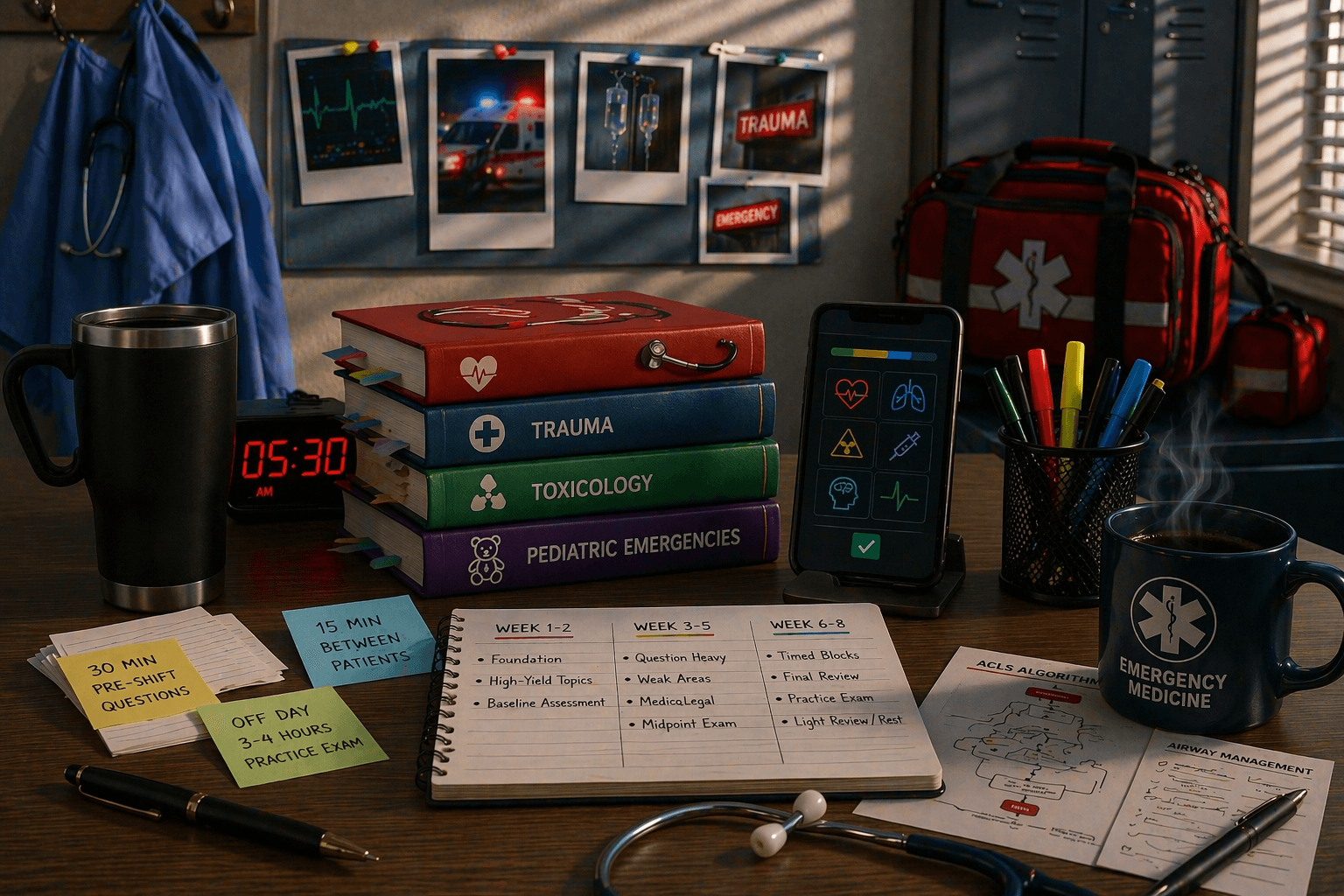
Emergency medicine board preparation has a unique constraint: EM shift schedules make sustained study blocks nearly impossible. Your study plan must work in fragments — 30-minute pre-shift sessions, 15-minute between-patient drills, and longer blocks on off days.
Weeks 1-2 (Foundation)
High-yield topic coverage: cardiac emergencies (ACS, arrhythmias, arrest algorithms), trauma (ATLS approach, imaging decisions), toxicology (common overdoses, antidotes), paediatric emergencies (fever, respiratory distress, NAI screening). Do 20-30 questions daily from Rosh Review (the EM standard Q-bank). Take a baseline assessment. Begin iatroX adaptive mode — 15-minute mobile sessions targeting weak clinical areas.
Weeks 3-5 (Question-Heavy)
Increase to 40-50 questions daily. Focus on weak areas revealed by your baseline assessment. Add targeted review of medicolegal content (consent, capacity, restraint, involuntary hold criteria), procedural sedation protocols, and environmental emergencies (heat illness, hypothermia, drowning, envenomation). Take a mid-point practice exam at the end of week 5. Continue daily iatroX spaced repetition to maintain topics studied in earlier weeks.
Weeks 6-8 (Performance)
Timed blocks on off days. Final practice exam in week 7. High-yield review: toxicology antidotes, trauma imaging algorithms, resuscitation protocols, common paediatric presentations. Targeted revision of persistent weak areas via adaptive mode. Last few days: light review, rest.
Studying Around Shifts
Pre-shift (30 minutes): focused question practice on one topic. This is your highest-quality short-session study time. Off days (3-4 hours): longer timed blocks and practice exams. Post-call: rest first, then light review only if energy allows. Between patients (if downtime): iatroX mobile 15-minute adaptive drills. Commute: EM podcasts (EMCrit, EM Basic, Taming the SRU).