The emotional whiplash of Match Week is real.
For months, the question has been simple, even if exhausting: How do I get through this process? Then, almost immediately after the pressure lifts, a different anxiety appears: What exactly should I do now?
That shift catches people off guard. Before Match Day, you are studying for selection. After Match Day, you are preparing for supervised responsibility. Those are not the same job.
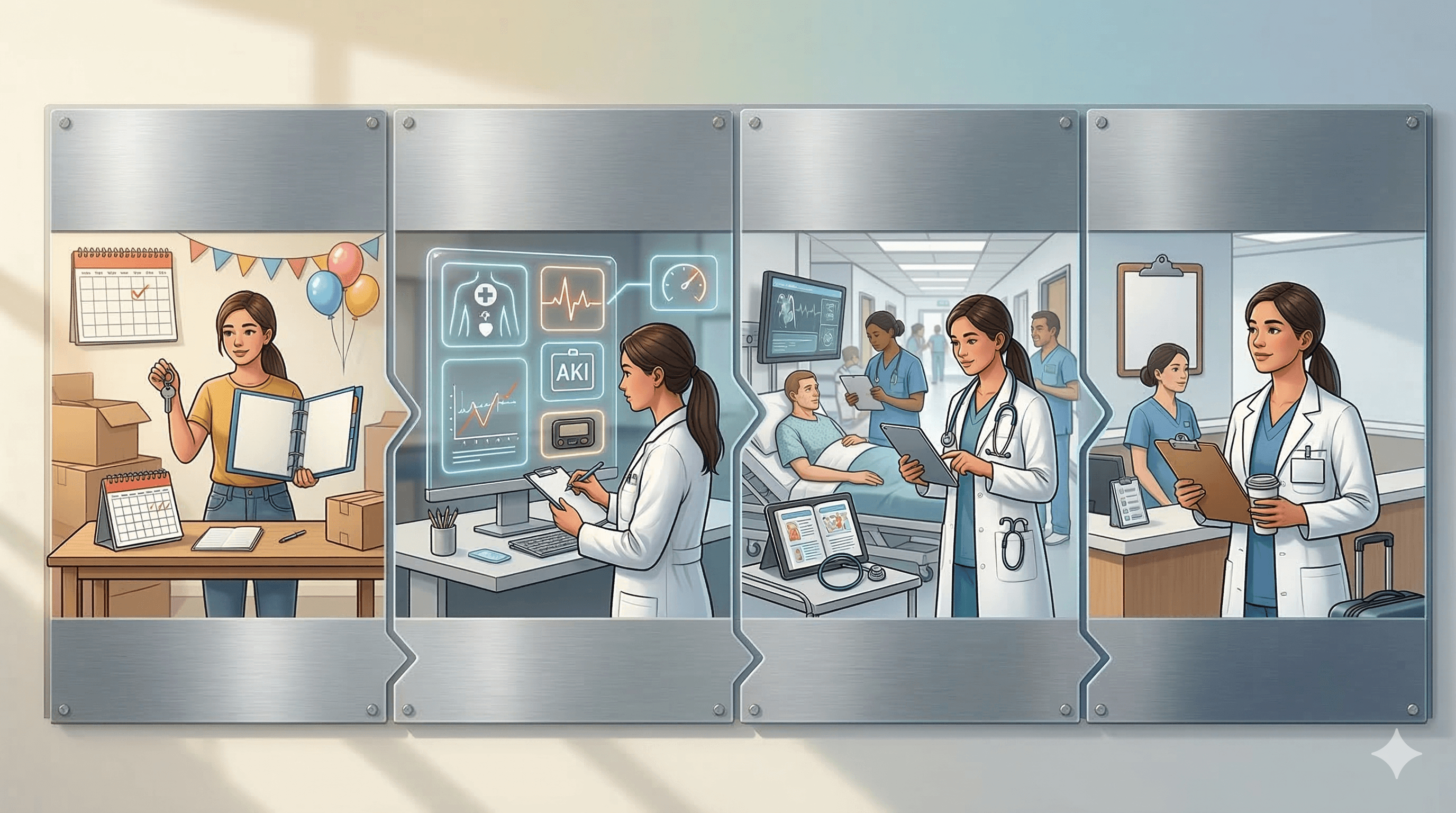
This is why the best post-Match plan is not a guilt-driven cram schedule and not a vague “just enjoy your break” shrug either. The smartest approach is a phased 100-day transition: stabilise your life first, then rebuild your study around real intern work, then taper into July less fragile, less scattered, and more practically ready.
This article is built around that idea.
It is not another SOAP explainer. It is not another generic “relax, you’ll be fine” piece. It is a structured plan for the window between Match Week and intern year.
Days 1–7: stabilise your life before you optimise your study
The first mistake many newly matched students make is trying to convert emotional adrenaline into a heroic study plan.
Do not start there.
Your first week should be about stabilisation.
That means:
- celebrating, at least a little
- decompressing enough to think clearly
- completing immediate admin
- clarifying onboarding requirements
- checking paperwork and deadlines
- getting early visibility on licensing, credentialing, housing, relocation, payroll, and visa issues where relevant
- creating one organised system for all incoming programme tasks
This matters because the early post-Match period is not primarily a knowledge problem. It is a logistics problem with emotional noise around it. If you ignore that and leap straight into “productivity mode”, you often create the worst of both worlds: scattered admin and low-quality studying.
There is also a psychological reason to do this first. Once the big uncertainty resolves, many people feel compelled to prove they are already becoming competent. That is understandable. But the first smart move is not to simulate residency. It is to stop your life from becoming administratively chaotic.
This is especially true if you are moving city, changing systems, or managing visa and documentation issues as an IMG.
A strong first week is not impressive because it is intense. It is strong because it is clean.
Weeks 2–4: identify what intern year actually demands
Once the initial noise settles, the right next move is not “study harder”. It is “study for the right thing”.
This is where many post-Match plans drift. People keep using the same mental categories they used for exam preparation:
- cardio
- renal
- neuro
- GI
- pulm
Those categories still matter, but they are not how intern year arrives.
Intern year arrives as:
- a chest pain call
- an overnight fever
- an AKI on morning labs
- a confused patient who was fine earlier
- a patient who looks more short of breath than the sign-out suggested
- a medication reconciliation problem
- a discharge summary that still needs to happen
- a senior asking, “What do you think is going on, and what do you want to do first?”
That is a different frame.
So weeks 2–4 should be about role analysis. Ask yourself what new residents actually need in practice:
- common presentations
- note-writing logic
- escalation and handover
- communication under time pressure
- safe prescribing habits
- triage and prioritisation
- “what do I do first?” reasoning
- brief assessment structure
- common inpatient calls and cross-cover issues
This is also the point where your learning stack should become more intentional. If you are keeping a q-bank, good. But it should no longer be the whole system. It should become one layer inside a broader readiness plan.
A useful internal next step here is to pair this article with:
- Should You Still Use Question Banks After Match Day?
- Can one AI tool really cover both ward questions and exam prep?
Month 2: rebuild your study around clinical tasks, not exam categories
This is the heart of the transition.
If you keep studying in pure exam categories, you may stay busy without becoming meaningfully more ready for July. The better move is to reorganise your review around tasks and scenarios that feel like real intern-year medicine.
Instead of “renal”, think:
- AKI on morning labs
- low urine output overnight
- hyperkalaemia question
- fluid status uncertainty
- when to worry, what to recheck, what to escalate
Instead of “cardiology”, think:
- chest pain page
- tachycardia that could be benign or not
- rising troponin context
- heart failure patient getting more breathless
- whether the issue is emergent, urgent, or stable enough to re-evaluate
Instead of “infectious disease”, think:
- fever in an inpatient
- possible line infection
- pneumonia not improving
- “is this sepsis or noise?”
- antibiotics escalation awareness
Instead of “neuro”, think:
- altered mental status overnight
- delirium versus something worse
- when confusion is expected and when it is dangerous
- what basic structure you use before you call for help
Instead of “admin”, think:
- discharge summary and follow-up planning
- common admissions
- cross-cover tasks
- medication reconciliation
- how to leave the next person a usable note
That shift changes everything. It makes your studying feel less like random anxious revision and more like rehearsal for supervised work.
What to revise in April and May
The middle stretch of the 100 days is where most of the real value sits.
This is the period for rebuilding core confidence in common, high-yield, early-residency material without trying to pre-learn an entire specialty.
A clean list for April and May includes:
Common acute presentations
- chest pain
- dyspnoea
- fever
- altered mental status
- hypotension
- nausea/vomiting
- abdominal pain
- syncope
- falls
- worsening oedema
- common post-op or inpatient deterioration patterns
Electrolyte and fluid disorders
- hyponatraemia
- hyperkalaemia
- hypokalaemia
- hypocalcaemia
- fluid overload versus under-resuscitation
- common acid-base interpretation basics
Antibiotics and escalation awareness
You do not need to memorise every nuance in advance, but you should feel less brittle around common scenarios:
- suspected sepsis
- common pneumonia decisions
- likely source thinking
- when uncertainty matters enough to escalate early
Insulin and anticoagulation caution zones
These are classic risk areas for new doctors because small mistakes matter. You do not need to become a pharmacist. You do need more respect and familiarity here than many finals-style plans create.
Discharge medications and reconciliation concepts
Intern work is full of transitional moments. Understanding how medicines, follow-up, and documentation intersect is practical preparation.
Common labs and imaging
Not advanced interpretation for prestige. Basic interpretation for useful action:
- CXR patterns you should not ignore
- ECG fundamentals in common calls
- CBC/CMP trends
- ABG/VBG basics if relevant to your likely environment
This is also a sensible phase to use a mix of tools rather than one type of study behaviour. A q-bank is useful for retrieval. A quick-reference or evidence layer helps ground expectations. A reasoning layer helps you think more clearly when the scenario is messy.
That is also where iatroX fits naturally. Not as a replacement for revision, but as the layer that helps turn a topic from “I sort of know this” into “I understand how to think through this more cleanly”. Relevant internal routes include:
What to revise in June
June should look different.
That is an important point, because many people make June either too intense or too empty.
By June, the goal is no longer to hoard content. It is to consolidate confidence, protect energy, and reduce fragility before starting work.
That means June should usually focus on:
- shorter maintenance sessions
- quick review of common intern scenarios
- practical task rehearsal
- documentation habits
- handover and escalation phrasing
- medication-safety awareness
- rebuilding sleep
- relocation and packing
- reducing administrative uncertainty
- arriving less exhausted than the internet makes you feel you should be
This is the phase for sharpening, not hoarding.
If April and May are for building structure, June is for reducing friction.
What to stop obsessing about
This section matters because many post-Match plans fail not through laziness, but through distorted priorities.
Obscure zebras
Interesting is not the same as useful. The pre-July payoff for rare, dramatic pathology is usually much lower than the payoff for common deterioration patterns, medication pitfalls, and communication structure.
Perfect recall
You are not trying to become a finished doctor by July. You are trying to become less brittle under supervision.
Pre-learning an entire residency
This is not possible. It is also not the right target. The goal is not total preparedness. It is better early functioning.
Comparing yourself to the most intense people online
Reddit is not a curriculum. Neither is someone else’s panic.
Turning every free evening into a guilt session
You are allowed to rest, move, celebrate, and recover. A post-Match plan that destroys your bandwidth before internship is not a good plan.
This is one reason why the most effective transition plans feel moderately structured, not punishing.
The smartest tools to use before July
The best pre-residency tool stack is organised by job, not by brand.
1) Q-bank for retrieval
Keep one if it helps you maintain rhythm, repair weak areas, and rehearse common patterns. Just stop treating it as the whole system.
2) Evidence or quick-reference layer for practical checking
This is useful when you want to sense-check what real practice expects without disappearing into a long literature search.
3) Differential or clinical-reasoning layer for uncertain cases
This matters because real intern-year work is full of half-formed problems rather than neat stems.
4) Drug-checking layer for safety
Medication caution zones deserve their own respect.
5) Memory system for retention
If you rely only on passive reading, you will feel cleverer than you are prepared. Durable retention still needs retrieval, spacing, and repeat exposure.
This is where a practical mixed stack makes sense. Depending on the user, that might include a q-bank, a reference layer, and a clarification layer rather than one “do everything” product.
That also creates natural internal bridges to:
- What AI tool should a doctor actually use?
- AMBOSS is no longer just a q-bank: what that means for doctors in 2026
- Should You Still Use Question Banks After Match Day?
A sample 100-day plan
This is not meant to be rigid. It is meant to make the transition feel less abstract.
Days 1–7: admin, decompress, organise
- celebrate
- sleep properly
- gather programme tasks in one place
- clarify paperwork and onboarding
- make a relocation checklist
- avoid building an elaborate study plan while your nervous system is still noisy
Days 8–30: identify gaps, build system
- decide what your study stack actually is
- identify recurring weak zones
- start modest retrieval blocks
- begin role-based review rather than exam-category review
- build one simple weekly rhythm you can actually keep
Days 31–60: core clinical review plus retrieval
- focus on common intern patterns
- use questions for maintenance and weakness detection
- review common acute presentations
- reinforce prescribing caution zones
- practise brief assessment thinking
- keep your total volume sustainable
Days 61–90: workflow rehearsal and practical confidence
- work more on handovers, note logic, common calls, escalation wording, and prioritisation
- keep shorter retrieval sessions
- revisit topics that still feel fuzzy
- reduce unnecessary breadth
Final 10 days: taper, reset, arrive rested
- stop chasing new content
- complete moving and onboarding tasks
- stabilise sleep
- keep only light maintenance work
- arrive with a clear head rather than a falsely impressive June study log
If you are an IMG, what changes?
The broad structure stays the same. The emphasis shifts.
For IMGs, the pre-residency period often carries extra cognitive load from:
- system acclimatisation
- local workflow expectations
- paperwork and programme logistics
- communication norms
- visa or licensing-related stress
- translating clinical understanding into a new care environment
That means your post-Match plan may need even more weight on:
- workflow understanding
- communication and escalation phrasing
- common U.S. ward tasks
- documentation conventions
- practical orientation rather than abstract content volume
This is also where helpful tools can reduce cognitive load if they are used intelligently. The goal is not to outsource thinking. It is to reduce fragmentation so that more of your attention can go into adaptation.
A useful internal bridge here is your broader Academy, especially IMG-relevant and transition-focused content, plus the Clinical Q&A Library when you want explanation rather than another pile of notes.
Where iatroX fits in the 100-day plan
The strongest positioning here is not “iatroX replaces everything else”. That would make the article less credible.
A stronger and more useful framing is this:
If a q-bank helps you retrieve, and a quick-reference tool helps you check, iatroX fits best as the layer that helps you turn anxious revision into guideline-aware understanding and practical clinical reasoning.
That makes it especially useful in the post-Match window, because this phase is not really about squeezing out another score gain. It is about converting weak, vague, or exam-shaped understanding into something more durable and more clinically usable.
That is why the most relevant internal routes here are:
Common mistakes in the 100-day window
Mistake 1: treating post-Match like a second dedicated board season
The target has changed. Studying should change with it.
Mistake 2: doing nothing because “residency will teach me anyway”
It will. But a calmer, more structured transition reduces early fragility.
Mistake 3: using only one study mode
Questions alone are not enough. Passive reading alone is not enough. Quick AI explanations alone are not enough. Mixed methods work better here.
Mistake 4: ignoring logistics
Administrative chaos is one of the fastest ways to make yourself feel behind before internship even starts.
Mistake 5: refusing to rest
Recovery is not laziness. It is part of arriving functional.
FAQs
What should I do right after Match Day?
Start with stabilisation: celebrate, decompress, organise paperwork, and clarify programme logistics. Do not begin with a heroic study schedule.
How much should I study between Match Day and intern year?
Enough to stay oriented and reduce fragility, but not so much that the whole period turns into panic-driven cramming. Moderate, structured preparation is usually better than extremes.
Should I keep using question banks after the Match?
Yes, but in a different role. Use them for retrieval, maintenance, and weakness detection rather than as the whole system.
What should I focus on before July?
Common acute presentations, fluids and electrolytes, medication-safety risk areas, handovers, escalation, documentation logic, and practical intern-year tasks.
Is June the time to study hardest?
Usually no. June is better used for consolidation, light maintenance, practical rehearsal, moving, admin completion, and arriving rested.
Final verdict
Match Day is not the end of studying.
It is the end of studying for selection.
The next 100 days should not be about becoming superhuman. They should be about becoming less brittle.
That means:
- stabilising your life first
- rebuilding knowledge around real clinical tasks
- keeping retrieval in the system without letting it dominate
- rehearsing workflow, communication, and prioritisation
- arriving in July more organised, more rested, and more practically ready
The smartest post-Match plan is not random anxious revision.
It is a structured transition.
If you want to turn the pre-residency window into something more useful than panic and MCQs, your next internal reads should be: