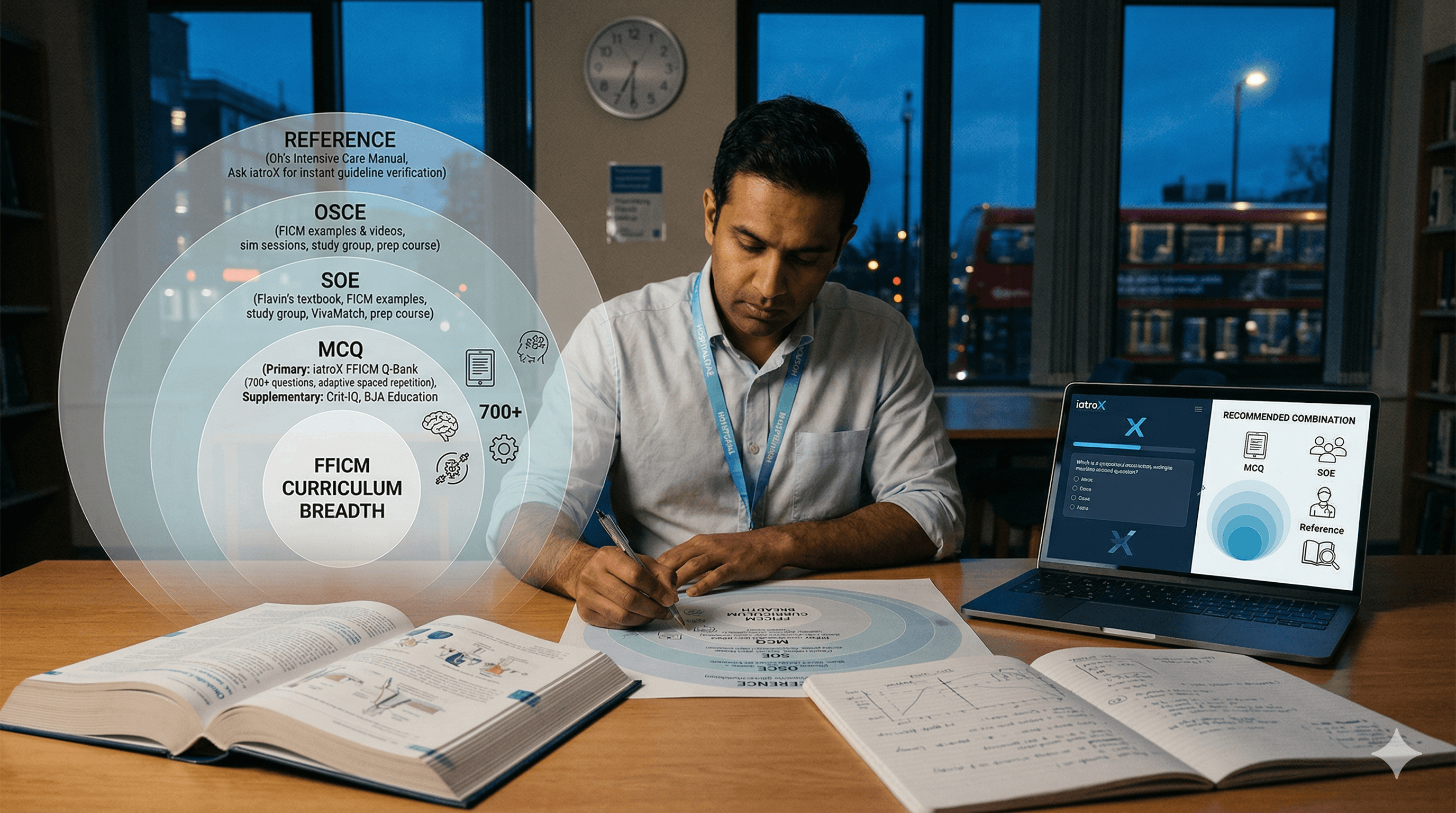
FFICM preparation resources are limited compared to MRCP or FRCA. There is no single dominant Q-bank with 5,000 questions. There is no universally agreed textbook. This scarcity makes resource selection more important — you need to combine multiple sources to cover the breadth the exam demands.
Question Banks
iatroX FFICM Q-Bank: 700+ questions mapped to the ICM curriculum with adaptive spaced repetition and guideline-grounded explanations. A single subscription provides access to multiple Q-banks, making it efficient for dual-CCT trainees. The adaptive algorithm targets your weaknesses automatically. Available on web, iOS, and Android — usable on the ICU during quiet moments. The strongest single resource for systematic MCQ preparation.
Crit-IQ: 150 MCQ questions with ICM focus. Developed by ICM clinicians. Good supplementary resource but insufficient volume as a sole Q-bank.
BJA Education MCQs: Requires subscription. Includes basic science questions relevant to FFICM (the anaesthesia-ICM overlap). Particularly useful for applied physiology and pharmacology.
OnExamination: Uses FRCA-related content that overlaps with FFICM. Useful for candidates with an anaesthesia background who want to leverage existing resources.
Textbooks
"Oh's Intensive Care Manual": The reference textbook for ICM. Comprehensive, evidence-based, and covers the full curriculum. Use as a reference for topics you encounter in Q-bank practice — do not attempt cover-to-cover reading.
"Intensive Care Medicine MCQs" (Steve Benington, 2015): The only dedicated FFICM MCQ textbook. Contains MCQ questions with explanations. Dated in places but the format-specific practice remains valuable.
"Questions for the Final FFICM Structured Oral Examination" (Kate Flavin, 2018): SOE-specific preparation. Provides question stems and model answers in the SOE format. Essential for SOE preparation.
Oxford Handbook of Critical Care: Pocket reference. Useful on shift and for quick topic revision. Not a primary study resource but a valuable clinical reference.
Online Resources
FICM Resources for Candidates page: Published example questions for OSCE and SOE. Performance videos demonstrating pass and borderline answers. Essential free resource.
ICM Case Summaries: Clinical cases with discussion linked to recent evidence and guidelines. Useful for SOE preparation.
BJA Education articles: Free articles (subscription for MCQs) covering ICM-relevant topics including applied physiology, pharmacology, and clinical management.
Ask iatroX: Instant clinical reference during study — verify any uncertain management pathway against current UK guidelines. Also valuable during clinical shifts for real-time guideline reference.
Courses
FICM FFICM Prep Course: Run by the Faculty. Two-day OSCE/SOE preparation with structured practice. Intended for candidates who have passed the MCQ.
ICM Line OSCE/SOE Course: Run at the Royal Victoria Infirmary, Newcastle. OSCE and SOE practice with individualised feedback.
SPPICE Course: Two-day course from the Southwest region. Workshops on ECGs, radiology, data interpretation, plus SOE practice.
A-Line VivaMatch: Peer-to-peer viva practice over Zoom, running 5 weeks before each exam sitting. Flexible scheduling around clinical commitments.
The Recommended Combination
MCQ: iatroX FFICM Q-Bank (primary — 700+ questions, adaptive) + Crit-IQ (supplementary) + Benington's textbook (format practice).
SOE: Flavin's textbook + FICM example questions + study group/VivaMatch + prep course if affordable.
OSCE: FICM example questions and videos + simulation sessions + study group + prep course.
Reference: Oh's Intensive Care Manual + Ask iatroX for instant guideline verification.