Use-case fit in 30 seconds
Best for: Visual recognition of rashes and lesions, identifying medication reaction patterns, and patient education/explanation. Not for: Creating full general medicine management plans in UK pathways (referral criteria differ). Output: A visual differential builder + guided work-up prompts.
Why dermatology is the GP “risk hotspot”
For many GPs, dermatology is a high-stakes game played under extreme time pressure. You have 10 minutes to differentiate a benign rash from a life-threatening drug reaction or a subtle malignancy. The "risk hotspot" is created by the combination of diagnostic uncertainty (morphology is hard), referral gatekeeping (2-week-wait criteria are strict), and high patient anxiety. VisualDx is designed to lower the temperature in this specific pressure cooker.
What VisualDx is
VisualDx is a visual clinical decision support system (CDSS). Unlike a textbook or a guideline repository, it is built to start with the visual features of a patient's presentation. It emphasises point-of-care differential building by combining patient factors (age, medication) with morphological descriptions (VisualDx).
The GP workflow it supports (the “3-screen method”)
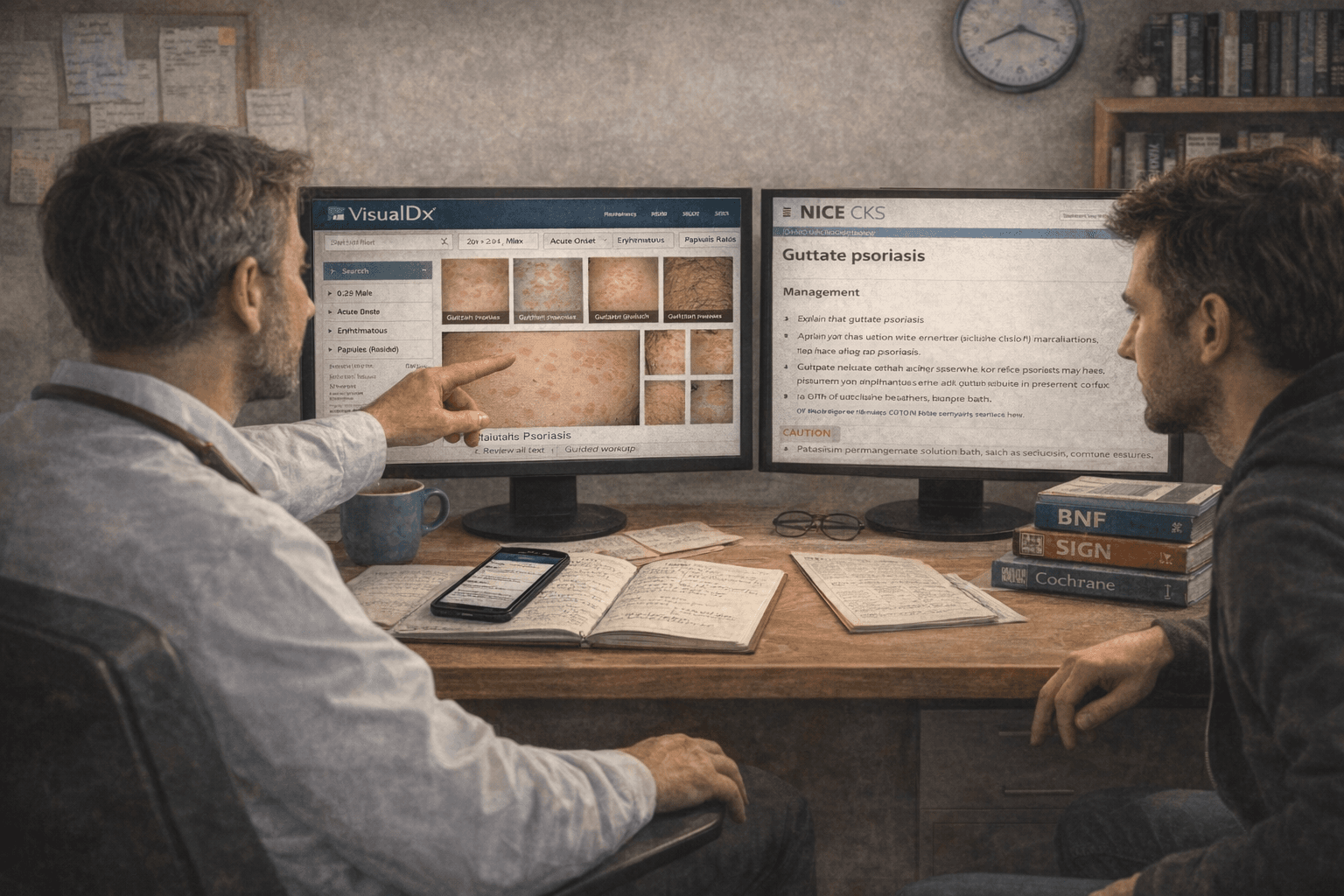
To use VisualDx effectively in a UK consultation, think of it as the middle step in a "3-screen" workflow:
- Screen A: The Patient (History + Morphology). You take the history and identify the key terms: "annular," "scaling," "erythematous."
- Screen B: VisualDx (Pattern Match). You input these terms into the VisualDx builder. It generates a "visual differential"—a grid of images matching your description. You scan this to find the pattern that fits your patient.
- Screen C: UK Action Check (NICE CKS). Once you have a likely diagnosis (e.g., Pityriasis Rosea), you must verify the management and referral thresholds against NICE CKS. VisualDx gives you the what; NICE CKS gives you the now what for the NHS (NICE CKS).
Where VisualDx is genuinely excellent
- Visual anchoring: It forces you to look at the lesion and describe it accurately, which is the foundation of good dermatology.
- Drug eruptions: Its ability to match a rash to a specific medication history is world-class. You can enter a drug name and see the common reaction patterns, which is invaluable for complex polypharmacy cases.
- Patient confidence: Turning the screen to show a patient a library of images that match their condition can be a powerful reassurance tool—provided you frame it correctly ("This tool helps us compare patterns").
Failure modes (where you need to be careful)
- Image anchoring: The risk of picking the first picture that "looks right" without considering the full clinical context.
- Skin tone bias risk: While VisualDx has made significant strides with its skin of color atlas, no dataset is perfect. Always sanity-check your differential across different skin types to ensure you aren't missing a presentation that looks different on pigmented skin.
- Context mismatch: A rash in a returning traveller is different from one in a pregnant woman. Avoid "one-image diagnosis"; the patient's context must drive the differential.
- Governance misunderstanding: It is easy to treat it as "just a picture tool." It is a CDSS. If you use it to make a decision, you must document it as such.
UK data/privacy note
Using cloud-based CDSS tools in the NHS requires diligence. UK organisations often produce specific privacy notices for platforms like VisualDx, treating them as educational and diagnostic aids. Always ensure you are using the tool in line with your local Data Protection Impact Assessment (DPIA) and Information Governance (IG) expectations (nhsgrampian.org).
VisualDx vs generalist AI “diagnosis chatbots”
- VisualDx: Uses a curated, visually-led structured differential workflow. It shows you possibilities based on verified medical data.
- Generalist LLMs (ChatGPT): Fluent, but the provenance of their diagnostic suggestions can be opaque.
- The Rule: Use AI for structure and retrieval; never for unverified diagnosis claims.
Where iatroX fits
iatroX acts as the "UK guidance + citations" layer in this workflow.
- Step 1 (VisualDx): "What could this be?" (Generates differential: e.g., Guttate Psoriasis).
- Step 2 (iatroX Ask): "What does NICE CKS say about the management of Guttate Psoriasis, and what are the referral criteria?" (Returns cited UK guidance).
- Step 3 (iatroX Brainstorm): "Structure a referral letter for this patient." (Creates a structured reflection or note).
iatroX is a UKCA-marked, MHRA-registered Class I medical device (iatroX, Google Play), making it the ideal partner for converting a visual diagnosis into a safe, compliant NHS management plan.
The “GP Derm Evidence Stack” in 6 minutes
- VisualDx: For the visual differential.
- NICE/CKS: For the UK management default (NICE CKS).
- iatroX: For fast, cited synthesis across UK sources (Google Play).
FAQs
Is VisualDx worth it for GPs? For anyone who finds dermatology challenging, yes. The speed of the visual differential builder is a significant asset in a 10-minute slot.
Can I use VisualDx in the NHS? Yes, widely. Many Trusts and libraries provide access. Check your local subscriptions.
How do I document use of decision-support software? "Visual decision support aid used to review differential. Diagnosis consistent with [Condition]. Management plan per NICE CKS."
What’s the safest way to combine VisualDx with NICE/CKS? Use VisualDx to find the diagnosis; use NICE CKS to treat it. Never assume the treatment advice in a global tool matches local NHS formulary or referral pathways.