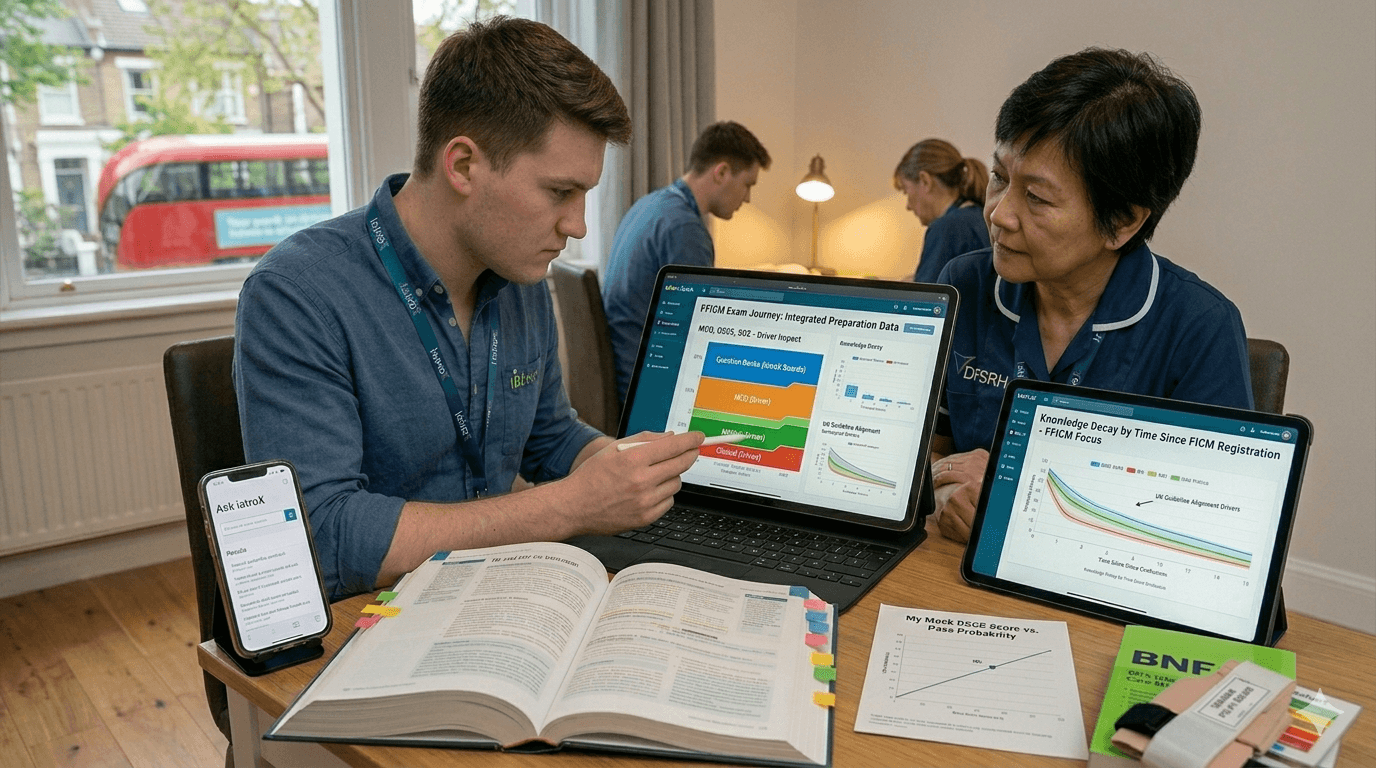
The path from FICM registration to FFICM Fellowship crosses three examination components, 12-18 months of preparation, and the full breadth of the intensive care curriculum. This guide covers the entire journey — from initial planning through to the day you receive your Fellowship.
Phase 0: Registration and Planning (2-3 Months Before MCQ)
Register with the Faculty of Intensive Care Medicine. Confirm your eligibility (primary exam pass from FICM or a complementary specialty). Choose your target MCQ sitting date. Gather your resources: iatroX FFICM Q-Bank (700+ questions, adaptive), supplementary Q-banks (Crit-IQ, BJA Education), textbooks (Oh's Manual, Benington MCQ book), and clinical reference (Ask iatroX).
Build your study schedule. 12-16 weeks for the MCQ. Start Q-bank practice immediately — the spaced repetition algorithm needs time to build your weakness profile and ensure retention.
Phase 1: MCQ Preparation (12-16 Weeks)
The MCQ is 130 SBAs (80 short, 50 long) in 3 hours. Pass rate approximately 84%.
Weeks 1-6: Systematic topic coverage — one major ICM domain per week. 30-50 questions daily from iatroX. Use Ask iatroX to verify every wrong answer.
Weeks 7-10: Remaining topics + mock exams. Increase question volume.
Weeks 11-12/16: Final mocks, weakness targeting, consolidation. Light revision in final days.
Exam day: Remote via TestReach. Private room, stable internet, valid ID. 3 hours, no scheduled breaks.
Phase 2: OSCE/SOE Preparation (12-16 Weeks After MCQ Pass)
Once you pass the MCQ, begin OSCE/SOE preparation immediately. Both components are taken together at first sitting.
For the OSCE (13 stations, RCoA London):
- Practise data interpretation under time pressure (ECGs, ABGs, radiology, haemodynamic data)
- Handle equipment during clinical shifts — the OSCE tests practical familiarity
- Practise communication scenarios with peers (breaking bad news, consent, family discussions)
- Attend simulation sessions for resuscitation stations
- Work through FICM published example questions and videos
For the SOE (4 stations, 8 questions, RCoA London):
- Build a viva practice partnership or join a study group
- Practise structuring answers out loud — concise, systematic, consultant-level
- Know landmark ICM trials (ARDS Net, NICE-SUGAR, PROSEVA, TTM, etc.)
- Work through Flavin's SOE textbook
- Attend prep courses if budget allows (ICM Line, SPPICE, A-Line VivaMatch)
Weeks 1-6: Knowledge consolidation (continued iatroX Q-bank practice) + beginning viva and OSCE practice.
Weeks 7-12: Intensive viva practice (2-3 sessions per week), simulation sessions, OSCE station practice, mock OSCEs if available.
Weeks 13-16: Final prep course attendance, last round of viva practice, review FICM example questions, rest before exam.
Phase 3: Exam Day (OSCE/SOE)
The OSCE and SOE are held face-to-face at the RCoA in London over a single day. Arrive early. Bring valid ID. Dress professionally but comfortably. Between stations, take deep breaths and reset — each station is marked independently.
OSCE: 13 stations, 7 minutes each, 1 minute reading time. Keep answers directed to the question. Verbalise your reasoning — the examiners mark what you say, not what you think.
SOE: 4 stations, 14 minutes each, two questions per station. Structure every answer. Demonstrate consultant-level judgement. Be honest about uncertainty — saying "I would seek specialist input" is better than guessing badly.
Phase 4: Fellowship
You pass. Both components. You receive your FFICM certificate within 8 weeks. You apply for GMC CCT. You are a consultant intensivist.
The knowledge you built with iatroX does not expire with the exam. Ask iatroX continues to provide instant clinical reference during shifts. The Q-Bank maintains your knowledge through continued spaced repetition. The CPD module documents your professional development for revalidation. The tools that got you through the exam support your career beyond it.