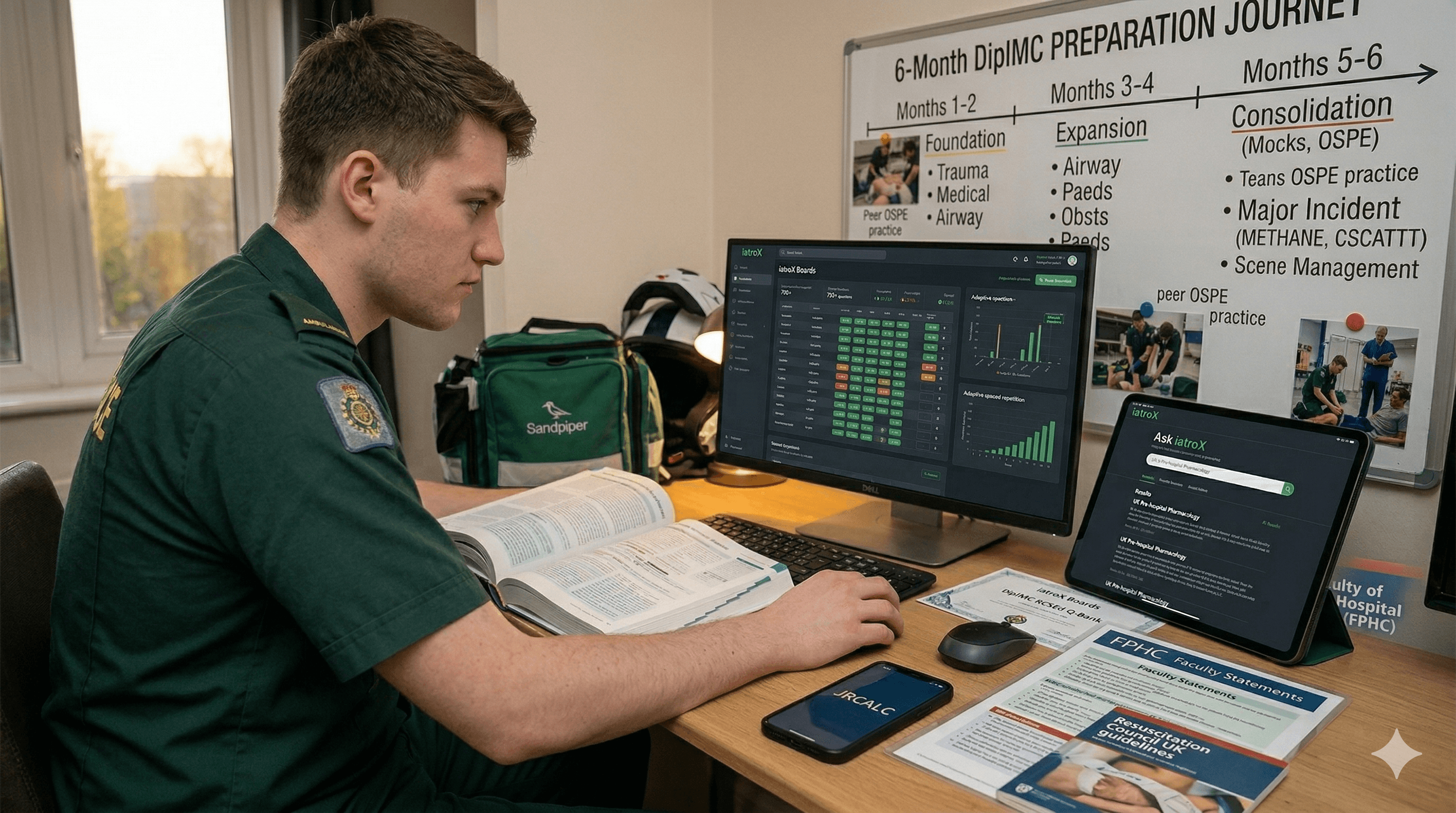
The DipIMC RCSEd is the benchmark pre-hospital care qualification in the UK. Passing it requires systematic preparation across a broad curriculum with scarce dedicated resources. This guide provides the complete framework — curriculum coverage, resource selection, and preparation strategy — from application to pass.
The Curriculum
The FPHC curriculum covers the following domains, each testable in both the SBA paper and the OSPE: trauma management (primary survey, specific injuries, damage control resuscitation), medical emergencies (cardiac arrest, ACS, stroke, anaphylaxis, seizures, toxicology, environmental), pharmacology (pre-hospital formulary, mechanisms, interactions, dosing), airway management (basic, advanced, failed airway, surgical), paediatric emergencies (age-specific assessment and management, safeguarding, newborn life support), obstetric emergencies (delivery, complications, pharmacology, neonatal care), major incident management (METHANE, CSCATTT, triage, command and control), scene management (dynamic risk assessment, extrication, packaging, transport), professional practice (consent, capacity, communication, documentation, ethics), and applied physiology (shock, respiratory, neurological, metabolic).
The Resource Stack
Q-Bank: iatroX DipIMC Q-Bank at iatroX Boards — 700+ curriculum-mapped SBA questions with adaptive spaced repetition. Single subscription includes multiple specialty Q-banks.
Textbook: ABC of Prehospital Emergency Medicine (essential).
Guidelines: FPHC Faculty Statements (directly testable), NARU Command and Control Guidance, Resuscitation Council UK guidelines, JRCALC (for paramedic candidates).
Clinical reference: Ask iatroX — instant UK-guideline-grounded answers during study and on clinical shifts.
Supplementary: St Emlyn's DipIMC blog and SBA questions, PHEM podcasts, BJA Education articles.
Courses: GNAAS Pre-Hospital Obstetrics, ATACC, local BASICS courses, air ambulance education days.
The Strategy
6-month timeline. Months 1-2: Foundation building (ABC textbook + daily Q-bank). Months 3-4: Expansion (remaining topics + begin OSPE practice). Months 5-6: Consolidation (mocks, weakness targeting, OSPE simulation, final review).
SBA preparation. 700+ questions from iatroX Boards with adaptive spaced repetition + supplementary questions from St Emlyn's and any other available sources. Target 1,500-2,000+ questions total. Complete 2-3 full timed mocks.
OSPE preparation. Peer practice sessions weekly from month 3 onwards. Equipment familiarisation. Communication scenario practice. Major incident framework drills. At least one pre-hospital course for hands-on procedural practice.
Continuous learning. Ask iatroX during clinical shifts — every clinical encounter that raises a question is a learning opportunity. The CPD module documents your professional development throughout the preparation period.
The Outcome
The DipIMC demonstrates that you can provide gold-standard pre-hospital emergency care — regardless of whether you are a doctor, paramedic, or nurse. The qualification is recognised across UK ambulance services, air ambulance organisations, BASICS schemes, military medical services, and PHEM training programmes. It strengthens every application where pre-hospital competence matters.
Prepare systematically with iatroX Boards. Pass confidently. And use iatroX throughout your career — the clinical reference that prepared you for the exam supports your practice beyond it.