Executive summary
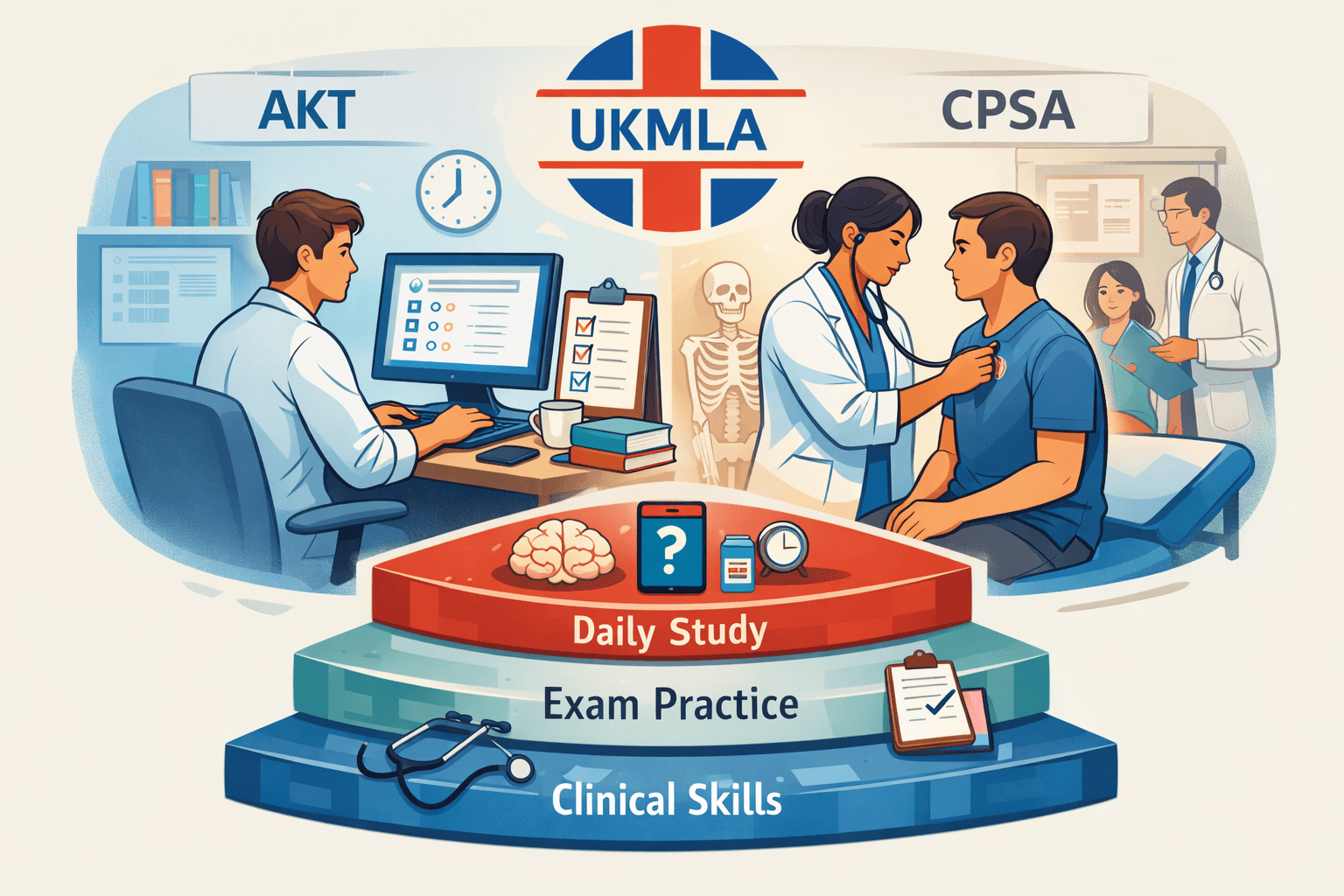
The UK Medical Licensing Assessment (UKMLA) is now the single, mandatory gateway to the medical register for all UK graduates and international medical graduates. It consists of two distinct parts: the Applied Knowledge Test (AKT) and the Clinical and Professional Skills Assessment (CPSA). Crucially, both are mapped to the same blueprint: the GMC MLA Content Map.
Your revision strategy must reflect this structure. Success in 2026 requires a "3-layer stack": a daily engine for knowledge retention, a simulation layer for exam technique, and a skills layer for performance. This guide breaks down the best resources for each layer, from the official content map to high-yield question banks like Quesmed and Passmedicine, and shows how to use free AI tools like iatroX to power your daily revision.
What UKMLA/MLA is (plain English)
- The MLA (Medical Licensing Assessment): This is the national exam that replaces the old finals system. It ensures that every doctor joining the UK register meets a common threshold of safe practice.
- Who runs it: For UK medical students, the MLA is delivered by your medical school as part of your final degree. You must pass it to graduate. For international graduates, it replaces the PLAB.
- The Blueprint: The entire exam is based on the MLA Content Map, published by the General Medical Council (GMC). This lists every condition, presentation, and practical skill you can be tested on.
AKT vs CPSA: what changes in your revision approach
You cannot revise for these two components in the same way.
- AKT (Applied Knowledge Test): This is a computer-based exam consisting of Single Best Answer (SBA) questions. It tests your ability to apply clinical knowledge to a scenario.
- Revision Focus: Retrieval practice, pattern recognition, and timed question blocks.
- CPSA (Clinical and Professional Skills Assessment): This is a practical, OSCE-style exam. It tests your ability to take a history, perform an examination, and communicate effectively.
- Revision Focus: Structured practice, verbal rehearsal, and performance feedback.
The 3-layer revision stack
Don't just buy a random Q-bank. Build a stack that covers all three needs.
Layer 1: Daily engine (adaptive + retention)
This is for building and maintaining your core knowledge base. You need a tool that identifies what you don't know and forces you to review it.
- Tool: iatroX Quiz (Free).
- Why: Its adaptive algorithm targets your weak areas, and its spaced repetition mode ensures you don't forget what you learned last week.
Layer 2: Simulation layer (volume + timing)
This is for learning how to pass the exam itself. You need a large volume of exam-style questions to build stamina and pattern recognition.
- Tools: Passmedicine, Quesmed, or BMJ OnExamination.
- Why: These banks offer thousands of questions that mimic the style and difficulty of the real AKT.
Layer 3: Skills layer (performance)
This is for the CPSA. You cannot learn this from a book; you must do it.
- Tool: Geeky Medics.
- Why: Their checklists and video guides are the industry standard for structuring your OSCE practice.
Best study strategy (8-week framework)
| Weeks | Phase | Focus |
|---|---|---|
| 1–2 | Baseline | Download the MLA Content Map. Do a full mock exam to find your baseline. Start daily adaptive quizzes on iatroX to clear the "low-hanging fruit" of your weakest topics. |
| 3–6 | Conversion | The 70/30 Split: Spend 70% of your time on your weak areas and 30% on mixed practice. Do 60-80 SBAs/day. Start practising 2 CPSA stations per evening with a partner. |
| 7–8 | Conditioning | Timed Mocks: Simulate the full exam conditions (e.g., 100 questions in 2 hours). CPSA Circuits: Run full 8-station mock circuits to build stamina and slickness. |
Resource guide (honest, neutral)
- Quesmed: A modern, popular platform that claims direct alignment with the MLA Content Map. It integrates flashcards and notes well with its question bank (Quesmed).
- Geeky Medics: Markets a dedicated MLA AKT Q-bank mapped to the content map, alongside its world-class OSCE resources. It’s a strong "all-in-one" contender (Geeky Medics).
- BMJ OnExamination: Has a dedicated MLA product with over 2,000 questions. Crucially, it is often offered free to BMA members, making it a high-value option for those on a budget (BMJ OnExamination).
- Passmedicine: The volume king. Huge question bank, very affordable, and widely used by UK students for years.
Where iatroX fits
iatroX is your free daily engine. It is not a replacement for a large Q-bank like Passmedicine; it is the smart layer that makes your revision efficient.
- Use iatroX Quiz for your daily spaced repetition to ensure you retain facts.
- Use iatroX Ask to quickly clarify concepts and find UK guidelines (NICE/CKS) when reviewing your Q-bank errors.
- Cost: Free, with no ads.
FAQ
Is UKMLA the same as MLA? Yes. You will hear both terms used interchangeably. It stands for the UK Medical Licensing Assessment.
What’s the difference between AKT and CPSA? The AKT is a written, multiple-choice knowledge test. The CPSA is a practical, clinical skills exam (like an OSCE). You must pass both components to qualify.
Do I need more than one Q-bank? Not necessarily. One large bank (like Passmedicine or Quesmed) covers the content well. However, adding a free adaptive tool like iatroX for daily retention is a highly effective, zero-cost way to boost your score.