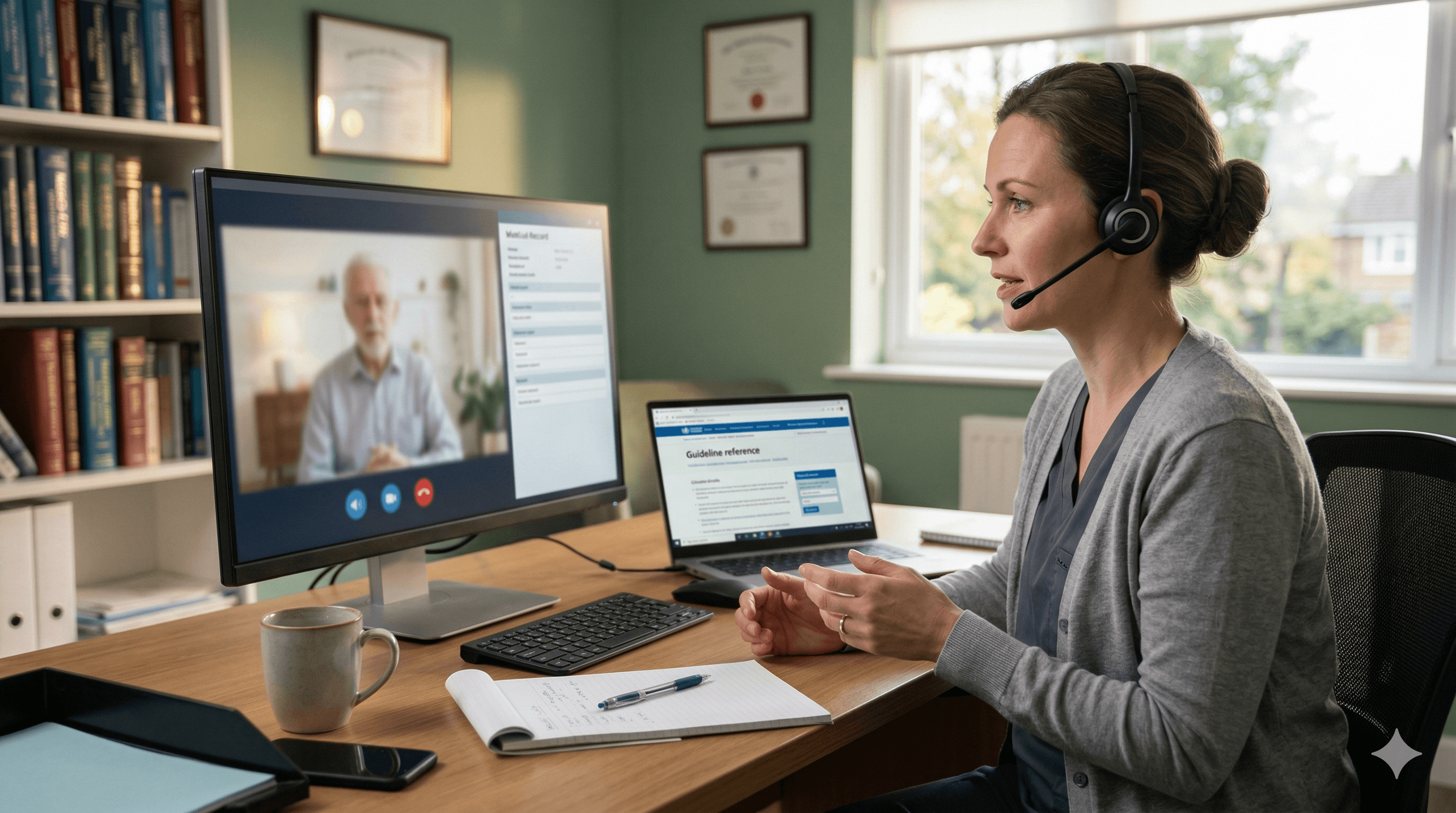
Remote consultations aren't new anymore. Since 2020, they've become a permanent fixture of UK general practice — typically 20–40% of all GP consultations are now conducted by telephone or video. Yet most GPs received no formal training in remote consulting skills, and the medico-legal framework remains poorly understood.
Here's the practical guide.
When remote works (and when it doesn't)
Good for remote: Medication reviews, chronic disease monitoring (where bloods are already done), results discussions, mental health follow-ups, sick note requests, simple administrative queries, and stable conditions where examination isn't needed.
Needs careful judgement: New presentations where the differential includes conditions requiring examination. The key question: "Can I safely exclude the serious diagnoses without examining this patient?" If yes, remote is appropriate. If no, bring them in.
Not appropriate for remote: Acute abdomen, chest pain, suspected cancer presentations (need examination for referral), rashes that need dermoscopy, musculoskeletal problems needing examination, any presentation where the patient is distressed and needs in-person support.
Clinical technique for remote consultations
Structure the consultation deliberately. In face-to-face, you can observe while the patient talks — body language, gait, general appearance. On the phone or video, you lose most of this. Compensate by being more structured in your history-taking:
Open with: "Tell me what's been happening." Then systematically cover: presenting complaint details, red flags for the relevant differential, relevant PMH, current medications, and allergies. Don't skip the review of systems — you can't rely on visual cues to prompt additional questions.
Safety-net explicitly. In every remote consultation, give clear safety-netting advice: "Come back / call back if X, Y, or Z happens." Document it. Remote consultations carry higher medico-legal risk because you haven't examined the patient, so your safety-netting needs to be more explicit and more thoroughly documented than in face-to-face.
Use video when available. Video adds significant clinical value over telephone: you can observe general appearance, assess respiratory rate, look at skin lesions (roughly — not diagnostic quality but useful for triage), and assess a patient's affect and body language. If your practice has video capability, use it for any consultation where visual information would help.
Document that it was remote. Your note should state: "Telephone consultation" or "Video consultation" and include your clinical reasoning for managing remotely vs bringing the patient in. If you decided examination wasn't needed, document why.
Medico-legal considerations
The duty of care is the same. Whether you see a patient face-to-face or by phone, the same standard of care applies. You can't blame a missed diagnosis on the consultation being remote if the diagnosis should have prompted a face-to-face assessment.
Document your reasoning for remote management. If a complaint arises, the medicolegal question will be: "Was it reasonable to manage this remotely?" Your notes need to demonstrate that you considered whether examination was needed and made a justified decision.
Consent and confidentiality. Confirm the patient's identity at the start of a remote consultation (particularly telephone). Check they're in a private space where they can speak freely. If they're not (on a bus, in an open-plan office), offer to call back at a better time.
Prescribing remotely. You can prescribe based on a remote consultation, but the same prescribing standards apply. If you'd normally examine before prescribing (e.g., examining a child's ears before prescribing antibiotics for otitis media), consider whether prescribing without examination is safe and appropriate.
Making it work practically
Allocate appropriate time. Remote consultations are not faster than face-to-face. They're faster to start (no walking to the waiting room, no coats and bags) but the clinical content takes the same time. Don't schedule 5-minute telephone slots for 10-minute clinical problems.
Use clinical reference tools in real-time. One advantage of remote consulting: you can check guidelines during the consultation without the patient watching you type. iatroX's clinical search is designed for exactly this — quick, guideline-referenced answers during clinical decision-making.
iatroX is built for the point of clinical decision-making — whether that's face-to-face or remote. AI clinical search covering NICE/CKS guidelines for UK GPs.