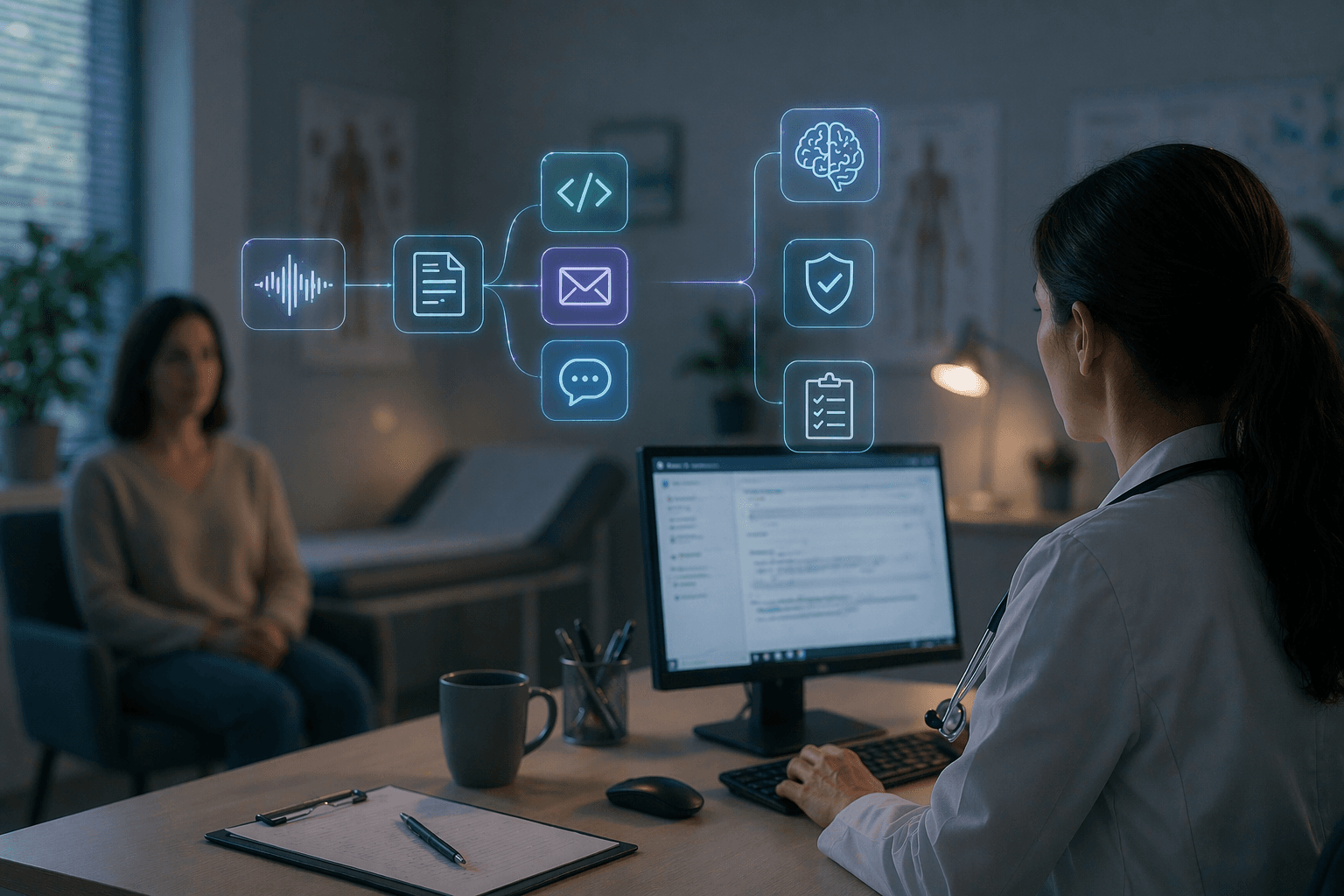
The category that launched as "AI scribe" is converging toward something far more consequential. Tandem's trajectory — and Heidi's parallel positioning — suggests that ambient documentation was never the destination. It was the entry point.
What Tandem Is Today
An ambient AI system that listens to clinical consultations and generates structured medical records — notes, clinical codes (ICD-10, SNOMED), referral letters, advice and guidance requests. It integrates with 100+ EHR systems and is used by 5,000+ care organisations across Europe. The Accurx partnership reaches 200,000+ NHS clinicians. The DCA partnership announced today embeds it into 60,000+ monthly virtual consultations.
But the product already extends well beyond transcription.
What It Already Does Beyond Scribing
Clinical coding — suggesting ICD-10 and SNOMED codes from consultation content, with Europe's first MDR Class IIa certification for its Coding Assistant. Referral letter generation — structured letters created directly from consultation content. Follow-up message drafting. Structured data extraction for clinical records. Voice-controlled editing — the clinician tells Tandem what to change, and the note updates without typing.
Each of these capabilities requires the system to understand clinical content — not just transcribe it. The system is already parsing diagnostic information, treatment decisions, and clinical context.
The Heidi Comparison
Heidi Health has explicitly repositioned from "AI scribe" to "care partner" — adding evidence access, clinical decision support features, and a broader clinical assistance layer beyond documentation. The messaging is deliberate: Heidi is not a scribe that also does other things; it is a care partner that includes scribing.
Tandem has not made the same rhetorical shift — but its product trajectory is converging on the same destination. When Tandem describes itself as "the AI-native operating system for healthcare," the ambition is clear: the operating system runs the workflow, not just one task within it.
The Convergence Trend
Documentation → workflow automation → decision support. This is the trajectory for every major player in the space. Once the system hears the consultation, structures the clinical data, codes the diagnoses, and generates the documentation — it has all the information needed to suggest diagnoses, recommend guideline-aligned management, prompt safety checks, and flag risk factors.
The scribe is the data ingestion layer. Everything that follows — coding, referrals, safety prompts, guideline nudges — is a downstream application of the same structured clinical data.
Why CDSS Is the Logical Next Step
The technical barrier to clinical decision support is structured clinical data at the point of care. Traditional CDSS systems failed because clinicians had to enter data separately to receive decision support — double the work, no adoption. Ambient scribes solve this: the data is captured passively during normal clinical conversation. The system already knows the patient's presenting complaint, medications, comorbidities, and the clinician's working diagnosis.
From there, the path to lightweight CDSS is short: in-consult prompts ("this presentation meets NICE referral criteria for suspected cancer"), guideline nudges ("NICE recommends X as first-line for this condition"), interaction flags ("the prescribed medication interacts with the patient's existing regimen"), and risk scoring ("this patient's presentation scores X on the Wells criteria").
Prediction
Tandem will move toward in-consult clinical prompts within the next 12-18 months. The DCA partnership provides the consultation volume and data density to train and validate these features. The Humanitas partnership provides the academic and research infrastructure. The Accurx partnership provides NHS-scale deployment.
The question is not whether ambient scribes become clinical copilots. It is how quickly — and who gets there first.