Introduction
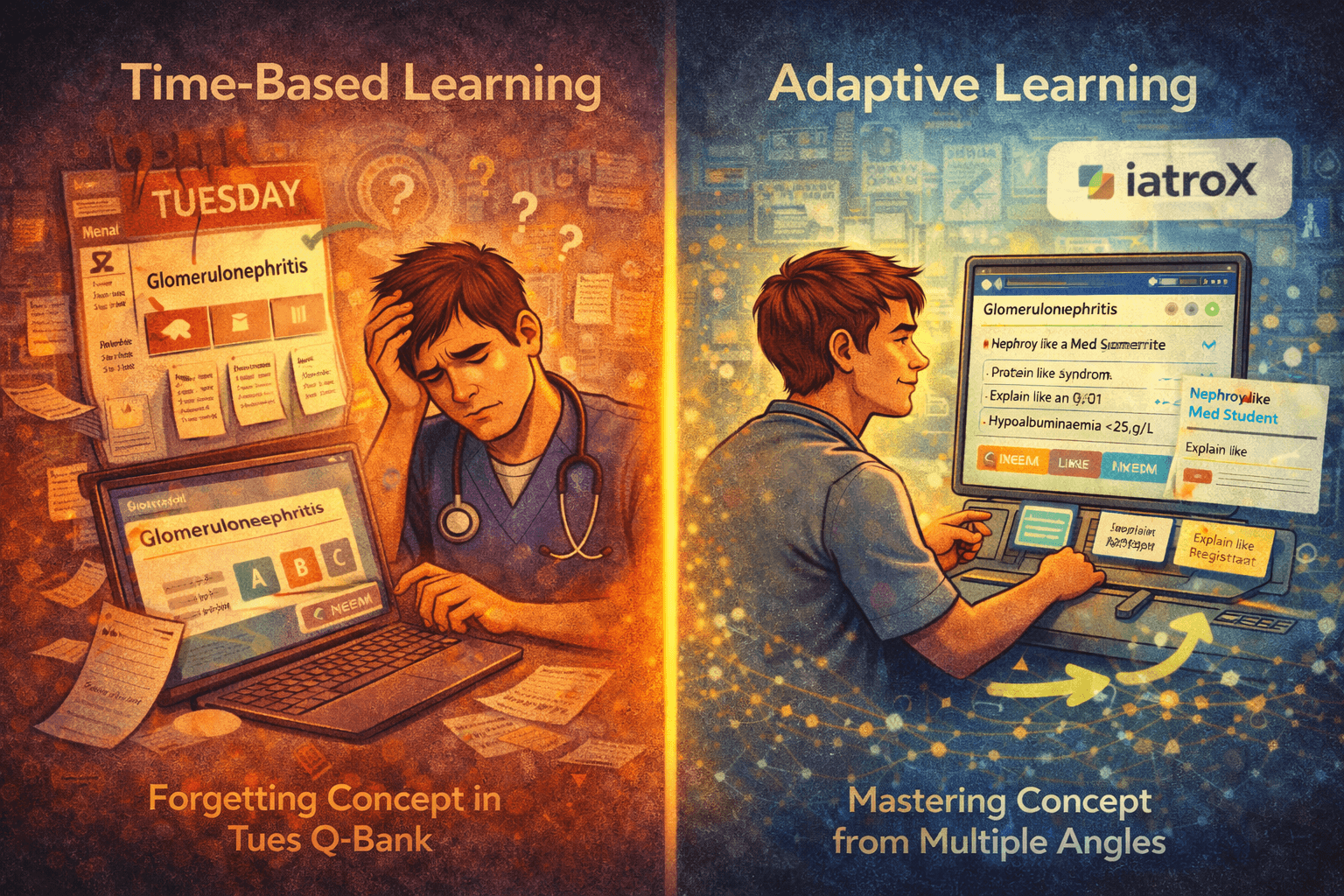
You “covered” glomerulonephritis last week. You read the textbook chapter, highlighted the notes, and felt confident. But today, faced with a question bank vignette, you freeze. Rapidly progressive glomerulonephritis, post-streptococcal GN, and IgA nephropathy blur into a single, confusing clinical picture.
The issue isn’t your effort. The issue is the model. You are stuck in a "time-based" system where you move on to the next topic because the calendar says it is Tuesday, not because you have mastered Monday’s material.
In 1984, educational psychologist Benjamin Bloom identified a phenomenon that has haunted educators ever since. He found that students who received one-to-one tutoring performed two standard deviations better than those in a conventional classroom—the famous "2 Sigma Problem." The average tutored student performed better than 98% of the classroom students. The problem? Providing a personal tutor for every student is economically impossible.
In 2025, artificial intelligence changes the economics. But AI only solves the problem if it is designed correctly—not as a passive generator of text, but as an active engine for mastery learning, retrieval practice, and adaptive scaffolding.
The “old way”: time-based learning
The pathology of the timetable
In traditional medical education, the syllabus dictates the pace. You have two weeks for Cardiology, then you move to Respiratory. If you finish the Cardiology block with only 70% understanding, that missing 30% becomes "knowledge debt." As you progress, this debt compounds. You can’t fully understand acid-base balance (Respiratory) if you didn't master buffering systems (Renal).
Why medicine is uniquely punished by this model
Medicine is hierarchical and interdependent. Unlike history dates, which can be learned in isolation, clinical reasoning requires a web of connected concepts. When you rely on "time-based" learning—reading notes until the clock runs out—you often succumb to the illusion of competence. Re-reading feels good; it creates familiarity. But familiarity is not mastery, and it disintegrates under the stress of high-stakes exams like the UKMLA or MRCP.
The science: Bloom’s 2 Sigma Problem (and the honest version)
What Bloom actually argued
Bloom’s seminal 1984 paper argued that the "one-to-many" lecture model was inefficient. He demonstrated that the combination of mastery learning (not moving on until competent) and one-to-one tutoring produced results that were statistically off the charts compared to standard teaching.
The credibility check
It is important to be precise. Bloom's "2 sigma" (two standard deviations) figure is influential, but it is not a universal constant. Subsequent meta-analyses and reviews suggest that while tutoring and mastery learning have profound positive effects, the real-world uplift is often more moderate (typically around 0.5 to 0.8 SD). However, even a 0.8 SD improvement is massive—it is the difference between an average student and a top-tier performer. The core insight remains irrefutable: personalised, mastery-oriented instruction beats one-size-fits-all teaching every time.
The core method: mastery learning
Mastery learning is the simple principle that you should not progress to concept B until you have demonstrated competence in concept A.
- Why it fits medicine: You cannot interpret an ECG (Concept B) if you do not understand cardiac vectors (Concept A). If a student gets 60% on a test, the traditional model gives them a 'C' and moves them on. The mastery model identifies the 40% they missed and provides corrective instruction until they get it right.
- The bottleneck: Historically, this was impossible to implement at scale. You cannot hold back an entire lecture hall for three students who didn't get it.
The “new way”: adaptive scaffolding
What is scaffolding?
Scaffolding is temporary, targeted support that helps a learner achieve a task they cannot yet do alone. As competence increases, the support fades. This relates to Vygotsky’s "Zone of Proximal Development"—the sweet spot just beyond your current capability where learning happens.
What a human tutor does that books can’t
A great human tutor does five things a textbook cannot:
- Diagnoses exactly why you are stuck (is it a knowledge gap or a reasoning error?).
- Adjusts the explanation depth (simple terms vs. technical nuance).
- Forces retrieval by asking questions rather than just telling answers.
- Times the review perfectly to prevent forgetting.
- Builds confidence without creating dependency.
Why AI changes the economics
Until now, only a human could do this. Today, AI-driven Intelligent Tutoring Systems (ITS) can approximate these behaviours at near-zero marginal cost. By combining generative AI with cognitive science principles, we can democratise the "personal tutor" experience for every medical student.
The learning mechanics that make this work
Retrieval practice: why “being asked” beats “being told”
The "testing effect" is one of the most robust findings in psychology. Actively retrieving an answer from memory strengthens neural pathways far more effectively than restudying. Answering a question about glomerulonephritis—even if you get it wrong—primes the brain to retain the correct answer when it is presented.
Spaced repetition
Mastery is not a one-time event. Spaced digital education ensures that once a concept is mastered, it is reviewed at expanding intervals to lock it into long-term memory.
Mastery thresholds
Good AI tools set a "mastery threshold." They don't let you tick off a topic because you read it; they require you to demonstrate a high success rate in applying the knowledge before they consider it "learned."
How iatroX implements the “personal tutor”
We built iatroX to solve the scale problem. It is not just a question bank; it is an automated tutor loop.
1. “The Tutor Loop”
- Diagnose: The iatroX engine detects hesitation patterns. If you answer quickly but incorrectly, it flags a misconception. If you answer slowly, it flags a lack of fluency.
- Prescribe: It assigns the right next move. It might offer a micro-explanation followed by one targeted question, or a mini-set of three questions to confirm you've grasped the nuance.
- Reinforce: It schedules the re-exposure. It brings the topic back tomorrow, then in three days, then in ten days, until the knowledge is stable.
2. Adaptive “scaffolding modes”
Our "Explain like..." feature is designed as a UI for scaffolding. You can toggle the complexity of the explanation based on your current level:
- "Explain like a Med Student": Foundations, definitions, basic pattern recognition.
- "Explain like an FY1": Immediate workup, red flags, initial management.
- "Explain like a Registrar": Nuance, edge-cases, controversy, and evidence strength.
3. Rephrasing for durable understanding
Rote memorisation fails when the exam vignette changes. A human tutor varies the question to test understanding. iatroX does the same. It can present the same pathology (e.g., Nephrotic Syndrome) from different angles—first via pathophysiology, then via clinical symptoms, then via lab results—to ensure you understand the concept, not just the card.
What AI can’t replace (and shouldn’t try to)
We must be clear about the limits. AI cannot replicate clinical supervision, bedside manner, or professional identity formation. It cannot mentor you through a difficult rotation. However, it can reliably take over the expensive, repetitive parts of tutoring: the formative assessment, the targeted correction, and the scheduling of spaced review. By offloading these tasks to AI, we free up human educators to focus on the art of medicine.
The takeaway
The future of medical education is not more content. We have enough content. The future is more correction, more timing, and more personalisation—delivered as a tutor loop, not a textbook.
If you want the benefits of a personal tutor without the cost, try the iatroX adaptive learning loop. Identify your weak spots, fix them, then let the system bring them back to you at exactly the right time.